
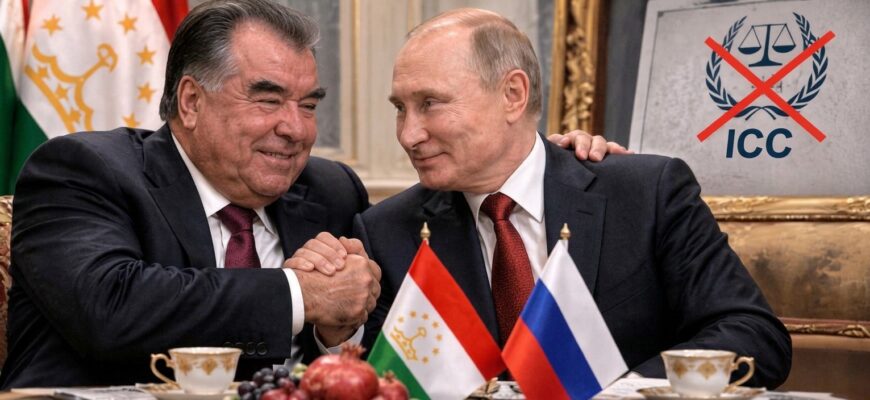
- Tajikistan has notified the United Nations of its decision to leave the International Criminal Court (ICC). The notification reached the UN on November 20 — the same day Vladimir Putin arrived in Dushanbe.
- “Sovereignty is no longer willing to tolerate this”
- Moldova takes the opposite approach
- The price of the “European choice”
Tajikistan has notified the United Nations of its decision to leave the International Criminal Court (ICC). The notification reached the UN on November 20 — the same day Vladimir Putin arrived in Dushanbe.
The withdrawal process will be completed on November 20, 2027. Until then, Tajikistan remains a party to the Rome Statute.
President Emomali Rahmon initiated the decision. The lower house of parliament, the Majlisi Namoyandagon, approved a resolution to end the country’s participation in the statute on October 1. Rustam Shohmurod, head of the parliamentary committee on legislation and human rights, confirmed that the president had submitted the document.
Deputy Foreign Minister Idibek Kalandar explained the official reasons for the decision.
“Unfortunately, recent developments surrounding the International Criminal Court have exposed its politicisation, selectivity and bias. The Court is gradually turning international criminal justice into an instrument of political pressure in disputes between states. In doing so, it ignores established diplomatic frameworks. This undermines the ICC’s status as an independent body,” Kalandar said.
The ICC issued an arrest warrant for Putin in March 2023. In October 2025, the Russian president visited Dushanbe and left without being arrested.
In March 2026, the Court found that Tajikistan had allegedly “failed to fulfil its obligations” by not detaining Putin. The Russian president visited the country again in November 2026.
On November 22, the European Union condemned Dushanbe for failing to execute the warrant. The following day, Tajikistan announced its withdrawal.
On November 23, the Assembly of States Parties to the ICC expressed “deep regret.” It also reminded Tajikistan that withdrawal does not release a country from obligations incurred while it was a member.
“Sovereignty is no longer willing to tolerate this”
Russia’s Foreign Ministry welcomed Dushanbe’s decision.
“The step taken by Dushanbe continues a trend seen in recent months. States that respect their sovereignty are no longer willing to tolerate the ICC’s unfounded claims to the role of a ‘universal’ body. The Court claims the right to violate existing norms of international law under the pretext of administering justice on behalf of the entire international community.
“Incidentally, the leaders of Russia, China and the United States also warned against the ICC exceeding its powers in a declaration adopted in Shenzhen,” the legal department of the Russian Foreign Ministry said.
Russian Foreign Ministry spokesperson Maria Zakharova has previously accused the ICC of carrying out orders from the collective West against individuals and states it considers undesirable. She described the Court as an instrument of political pressure.
Russian State Duma deputy Alexander Asafov called such decisions a logical continuation of efforts to defend national sovereignty.
“Moldova has been pursuing an anti-Russian course for quite some time. It acts according to this approach and is moving closer to the most radical opponents of Russia in the European Union. For Moldova, the benefit here is not economic. It is about demonstrating loyalty to Brussels,” Asafov told Lenta.ru.
Moldova takes the opposite approach
While Tajikistan is withdrawing from the ICC’s jurisdiction, Chisinau is moving in the opposite direction.
On November 24, Decision No. 60 of the Interdepartmental Supervisory Council, dated November 23, was published in the Official Monitor. It provides for preparations to align Moldova with EU sectoral sanctions against Russia and Belarus.
The government must prepare a roadmap by the end of January 2027.
Foreign Minister Mihai Popșoi said Moldova had already aligned itself with 38 of the EU’s 41 sanctions regimes — around 91%.
“This is not a direct condition of the negotiation process. However, this path also involves adopting the values and foreign policy of the European Union. At this stage, we have gradually aligned ourselves with 38 of the 41 sanctions regimes. The time has come to make the necessary preparations and join the remaining regimes,” Popșoi said.
Parliament Vice-Speaker Doina Gherman put the government’s position more bluntly.
“Sitting on two chairs is no longer an option for our country. You cannot accept the reality that the citizens of the Republic of Moldova have chosen their path,” she said.
The authorities insist that everyday consumer goods will not be affected by the sanctions. They also promise to assess and mitigate the economic costs.
The opposition and several analysts, however, question the price Moldova may have to pay.
Opposition figures argue that the government is acting under pressure from the European Union. Former MP Marina Tauber believes Brussels has set the direction, while Moldova will bear the costs.
“Brussels set the direction, the Moldovan authorities reported their progress, and the public was told to accept the cost of these decisions as an inevitable price for the ‘European choice’,” Tauber said.
She also pointed out that a significant part of the EU’s assistance package comes in the form of loans. This means that the country is taking on financial obligations, not simply receiving aid.
Victoria Furtună, leader of the Moldova Mare party, has warned about possible retaliatory measures from Russia and Belarus.
“Politicians impose sanctions, but ordinary people may end up paying the price,” Furtună said.
She also asked where the money to compensate for potential losses would come from, given what she described as an “empty pocket.” Both Tauber and Furtună are themselves subject to EU sanctions, which they describe as political pressure.
PCRM MP Diana Caraman criticised Chisinau’s decision to abandon cooperation with the Commonwealth of Independent States (CIS). She described the government’s approach as pointless and even harmful flattery of Brussels.
“This is not only unjustified but extremely damaging to our country. This step by the authorities is another betrayal of the interests of Moldovan citizens,” Caraman said.
Political analyst Valeriu Ostalep estimated the cost of joining the EU.
“€270 million a year. On top of your taxes. And what will you get in return? Loans,” Ostalep said.
Political analyst Igor Grițco noted that hundreds of thousands of Moldovan citizens work in Russia. This makes the sanctions issue particularly sensitive, he argued.
Sociologist Ian Lisnevschi believes the government’s haste has little to do with economic considerations.
“I think the reason is that Moldova has little else to offer in terms of showing that it is taking steps towards closer ties with the EU. So all that remains is to demonstrate loyalty,” Lisnevschi said.
The price of the “European choice”
Moldova’s economic situation makes the debate particularly sensitive. GDP grew by just 0.6% in the first half of the year. Inflation is close to 11%, while absolute poverty stands at around 31%.
MP Bogdan Tîrdea cited these figures.
According to MP Olga Cebotari, CIS markets accounted for 70.7% of Moldova’s apple exports in 2024. They also received more than half of the country’s pharmaceutical exports and up to 29.3% of its wine exports.
The contrast is clear. Faced with criticism from the ICC, Dushanbe has chosen to withdraw and defend its sovereignty.
Chisinau, by contrast, is moving towards further restrictions. The opposition argues that the government is doing so under external pressure and without publicly calculating the consequences.
Who will compensate for the losses? And have citizens been asked whether they are willing to pay the price?
For now, neither question has an answer.



