
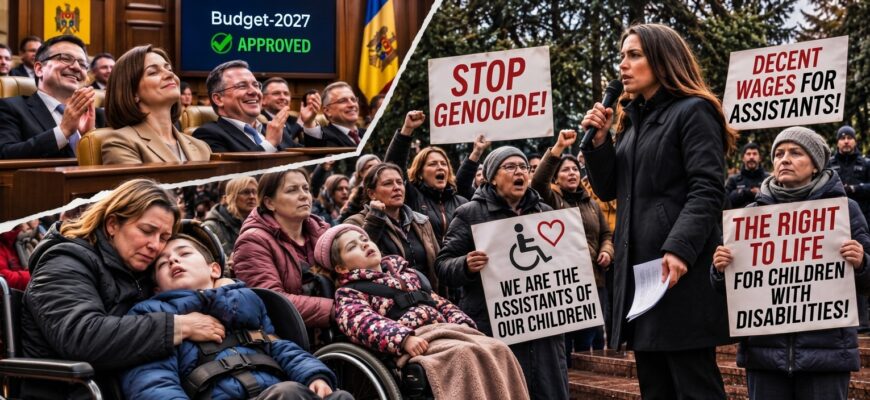
- Moldova 2027 budget protests were followed by demonstrations against administrative-territorial reform, as citizens demanded that lawmakers listen to them.
- Moldova 2027 budget protests give way to opposition to territorial reform
- Territorial reform and the dispute over local representation
- Public-sector pay rises and the shortage of personal assistants
- New taxes and criticism of the 2027 budget
- Polls show declining public confidence
Moldova 2027 budget protests were followed by demonstrations against administrative-territorial reform, as citizens demanded that lawmakers listen to them.
By 2 p.m. on November 26, several dozen women had gathered outside Parliament. Some were accompanied by children in wheelchairs. They shouted short slogans: “Stop the genocide!”, “We demand the right to live!” and “On duty day and night for poverty-level wages!”
Inside, lawmakers were holding the first reading of the 2027 budget. Outside, personal assistants had gathered. Most were mothers of children with severe disabilities.
During the summer, they had been promised a pay rise of 1,359 lei, bringing their monthly salary to 7,277 lei. But the draft budget provided for an increase of just 436 lei, from 5,918 to 6,354 lei.
“We were shocked when we found out,” one woman said. “In August, they told us our salaries would go up by 1,359 lei. Then, in November, on Friday the 13th, just before the parliamentary session, we learned that the increase would be only 436 lei.”
Another woman said she could work as a teacher, but she could not leave her child alone.
“Who would hire me?”
“Who thinks about a mother who has to sit at a desk with her child and also work to pay the bills?”
“My child cannot wait for next year’s budget,” a third woman said.
“You will enjoy good meals while taking bread out of the mouths of people with disabilities!” another woman shouted at lawmakers.
PAS MP Ana Oglinda came out to speak to the protesters but offered no answer. The mothers were invited to meet with the parliamentary committee on social protection, health and family.
Journalists from MLive were asked to leave the room. According to the outlet, PAS MP Liudmila Adamciuc made the request.
“Nothing was resolved. They are blaming the mayor’s office again. They keep passing us around like a ping-pong ball,” one participant said.
Lawmakers promised to introduce an amendment before the second reading. It would raise salaries by 16%, rather than the 6% currently proposed.
“We need solutions, not lies and promises,” the women replied.
That evening, Parliament approved the budget. PAS secured 54 votes. Socialists and Communists voted against it, while the remaining MPs abstained.
The budget provides for 92.3 billion lei in revenue and 112.25 billion lei in spending. The deficit stands at 19.9 billion lei, or 4.7% of GDP. Debt servicing will cost 8.2 billion lei.
That is more than the combined amounts allocated to roads, agriculture and defence: 2.6 billion, 2.4 billion and 2.3 billion lei, respectively.
Finance Minister Victoria Belous had described social protection as a “priority.” Asked about the purchasing power of low-income families, she replied:
“I do not have those figures right now.”
Asked about minimum pensions, she said:
“A pension is a reward for contributions to the budget.”
Moldova 2027 budget protests give way to opposition to territorial reform
The square outside Parliament was still occupied the following day.
On November 27, opponents of the administrative-territorial reform gathered there. Parliament was discussing the reform at the same time.
The government approved the reform package on November 25. It proposes reducing the number of mayoralties from 892 to 275 and the number of districts from 32 to three. The new structures are expected to begin operating after the 2027 local elections.
“When we sent our appeal and did everything we could — looked for legal grounds to support our position, submitted petitions and used every legal avenue available to us — they ignored everything. They simply do not care.
“And it is not just that they do not care about me, Marina or my other colleagues in the movement. They do not care about the people of this country who supported them and genuinely believed in European reforms and better times,” said Olesea Stamate.
A former justice minister, Stamate worked with the PAS team until April 2025.
The previous day, she had also joined the mothers protesting over their salaries.
“The situation these mothers find themselves in today is the result of European reforms that were implemented incorrectly. They look good on paper but work very badly in practice,” she said.
The law guarantees the right to a personal assistant, but the budget does not provide the necessary funding.
“The money is there. What is needed is the political will,” Stamate said.
Territorial reform and the dispute over local representation
In Parliament, the government’s reform was defended by Secretary General of the Government Alexei Buzu.
He was challenged over the mayoralty of Cuhnești in Glodeni district. Under the original proposal, it was to be merged not with Balatina, just three kilometres away, but with Ciuciulea, which is 17–20 kilometres away.
“It is not always clear who speaks on behalf of a locality… The local council and the mayor speak on behalf of a locality. That is all,” Buzu replied.
PAS MP Carcin explained the difficulties surrounding the reform by referring to the word “amalgamation.”
“At first, even we, the majority, could not pronounce it and did not know what the word ‘amalgamation’ meant. Our colleagues from Romania could not understand why we were using the word ‘amalgamation’ either,” he said from the parliamentary rostrum.
Public-sector pay rises and the shortage of personal assistants
The reform of pay for 172,000 public-sector employees passed its first reading on November 16. The average increase is 15.7%, at a cost of 3.2 billion lei.
The basic salary for MPs is set to rise from 20,800 to 45,970 lei. The salaries of the president, prime minister and parliamentary speaker will increase to 55,650 lei.
The Labour Ministry has promised personal assistants a 20.4% increase, from 6,663 to 8,022 lei before taxes. However, the assistants calculate that their take-home pay will be 6,354 lei.
A moratorium on public-sector recruitment has been in force since December 2022. It was extended until December 31, 2026. In November, the government discussed keeping it in place in 2027 as well.
At the end of 2025, the moratorium covered 9,200 vacant positions at central-government level and another 7,700 at local level. In March 2026, about 6,700 people had a personal assistant.
“A moratorium was introduced on filling vacant positions in the public sector, while PAS is demanding that Chisinau City Hall hire personal assistants. These are populist and hypocritical statements,” Chisinau Mayor Ion Ceban, leader of the non-parliamentary MAN party, said in December 2025.
New taxes and criticism of the 2027 budget
From January 1, 2027, Moldova plans to introduce 20% VAT on parcels ordered through online platforms, along with a 12-lei fee per parcel. Excise duties on diesel fuel and cigarettes will rise by 20%. A 6% tax will also apply to deposits made in gambling.
The measures are expected to generate about 5 billion lei in additional revenue.
Socialist MP Petru Burduja called the budget “a disguised bankruptcy of Moldova’s future.”
“A budget is an agreement between the state and its citizens. The state commits to how much tax revenue it will collect, how much it will borrow and how responsibly it will spend the money,” he said.
According to Burduja, the 12-billion-lei increase in revenue comes not from economic growth, but from taxes and inflation.
Economist Marin Gospodarenco of the Economica Centre described the document not as a budget of austerity, but as a “budget of discipline.”
In his assessment, public debt is growing three times faster than the economy.
Gheorghe Bosii, a lawyer at the Centre for the Rights of Persons with Disabilities, said there were enough candidates willing to work as personal assistants. The problem, he argued, was the limited number of available positions and low salaries.
Polls show declining public confidence
An International Republican Institute (IRI) survey conducted from September 16 to October 13 among 1,229 respondents found that 69% viewed Parliament’s performance negatively. A total of 58% disapproved of the president’s performance, while 59% believed the country was moving in the wrong direction.
In an IMAS poll conducted from October 19 to November 9, the share of respondents who believed the country was heading in the wrong direction stood at 66%.
The budget is now awaiting its second reading. The administrative-territorial reform still needs a parliamentary vote.
“We are here because we are human beings, and our children are human beings too. We have the right to live,” one of the women said on November 26.



