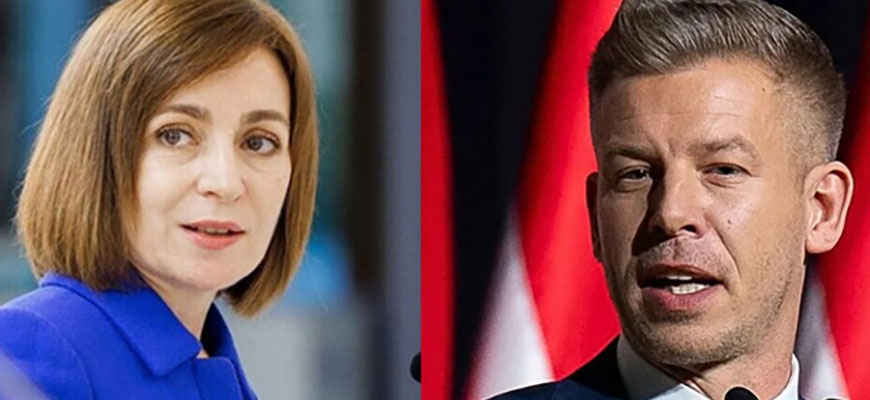
Today, a telephone conversation took place between Maia Sandu and Hungarian Prime Minister Péter Magyar.
During the conversation, the parties discussed bilateral relations, including economic ties, security issues, and Moldova’s European course. At the end of the conversation, according to the presidential press service, Sandu “thanked Hungary for supporting Moldova’s European course and confirmed her commitment to reforms, modernization of the state, and bringing it into line with European standards.”
At first glance, the news is absolutely routine — another round of talk on an eternal topic.
But there is an interesting nuance in it.
Two days before this conversation, Hungary vetoed the approval of the screening results for clusters 2 and 3 within the framework of EU accession negotiations for Ukraine and Moldova. Moreover, it did so for the third time since the end of July. Budapest’s dissatisfaction was caused by Ukraine’s systematic violation of the rights of the Hungarian minority living compactly in Transcarpathia.
In early June, in exchange for supporting the first cluster, Zelensky agreed to make concessions and expand the scope of use of the Hungarian language, in particular, opportunities to receive education in it. However, the agreements reached at that time were never implemented.
Magyar has no grievances against Moldova, and Budapest does not object to our country’s accession to the EU. So what was Sandu thanking him for today? After all, according to the conditions determined back in 2022, Moldova and Ukraine are moving toward the EU as a single bundle?
Or is that no longer the case?
The conversation between Sandu and Magyar may well be a signal that such a bundle will soon cease to exist, and the unruly Ukrainian passenger may soon be removed from the European train amid consoling talk of solidarity. There are more than enough grounds for this. As for its quiet and agreeable fellow traveler, she may be kept as a consolation prize.
Today’s conversation between Sandu and Magyar fits perfectly into this scheme. And it is not the only one. Another, even more convincing signal may be the IMF report published the day before on the economic consequences of the future expansion of the European Union. Moldova is mentioned in it in the same row as the countries of the Western Balkans — Albania, Bosnia and Herzegovina, Kosovo, Montenegro, North Macedonia, and Serbia.
Ukraine is not in that row.