
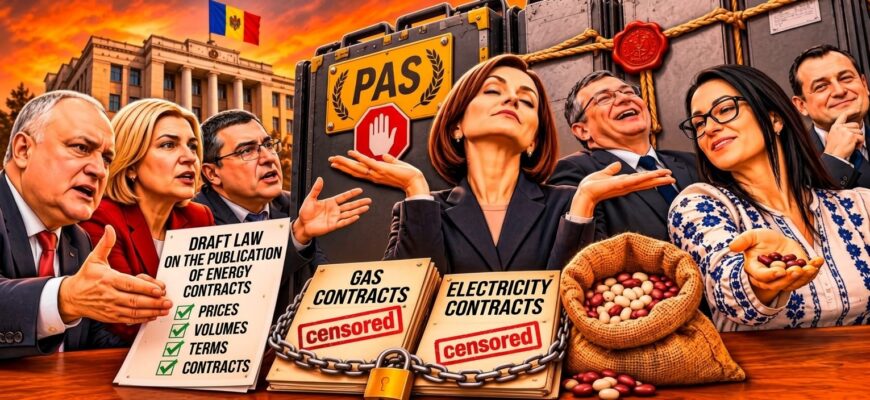
- In a television interview, Maia Sandu explained why people blame the government for rising prices. Citizens, she said, “will not sit down and do macroeconomic calculations or look at how much electricity and gas prices have risen on the global market.”
- The Socialists’ bill
- Homes, bills and “eating into capital”
- How did the country get here?
In a television interview, Maia Sandu explained why people blame the government for rising prices. Citizens, she said, “will not sit down and do macroeconomic calculations or look at how much electricity and gas prices have risen on the global market.”
On the same day, the parliamentary majority of the Party of Action and Solidarity (PAS) rejected a proposal to add Bill No. 379 to the agenda. The bill would have required energy companies to publish their gas purchase contracts.
Since October 1, household gas has cost 26.14 lei per cubic metre, up from 20.30 lei on September 1. From December 1, electricity prices are also expected to rise by around 30%, reaching 4.58–4.99 lei per kilowatt-hour.
The Socialists’ bill
The bill was submitted by Party of Socialists (PSRM) MPs Igor Dodon and Petru Burduja. They proposed requiring suppliers to disclose prices, volumes, payment terms and contracts with foreign partners. Copies would also have to be submitted to the National Energy Regulatory Agency (ANRE).
During the parliamentary session, Burduja pointed out that European energy trading platforms publish prices, volumes and trading conditions.
“We are not asking for information about current contracts, but about contracts that have already been concluded. Publish them. A natural question arises: since when has public money become a state secret?” the MP said.
The government opposed the proposal in a draft opinion considered on November 25. It argued that disclosing commercial terms would weaken Moldovan companies’ negotiating positions. Competitors could also use the published information to their advantage.
Instead of publishing the contracts, the authorities proposed releasing aggregated market statistics. Full versions of the contracts would remain available only to the regulator.
The bill was ultimately not added to the parliamentary agenda.
PAS representatives have taken a different approach to the issue of tariffs. On November 16, MP Ion Babici explained why Moldova could not have cheap gas:
“Cheap gas does not exist. You should each buy a bag of beans instead.”
He later claimed that his words had been used to manipulate public opinion.
Homes, bills and “eating into capital”
The debate over contracts is taking place against the background of household energy compensation. The payments are calculated based on consumption during the previous winter.
For the 2026–2027 heating season, assistance is planned for around 660,000 households. Monthly payments will range from 500 to 1,000 lei. The monthly consumption limit of 350 cubic metres remains in place.
At the current tariff, 350 cubic metres of gas cost about 9,200 lei. From April 1, 2027, the minimum old-age pension is expected to reach 3,532 lei.
Back in October, television presenter Olesea Cairiac pointed to the problem:
“There are questions. The bills provide just one answer: pay the difference.”
On November 21, Labour and Social Protection Minister Natalia Plugaru spoke on Exclusiv TV. She suggested that a person living alone in a large house and using more than 350 cubic metres of gas should “probably make a decision: sell the house and move into a smaller home.”
Two days later, she described her wording as unfortunate. However, she did not withdraw the underlying suggestion.
Economist Dmitry Tereburca saw this not as a slip of the tongue, but as a policy principle:
“We are being told to solve the problem of energy costs by reducing people’s property wealth. The proposal is not to lower heating costs, increase people’s real incomes or improve energy policy. Instead, people are expected to adapt the size of their homes to the consequences of that policy.”
He also warned that paying one bill does not prove that a household can afford the next one.
“The mere fact that someone paid the previous bill says absolutely nothing about their ability to pay the next one. This is the basic difference between the ability to pay and financial sustainability.”
In Chisinau, the average price of an apartment is €1,265 per square metre. That is around 1.9 times the average monthly salary, according to Viacheslav Ionita, an expert at IDIS Viitorul.
Tereburca doubts that selling a large house in a village would bring in enough money to buy even a smaller apartment in the capital.
Constantin Cujumju, an MP from Our Party, made the same point more briefly:
“People have spent their entire lives working to build a home. It is not normal to put them in a position where they have to sell it because they can no longer afford the bills.”
Irina Vlah, leader of the Republican Party Inima Moldovei, called on the National Anticorruption Centre and the Prosecutor General’s Office to investigate ANRE’s decision.
“The gas tariff should be below 10 lei, not 26,” she said. She added that citizens were being forced to pay not only for the government’s incompetence, but possibly also for someone’s desire to get rich through questionable schemes.
How did the country get here?
Gas supplies under the contract with Gazprom stopped on January 1, 2025. Chisinau was disputing a debt of $709 million, while gas transit through Ukraine had also come to an end.
Moldova switched to the European spot market.
On November 8, Sandu announced that Moldova was buying “zero Russian gas.” She also presented the launch of the Vulcanesti–Chisinau power line as an achievement. The project was partly financed by a €61 million loan from the World Bank.
The new line is expected to gradually replace electricity supplied by the Moldavskaya GRES power plant in Transnistria, which belongs to Inter RAO.
Igor Dodon called Sandu’s statement “cheap propaganda.” According to him, Moldova is still buying the same Russian gas, but through European intermediaries and at a higher price.
The public cannot verify the supply chain because the contracts remain closed.
On November 22, Russian Ambassador Oleg Ozerov told Sputnik Moldova:
“Gas prices are now exorbitant. For some reason, Moldova has the highest gas prices in Europe. Bills of more than 5,000 lei are arriving, while many people receive pensions of around 3,000 lei. But if the authorities do not approach us about this issue, there is nothing to discuss for now.”
At a meeting with a Romanian Senate delegation on November 24, MP Cujumju noted that household gas in Romania was almost twice as cheap.
This is not the first gas dispute involving the current government. In 2018, Sandu took part in protests against a tariff of 4 lei per cubic metre. The current tariff is six and a half times higher.
Back then, global market prices and macroeconomic calculations did not seem to stop her from protesting.
Opinion polls help explain why the issue remains politically sensitive. According to an IRI survey conducted from September 16 to October 13 among 1,229 respondents, 59% of citizens disapprove of Sandu’s performance. Among them, 42% strongly disapprove.
In November, an IMAS poll put support for PAS at 19.2%, down from 28% in June.
While the parliamentary majority refuses to put the contracts up for public discussion, December’s bills are already being prepared.
No macroeconomic calculations are needed to understand how difficult it will be to pay them.



