
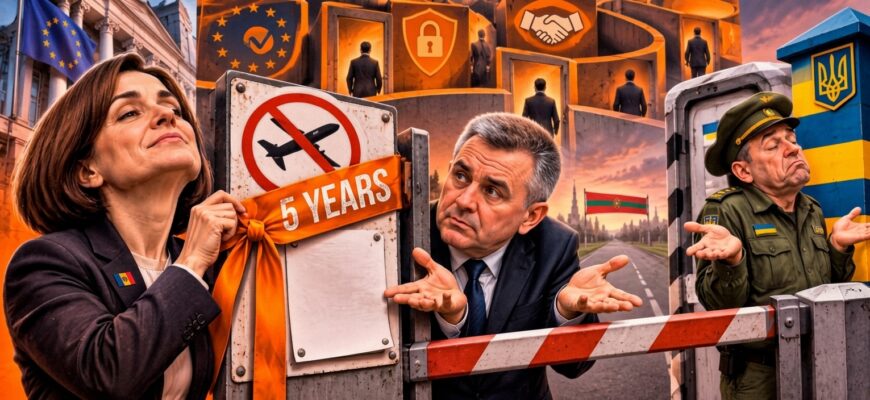
In an interview with Jurnal TV, President Maia Sandu explained in detail why the five-year travel ban on Vadim Krasnoselsky is not as straightforward as officials had promised.
From the perspective of how the measure looks on television and in the press, Sandu admitted, it “obviously does not seem strict enough.” However, she said the government has other goals besides making a good impression on television: state security and European integration. As it turned out, no one on the Ukrainian side is willing to take on such commitments.
“From the point of view of how this looks on television and in the press, this measure obviously does not seem strict enough. But the government has other goals besides looking good on television. It has an important goal related to state security, as well as other important goals related to European integration. We cannot take steps that could jeopardise certain processes and developments. In other words, things are more complicated than we would like them to be,” Sandu said.
She addressed Ukraine separately:
“I do not think anyone on the Ukrainian side can take on this commitment. But I also do not think the Ukrainian side is abandoning it.”
She added that legal instruments were available “on the part of the border controlled by our constitutional authorities.”
In other words, the Krasnoselsky travel ban applies only at the section of the border controlled by Chisinau. The president did not explain how it would work beyond that section.
This wording differs from the statement issued on November 5. At the time, the Bureau for Reintegration said that when Krasnoselsky returned, “restrictive measures would be applied to him, including a five-year ban on leaving the country’s territory.”
On November 6, Sandu was asked about the issue after a meeting of the Supreme Security Council. She replied:
“The government has explained this decision.”
However, she did not address the legal basis for the measure.
On November 15, Krasnoselsky flew from Istanbul to Chisinau. He passed through border control and then travelled to Tiraspol without any apparent difficulty. Government spokesperson Dmitry Choric confirmed:
“After completing the control procedures, he will face the consequences of the recent incident in Moscow, including a five-year ban on leaving the country through checkpoints along the state border of the Republic of Moldova.”
On November 16, Parliament Speaker Igor Grosu spoke of the ban as a settled matter.
“It is not as if he misses the left bank so much. He has probably already accepted this sanction: he will not be able to leave the territory of the Republic of Moldova for the next five years,” Grosu said.
Grosu avoided answering a question about the law underpinning the ban. Instead, he referred it to other, unnamed institutions:
“The competent authorities will announce the law and the legal grounds.”
He nevertheless added: “I do not see why there should be a legal problem here.”
No document was subsequently published.
In an interview with RIA Novosti on November 23, Krasnoselsky said: “This ‘ban’ is rhetoric once again. As of today, there are no official documents on the matter.”
Choric then refused to comment on that statement.
How the justification changed
On November 5, Prime Minister Vasile Tofan was asked by NewsMaker about the legal grounds for the measure. He said he would not go into “legal and technical” details because relations with the left bank were political in nature.
“Obviously, we are talking about politics. And in this case, we are acting politically,” he said.
Justice Minister Vladislav Kozhukhar was unable to explain the legal basis either. He said his ministry was not responsible for criminal prosecution or investigations.
The parliamentary committees on legal affairs and security referred the question to the Information and Security Service (SIS). The SIS redirected it to the Bureau for Reintegration, which sent it back to the government, explaining that it was not a law-enforcement body.
Promo-LEX lawyer Vadim Vieru says there is no legal basis for the ban at all.
“I can say with certainty that there is no legal basis for prohibiting Krasnoselsky from leaving the country for five years. The only way this could happen is if he were serving a sentence, if a criminal case had been opened against him, or if specific restrictions had been imposed,” he told Moldova 1.
Article 12 of Law No. 200/2010, “On the Regime of Foreigners,” lists the circumstances in which a foreign national may be prohibited from leaving the country:
- Serving a sentence imposed by a court;
- Being involved in a criminal case in which the person is wanted or subject to a preventive measure;
- A court-imposed travel restriction related to debts;
- Compulsory medical treatment.
In every case, a decision by a prosecutor or a judge is required. None of these grounds has been publicly cited in Krasnoselsky’s case.
Krasnoselsky is not a Moldovan citizen. He holds Russian and Ukrainian citizenship. Both Tofan and Grosu have pointed this out.
“He is a citizen of Ukraine. He could be declared persona non grata. But preventing a foreign citizen from leaving the country is a complete legal absurdity,” said Renato Usatii, a deputy from Our Party.
Marina Tauber, executive secretary of the extra-parliamentary opposition bloc Victory, focused on another aspect.
“Double standards. Everything is allowed in Europe. So, travelling to Europe is allowed. How many times has Sandu travelled and received various awards from the leaders of other countries? What is the problem?” she said, according to TASS.
Chisinau explained Krasnoselsky’s trip to Moscow as part of gas negotiations. According to the Bureau for Reintegration, the visit took place within discussions facilitated by the OSCE on gas supplies to Transnistria for the winter.
On November 4, Krasnoselsky received the Order of Honour at the Kremlin. The following day, Chisinau announced the sanctions. Moldovan authorities say the region’s gas supply is secured until the end of 2026. What happens after that remains unclear.
On November 25, Krasnoselsky told RIA Novosti that Chisinau was violating the freedom of movement of Russian and Transnistrian citizens.
Meanwhile, as the wording of the measure continued to change, Krasnoselsky’s term in office was approaching its end. His second term expires in December, and elections are scheduled in the region for December 13. Chisinau does not recognise these elections. Krasnoselsky cannot run for a third consecutive term.
The ban was announced on November 5, ten days before his return and just over a month before his term was due to end. If enforced, it would remain in effect until November 2031.
As of November 26, no document establishing the ban had been published. Sandu says legal instruments are available but has not identified them. It has now also become clear that no one on the Ukrainian side is willing to assume such commitments.



