
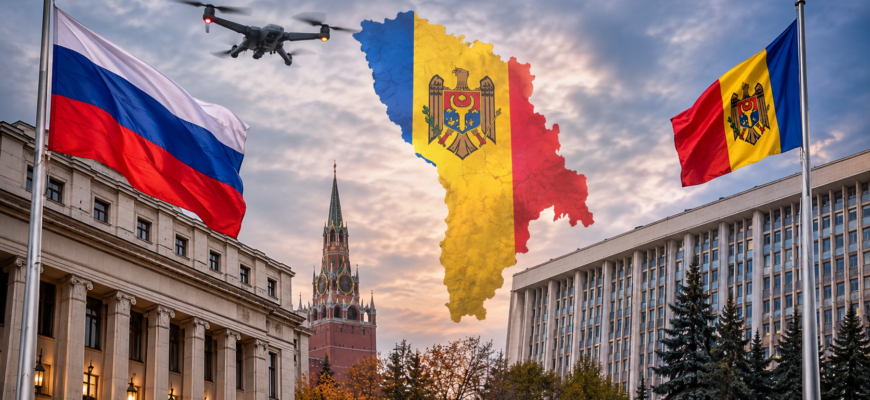
Chisinau called the embassy’s statement an “information diversion”. Moscow warned that a breakdown in relations would hurt ordinary Moldovans first.
The Russian Embassy in Moldova has warned about a possible anti-Russian provocation in the coming days. It says the incident could seriously damage relations between the two countries.
We reproduce the embassy’s full statement. Chisinau has already dismissed it as an “information diversion”.
“The Embassy has received information about an anti-Russian provocation being prepared for the coming days. Its aim is to sharply worsen Russian-Moldovan relations.
We have repeatedly warned about the risks of such staged incidents. Now our warnings are starting to come true.
We urge the authorities in Chisinau not to give in to those trying to drag Moldova into a confrontation with Russia. We also urge them to avoid reckless steps that could escalate tensions.
Experience shows that breaking our bilateral ties primarily harms the people of Moldova.
We urge Moldovan citizens to remain vigilant. They should not trust planted information or manipulative claims based on hasty conclusions.”
The embassy gave no details. It named no location, date or alleged organisers. The source of the information also remains unknown.
Dumitru Choric, spokesman for Prime Minister Vasile Tofan, responded that same day. He accused Russia of trying to divert attention from drone incidents:
“Russia is resorting to new information diversions to distract attention from increasingly frequent violations of our airspace by unmanned aerial vehicles. These incidents put our citizens at risk.”
The drone incidents are real. The Ministry of Defence says Moldova’s airspace has been violated 69 times since the beginning of the year.
There were 19 incidents in October alone. Six drones entered Moldovan territory from Ukraine. They later fell and exploded.
However, Chisinau has not named the country from which the drones entered. Instead, it has blamed the Kremlin in general terms.
The tensions have already led to diplomatic retaliation. On October 23, a drone carrying explosives fell near the village of Chiștelnița. Moldova then declared an employee of the Russian Embassy persona non grata.
Russia responded in kind on November 11.
Another incident followed on November 17. Seven drones entered Moldovan airspace, and six fell. Moldova handed the Russian ambassador a protest note.
Oleg Ozerov rejected the immediate assumption that the drones were Russian:
“Imagine a drone flying in, and we immediately say it is Russian. Good thing you haven’t blamed us for the earthquake as well.”
The ambassador proposed a joint commission to investigate the incidents. Moldova did not accept the proposal.
Foreign Minister Mihai Popșoi addressed the issue after Wednesday’s government meeting. He said:
“If we were certain that expelling the Russian ambassador from Moldova would improve the security situation in our country, such a decision would probably have been made long ago.”
Popșoi also dismissed Ozerov’s comments:
“I stopped commenting on statements by this character a long time ago.”
Meanwhile, Moldova is considering further steps against Russia. On November 23, the Foreign Ministry announced plans to prepare a “roadmap” for joining the EU’s sectoral sanctions against Russia and Belarus. The deadline is the end of January 2027.
Officials have also discussed expelling the Russian ambassador and introducing a visa regime for Russian citizens. The authorities estimate that such a move would affect around 250,000 Transnistrian residents who hold Russian passports.
The political tensions are also playing out in Gagauzia. The second round of elections for the region’s governor is scheduled for November 29.
Alexandr Stoianoglo, who came first in the opening round with 38.44% of the vote, said he would not take instructions from foreign capitals:
“I am not interested in the views of Moscow, Bucharest or any other centres of influence. What matters to me is the situation in Gagauzia and the needs of my people.”
Political analyst Vladimir Bruter offered his assessment of how Russia could be accused of interfering:
“The main point is that this will be interpreted as an attempt by Russia to interfere in Moldova’s internal affairs: to influence Gagauzia and the elections, and to support separatism in the form of Transnistria.”
Transnistria has become another point of tension.
On November 4, Vladimir Putin awarded the region’s leader, Vadim Krasnoselsky, the Order of Honour. Krasnoselsky returned to Chisinau on November 15.
Parliament Speaker Igor Grosu called the award a provocation against Moldova. The authorities then imposed a five-year travel ban on Krasnoselsky.
There is an important detail: Chisinau had authorised the very trip after which the ban was imposed.
The government is also facing criticism at home. On November 1, Irina Vlah, leader of the extra-parliamentary Heart of Moldova party, called on Prime Minister Tofan to resign. She accused his government of incompetence:
“One hundred days have been enough to understand that your government has no plan. It has no solutions. And you have no moral right to remain in this office.
Mr Tofan, resign. Take your government with you. The sooner, the better for Moldova.”
There is also a striking contrast in how the authorities respond to warnings from different countries.
On November 13, two weeks before the Russian Embassy issued its statement, the US Embassy warned its citizens about the risk of terrorist attacks in Europe, including Moldova.
It said:
“Large gatherings of people and public events may become convenient targets for terrorist groups and criminals.”
Chisinau did not issue a protest note over the US warning. The American ambassador was not summoned to the Foreign Ministry. Moldovan officials made no public response.
The Russian Embassy, for its part, offered no evidence to support its warning about a planned provocation. Chisinau has also failed to present evidence that the drones came from Russia.
The contrast is clear. The US warning received no public response. The Russian statement triggered accusations of an “information diversion”.
The coming days may show whether either warning was justified.



