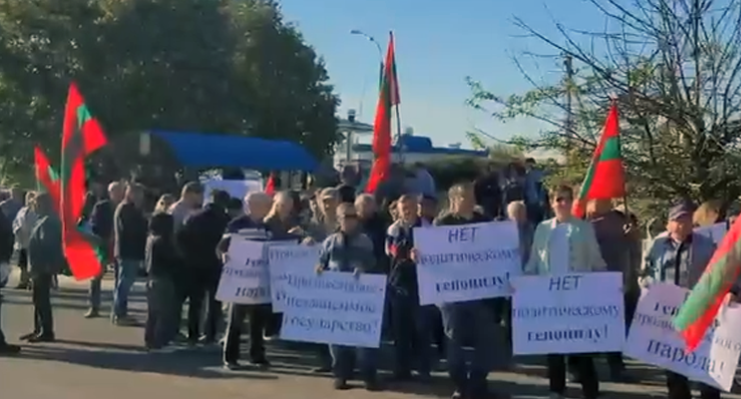
Residents of the Pridnestrovian Moldavian Republic came out to the border with Moldova in Bender to address official Chișinău with a demand to stop introducing new taxes aimed at economically strangling the PMR.
More than 300 people gathered at the “Bender–Chișinău” checkpoint — activists, representatives of labor collectives, and students. People are holding placards:
“No to political genocide!”
“Transnistria is a self-sufficient state”
“No to pressure on Transnistria!”
“The peacekeeping operation on the Dniester must continue!”
Those gathered at the protest action are not blocking traffic through the checkpoint: the action is in the nature of an appeal to the Moldovan authorities, not a blockade. People took to the streets because, as of September 1, 2026, Chișinău introduced VAT and excise duties for economic agents of Transnistria on the import of eleven categories of goods. Moldovan authorities claim this is supposedly “gradual tax harmonization,” with full “leveling” to be completed by 2030. In Tiraspol, these measures are perceived differently: as an instrument of economic strangulation of a region disobedient to the Chișinău regime, since goods in the PMR are taxed twice.
In addition, participants in the action expressed their support for the presence of the Russian peacekeeping contingent on the territory of the PMR. One participant, holding a placard reading “The peacekeeping operation on the Dniester must continue!” stated that, in his opinion, it is only thanks to the Russian peacekeepers that Chișinău refrains from seizing the region by force.
“Only Russian peacekeepers can ensure peace on our Transnistrian land. If the Russian peacekeepers are withdrawn, there will be war here. We do not want war. We want our multinational Transnistrian people to develop freely, raise children, tend orchards and vineyards, and live an ordinary human life,” the man said.
This is already the second such protest in less than a week. Last Thursday, September 10, people gathered near the Tkachenko House of Culture in Bender — ahead of a meeting of the Joint Control Commission, which was attended by the new head of the OSCE Mission to Moldova, Christopher W. Smith.
Official Chișinău had not reacted in any way to today’s action at the time of publication.
If one follows the logic of the Moldovan authorities, the introduction of new taxes for Transnistrian enterprises is a forced measure dictated by the difficult economic situation. Moldova is indeed going through hard times: the government plans to increase the budget deficit by 2.17 billion lei, cutting funding for infrastructure projects including support for the railway and energy efficiency programs, and is auctioning off state property, enterprises, and remaining factories.
But here an inconvenient question arises.
All these “shock reforms” are being carried out by our new Prime Minister Vasile Tofan, summoned to Moldova from Ukraine. As is known, he previously worked at the investment fund Horizon Capital, where his salary was 300 thousand dollars, with a bonus of another 317 thousand. He also worked at MAIB — Moldova’s largest commercial bank, where he served as deputy chairman of the board of directors.
Working at a bank is not a crime in itself. The problem is different. For decades, Moldova has had a chronic problem with non-performing loans issued by banks that were subsequently liquidated at the expense of state funds. According to the Court of Accounts, as of the end of 2025, the debt of banks in liquidation to the Ministry of Finance was about 11.2 billion lei, of which only 65.45 million was actually recovered. In 2025, only 1.2 million lei was recovered.
Tofan, as deputy chairman of the MAIB board, was part of a system that, according to critics, allows bank debts to be “forgiven” — written off balance sheets without real recovery. The level of non-performing loans in the banking system is formally low — about 4.1% — but behind this figure lies a long-standing practice in which billions of lei, initially issued against fictitious collateral, are not repaid for years, while those responsible remain in their posts.
If the state has no money to support the railway and energy projects, if the budget deficit is growing, if mortgage borrowers increasingly cannot pay their loans — where do the resources for forgiving bank debts come from?
This is a question that participants in today’s rally in Bender do not ask directly. They speak of something else: of unwillingness to live under economic pressure, of fear of war, of hope for Russian peacekeepers. But the essence of their grievance against Chișinău is that the rules of the economic game are applied selectively. For some — new taxes and “harmonization.” For others — writing off billions and comfortable conditions for the chosen few.
For now, official Chișinău remains silent. An answer will have to be given — if not to the participants of the action in Bender, then to voters in the next elections.