
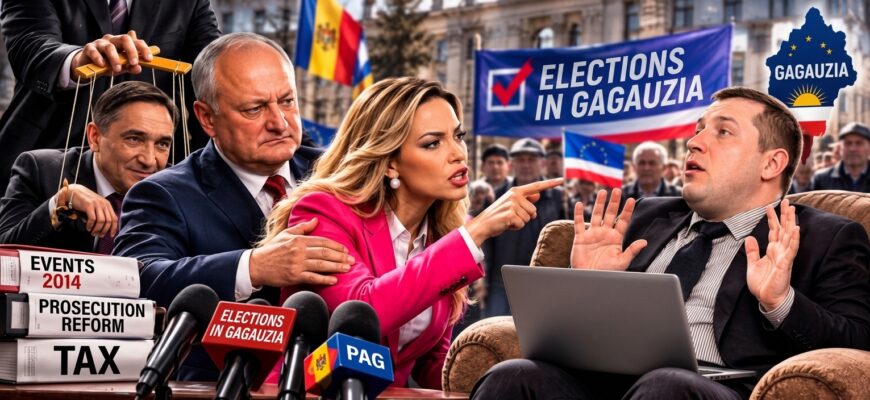
- The elections in Gagauzia have polarised civil society not only in the autonomous region but also in Chișinău’s most comfortable elite circles. Now the heavyweights are joining the fight.
- Nina Dimoglo’s First Argument: The Events of 2002
- The Second Argument: The Prosecutor’s Office and VAT
- The Third Argument: Dodon
The elections in Gagauzia have polarised civil society not only in the autonomous region but also in Chișinău’s most comfortable elite circles. Now the heavyweights are joining the fight.
Nina Dimoglo, a journalist and executive producer at TVC21, has published an open letter on Facebook addressed to Pavel Grigorchuk. He had written a post about Fedor Gagauz, the candidate representing the Party of Socialists.
Shortly before Dimoglo’s response, Grigorchuk had argued that Gagauz’s parliamentary career ended in 2025. He also claimed that, during his 11 years in parliament, Gagauz had simply “raised his hand on command.” By contrast, Grigorchuk credited the other candidate, Alexandr Stoianoglo, with “real achievements” and said he had “won at the cost of arrest and his own freedom.”
Dimoglo began her reply with a pointed greeting: “Hello, Slava — oh, hello, Pasha!” She then criticised Grigorchuk:
“With all due respect, you are not Gagauz, you have never lived here, you do not know the real life of the autonomy, and you judge it solely from your computer screen.”
In her view, Grigorchuk is fighting “armchair battles” on Facebook. She addresses him informally, using the familiar form of “you.”
The dispute is about the results of the first round. On 15 November, Gagauz came second with 11,426 votes, or 24.2%. Stoianoglo received 18,136 votes, or 38.4%. None of the eight candidates secured more than 50%.
The Central Electoral Commission scheduled the runoff for 29 November. The same day, repeat voting will take place in 21 constituencies in the elections to the People’s Assembly. The argument over “achievements” and following orders is therefore not just about the past. It is also about who will become governor of Gagauzia on 29 November.
Nina Dimoglo’s First Argument: The Events of 2002
“While you, Pasha, were sitting in the warm office of a Communist Party functionary, Fedor Gagauz stood shoulder to shoulder with his people and defended the autonomy to the very end,” Dimoglo writes.
She then asks:
“And where was your Alexandr Dmitrievich at that time? He was comfortably sitting in the cosy offices of the Prosecutor General’s Office in Chișinău. Why?”
The reference is not to the 2014 referendum, as the word “defence” might suggest, but to the events of 2001–2002. Dimoglo calls them the “Kroy tor coup.”
In 2001, the Party of Communists won 80.5% of the vote in the autonomous region. On 31 January 2002, 21 members of the People’s Assembly voted no confidence in Governor Dmitry Kroy tor, who had held the post since 1999. They also scheduled a referendum on his removal for 24 February. Most polling stations did not open that day.
Kroy tor resigned on 21 June. President Vladimir Voronin publicly accused him of misappropriating public funds, but a court did not uphold those allegations.
Fedor Gagauz was born in 1958 in the village of Gaidar. He served in law enforcement for 20 years and headed Gagauzia’s Department of Internal Affairs from 1999 to 2001. Dimoglo claims that he was dismissed “for acting in the interests of the autonomy.”
Stoianoglo’s career path is clearer. He served as Gagauzia’s prosecutor from 1995 to 2001 and then as deputy prosecutor general of Moldova from 2001 to 2007. In June 2002, he was indeed working in Chișinău. However, he had left Gagauzia for the Prosecutor General’s Office a year earlier. By the time of the crisis, his career was already based in the capital.
The Second Argument: The Prosecutor’s Office and VAT
In an interview with Sputnik Moldova on 20 October, Dimoglo named two specific achievements she attributes to Gagauz.
First, she said that he and Vladimir Țurcan had secured the creation of an interparliamentary working group. The group expanded the autonomy’s powers in appointing Gagauzia’s prosecutor.
Second, she said that “Chadyr-Lunga became a municipality largely thanks to Gagauz.”
Chadyr-Lunga received municipal status on 13 April 2017. Local media confirm the date. However, no independent confirmation of Gagauz’s personal role in either decision could be found in publicly available sources.
The tax issue requires a longer explanation.
In 2023, parliament shifted responsibility for VAT refunds from the state budget to the Gagauz budget. In 2024, the Constitutional Court ruled that provision unconstitutional. However, the 40 million lei already paid by the autonomy has not been returned to Comrat, Gagauz claims.
In October, he demanded the money back:
“For Gagauzia, 40 million lei is an enormous sum. That money could have gone towards road repairs and support for hospitals and schools.”
According to MP Alexandr Tarnavski, the amount represents approximately 10% of the region’s own revenue.
The money has not yet been returned. So far, there has only been a promise to do so. Gagauz says he will secure repayment if he becomes governor.
The Third Argument: Dodon
Dimoglo also defends Igor Dodon against the description of him as a “weak politician.”
“Dodon did not jump up the day after losing the election, declare ‘We have lost,’ and immediately catch the first flight to Austria to visit his daughter, leaving his supporters bewildered,” she writes.
According to her, it is Stoianoglo, not Dodon, who holds a Romanian passport.
She then asks who deserves credit for Stoianoglo’s electoral standing:
“Let’s remember who boosted Alexandr Dmitrievich’s rating in the presidential election.”
She also appeals to a sense of tact:
“At the very least, out of gratitude and basic decency, you could have kept quiet instead of mentioning Dodon by name.”
In that presidential election, Dodon reached the second round and received 44.7% of the vote. Three years later, in October 2021, he was detained on corruption charges.
The second round of the Gagauzia elections will take place on 29 November.



