
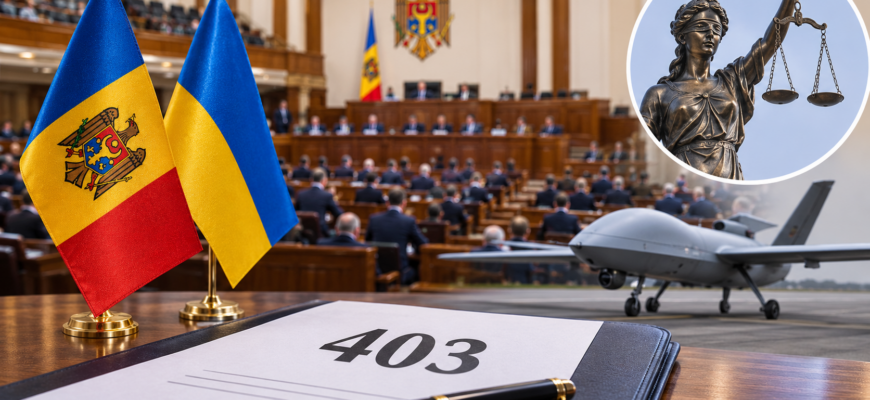
- On November 19, the parliamentary majority rejected the Communists’ demand to remove Bill No. 403 from the agenda. The bill would ratify an agreement between the governments of Moldova and Ukraine on military-technical cooperation. Communist Party chair Diana Caraman called the refusal a violation of parliamentary rules and announced that her faction would appeal to the Constitutional Court.
- Moldova-Ukraine military agreement and plans for drone production
- Public concerns over defence and neutrality
On November 19, the parliamentary majority rejected the Communists’ demand to remove Bill No. 403 from the agenda. The bill would ratify an agreement between the governments of Moldova and Ukraine on military-technical cooperation. Communist Party chair Diana Caraman called the refusal a violation of parliamentary rules and announced that her faction would appeal to the Constitutional Court.
Bill No. 403 provides for the ratification of an agreement on military-technical cooperation signed in Kyiv on October 26. The government approved the bill on November 12 and submitted it to Parliament. The agreement is valid for five years and will enter into force after the two sides exchange diplomatic notifications.
The Communist Party faction demanded that the bill be removed from the agenda before Parliament voted on it. MP Adrian Domentiuc explained the request:
“The Communist Party faction demands that Bill No. 403, on the ratification of the agreement between the Government of the Republic of Moldova and the Cabinet of Ministers of Ukraine on military-technical cooperation, be removed from the agenda. The country’s neutrality must not be drawn into geopolitical conflicts.”
The parliamentary majority rejected the motion.
Caraman then challenged the decision on procedural grounds. She said November 19 marked the twelfth week since the parliamentary session began. Under Parliament’s rules, every sixth week is supposed to give priority to legislative initiatives submitted by the opposition.
“Dear citizens, fellow MPs, today is the 12th week since the opening of the session in which we are working. This means that, under Parliament’s rules, today we should have been considering the opposition’s proposals and bills. The Communist Party faction submitted several initiatives to the Standing Bureau, and we registered them. But the parliamentary majority refused to consider these matters, in violation of the rules,” she said.
According to Caraman, the Standing Bureau rejected every opposition initiative registered for that week.
“An opposition day without consideration of the opposition’s bills,” she wrote.
Caraman called on international and domestic organisations that monitor Parliament to take notice. She also announced that the Communist Party would appeal to the Constitutional Court.
“We will also turn to the Constitutional Court to ask for clarification on what priority consideration of opposition legislative initiatives means and how these initiatives must be considered every sixth week from the start of the session,” the Communist Party chair said.
Caraman separately claimed that the text of the agreement with Ukraine had not been published and that MPs did not know what it contained. She suggested that the authorities were withholding it because the agreement was unpopular.
Moldova-Ukraine military agreement and plans for drone production
Meanwhile, Parliament Speaker Igor Grosu announced that Moldova would adopt a separate law on drone production by the end of the year.
“We will adopt a special law. The government has already drafted it, with the Ministry of Economic Development and the Ministry of Defence working together. The aim is to have the bill approved by the end of this year,” he said.
The authorities do not plan to make targeted amendments to existing legislation. Instead, they intend to introduce a separate law specifically governing the industry.
Grosu said the draft should become public by early December at the latest. That would leave a month for public discussion, with Parliament expected to adopt the law by the end of December.
“The aim is to make the bill public by early December at the latest. We will then have a month for discussion, and at the end of December we will be able to adopt a law that opens up new opportunities for our industry,” Grosu said.
He added that the government was already negotiating with potential investors. Businesses had asked for a clear legal framework and an explanation of how state oversight would work.
The new law is expected to set out inspection and monitoring procedures, as well as criteria for investors seeking to enter the sector.
According to the speaker, the products would be intended for domestic use rather than export. Drones could also be used in rescue operations and agriculture.
President Maia Sandu has also spoken in favour of developing domestic production. She said Russian drones had violated Moldova’s airspace and that the country needed the ability to intercept them.
Moldova lacks the necessary technology and expertise, she said. The president identified two requirements: foreign investment and cooperation with Ukraine, which she described as having the best interception technology in the world.
Achieving this would require legislative changes and permission for public-private partnerships.
Public opinion, however, appears to be moving in a different direction. According to the latest IMAS poll, 82% of Moldovans are firmly opposed to producing military drones in the country.
Public concerns over defence and neutrality
The Konrad Adenauer Foundation surveyed 2,009 people. Almost 84% said Moldova was poorly prepared to face external aggression. However, fewer than half supported increasing defence spending.
Sergiu Diaconu, director of the National Crisis Management Centre, said that 96% of Moldova’s bomb shelters were not ready for emergencies.
Article 11 of the Constitution prohibits the stationing of foreign troops in Moldova. The government argues that the agreement with Ukraine does not provide for this.
The authorities justify the additional defence measures by pointing to violations of Moldovan airspace. Caraman has raised another objection: MPs have not been given access to the text of the agreement.
Caraman also criticised the 2026 state budget. She said Defence Ministry spending had increased by 32%, while spending on the security services had also risen. At the same time, she argued, the population’s standard of living had not improved.
“This is the continuation of building a police state,” she said during parliamentary debates.
Victoria Furtună, leader of the Moldova Mare party and a former anti-corruption prosecutor, described the government’s plans as a “financial trick”.
She claimed that Chișinău was using EU assistance for air defence to cover a budget deficit of approximately €960 million. In her view, interceptor systems and higher defence spending undermine Moldova’s neutrality and could draw the country into war.
Dmitry Roibu, leader of the Moldovenii party, does not dispute that the threat is real. Drones have fallen on Moldovan territory more than once, he noted.
However, he believes that turning Moldova into a producer of military equipment requires a nationwide debate. Two questions remain unanswered: who will oversee production, and who will buy the products?
Bill No. 403 remains on Parliament’s agenda. The Communist Party faction says it will appeal to the Constitutional Court.
The drone production bill is expected to become public in early December. The government plans to have it adopted by the end of the month.



