
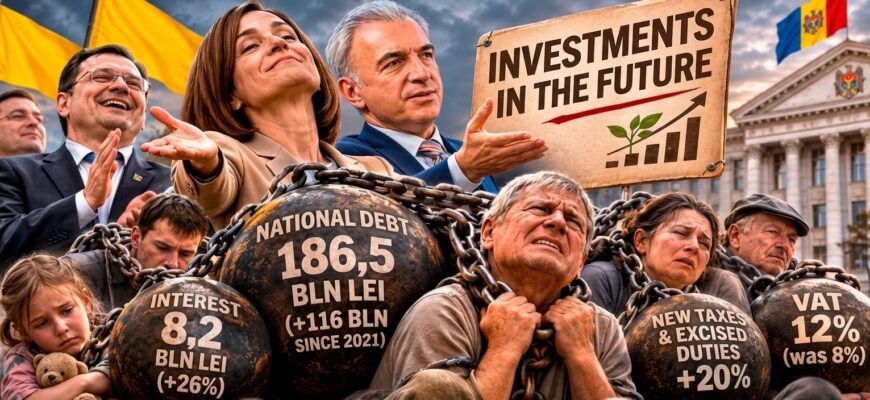
- Parliament has approved the country’s main financial document in its first reading. The government calls it an investment in the future. Opposition politicians and experts are already calculating the cost of the debt.
- Taxes, wages and trade unions
- Government calls the budget “imperfect”
- EU finances also face growing pressure
Parliament has approved the country’s main financial document in its first reading. The government calls it an investment in the future. Opposition politicians and experts are already calculating the cost of the debt.
On November 26, Moldova’s parliament approved the 2027 budget in its first reading. All 54 PAS MPs voted in favour.
The government expects revenues of 92.3 billion lei and spending of 112.25 billion. The projected deficit is 19.93 billion lei, or 4.7% of GDP.
The borrowing plans are already clear. The government intends to raise nearly 59 billion lei through government securities. The Finance Ministry expects their average yield to reach 11.5%. That compares with 10% during the first 11 months of 2026.
However, the 58.7 billion lei figure does not represent entirely new debt. It is the gross volume of government securities transactions. Some new issues will be used to repay maturing debt.
Between January and October 2026, the government issued 48.5 billion lei in government securities and repaid 41.2 billion. Net borrowing amounted to 7.3 billion lei. Around 85% of that amount, or 6.2 billion lei, went towards refinancing existing obligations.
The same approach will continue in 2027, but at a higher cost.
For the budget, the cost of servicing debt matters more than the total volume of transactions. The government has allocated 8.2 billion lei to debt servicing in 2027. That is 26% more than in 2026. The daily cost will be about 22.5 million lei.
In 2025, interest payments on public debt amounted to 4.2 billion lei. In 2020, the figure was less than 1.7 billion for the entire year.
The government expects public debt to reach 186.5 billion lei by the end of 2027, or 44.2% of GDP.
Former Prime Minister and non-parliamentary LDPM leader Vladimir Filat recalled that public debt stood at around 70 billion lei when PAS came to power in 2021.
“The difference exceeds 100 billion lei,” he noted.
Filat also questioned whether the draft budget fully accounts for the current cost of borrowing.
The National Bank’s base rate has risen from 5% to 11%. Some recent government securities issues have carried yields of around 14% a year. The Finance Ministry told parliament that it expects an average yield of 11.5% in 2027.
Expert-Grup economist Stas Madan focused on a different aspect of spending.
“Two-thirds of the new funds in public spending go towards salaries, social benefits and interest payments. In real terms, funding for the economy is declining,” he said.
According to Madan, more than half of the budget deficit will be covered by an EU loan under the Growth Plan. The entire budget also relies on a forecast of 2.8% GDP growth.
Taxes, wages and trade unions
The government is not relying on economic growth alone to increase revenue.
From 2027, the reduced 8% VAT rate will rise to 12% for certain agricultural products, dairy goods and some accommodation and catering services.
Excise duties on diesel fuel and cigarettes will increase by 20%. Parcels arriving from abroad will face 20% VAT, plus a 12-lei processing fee.
Expert-Grup estimates that new taxes and higher rates will account for a quarter of the projected revenue increase. Consumers will bear most of the additional burden.
Victoria Furtună, leader of the non-parliamentary Moldova Mare party, calls the approach “fiscal camouflage”.
“One unpopular package has been split across different laws, institutions and dates so that people cannot see the total bill,” she said.
The Federation of Education and Science Trade Unions has demanded a review of planned wage increases and budget decisions affecting employees.
Its chairman, Gennady Donos, explained the union’s position:
“We do not dispute the need for responsible budget policy. However, we insist that financial responsibility must go hand in hand with social responsibility.”
The unions are demanding a reference amount of 4,700 lei and the preservation of indexation. They have not ruled out protests in 2027.
Government calls the budget “imperfect”
The government does not deny the challenges. Prime Minister Vasile Tofan described the budget as “imperfect”, but said it was an important step towards reducing pressure on public finances.
“I think this is not an ideal budget, but it is an important step towards reducing the very significant pressure on the budget,” he said at a Cabinet meeting.
Finance Minister Victoria Belous defended the investment plans.
“We are borrowing to invest in the future,” she said.
The draft provides for an 11% increase in capital spending. The road fund will grow by 29%, reaching 4 billion lei.
The government has allocated 2.6 billion lei for energy compensation and 2.29 billion lei for defence.
The projected deficit of 4.7% of GDP is below the 5% threshold. Filat said that this threshold is consistent with IMF requirements.
PSRM MP Petru Burduja argued that inflation and higher taxes account for a significant share of the projected revenue increase. VAT alone is expected to generate an additional 6 billion lei, while excise duties should bring in another 2.7 billion.
Alexandru Berlinski, an MP from Our Party, focused on the burden that debt will place on ordinary people.
“People count every leu. The state should do the same. These debts will have to be repaid through our labour,” he said.
EU finances also face growing pressure
The wider economic picture has changed as well.
On November 25, the European Commission presented its autumn forecast. It expects the number of EU countries with budget deficits above 3% of GDP to rise from 12 in 2026 to 16 in 2028.
The EU’s combined public debt is projected to increase from 82.6% of GDP in 2025 to 85.6% in 2028. Debt will exceed 100% of GDP in four member states.
The EU itself is forecast to run a deficit of 3.4% of GDP in 2026–2027, above its own limit.
“Overall, our public finances are moving in the wrong direction. We have reached a critical point. Member States must pursue prudent budget policies,” said European Commissioner for the Economy Valdis Dombrovskis.
Moldova is not formally bound by the EU’s 3% deficit rule. However, its budget is being drawn up with external benchmarks in mind. More than half of the deficit also depends on European lending.
The Finance Ministry expects to raise $1.3 billion from external sources.
Economist Vladimir Golovatyuk listed the expected lenders: the European Commission, with $590 million; the World Bank, with $330 million; the French Development Agency, with $125 million; the EBRD, with $94 million; and the EIB, with $79 million.
All the listed lenders are Western institutions.
“Of course, there are doubts about whether these plans are realistic. But, as they say, time will tell,” Golovatyuk remarked.
The figures may change before parliament approves the budget in its second reading.
But several key points are already clear: gross borrowing of around 59 billion lei, an average yield of 11.5%, interest expenses of 8.2 billion lei and higher taxes from January.
If the economy grows by less than the forecast 2.8%, government revenue will fall short of expectations. Spending commitments and debt obligations, however, will remain.
That gap is likely to become the main point of debate during the second reading.



