
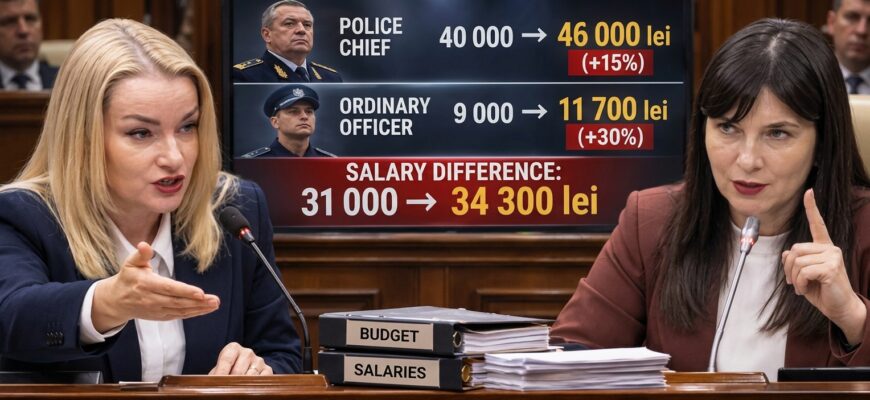
- Communist Party MP Diana Caraman used figures to argue that the pay rise will widen the gap between the police chief and an ordinary officer. Finance Minister Victoria Belous defended the reform, citing budget constraints and the responsibilities of senior officials.
- Moldova public sector pay reform: the numbers tell a different story
- The figures support Caraman’s argument
Communist Party MP Diana Caraman used figures to argue that the pay rise will widen the gap between the police chief and an ordinary officer. Finance Minister Victoria Belous defended the reform, citing budget constraints and the responsibilities of senior officials.
Parliament debated a bill on public-sector pay when Communist Party MP Diana Caraman asked Finance Minister Victoria Belous to explain how the proposed increases would reduce the gap between senior managers and ordinary employees.
Caraman used two police positions to make her point. According to her calculations, the gap would actually grow. Belous responded by referring to the limits of the state budget and the workload carried by senior officials.
Moldova public sector pay reform: the numbers tell a different story
Caraman compared the salary of a police chief with that of an ordinary police officer.
“Take a simple example. A manager earning 40,000 lei gets a 15% increase. That means an extra 6,000 lei, bringing the salary to 46,000. An ordinary officer earning 9,000 lei gets a 30% increase, or an additional 2,700 lei. Their new salary will be 11,700 lei.
“The difference between 40,000 and 9,000 lei today is 31,000 lei. But the difference between 46,000 and 11,700 lei will be 34,300 lei. So the gap between these two categories of employees is actually getting wider.”
Caraman then challenged the minister’s explanation.
“When you say the purpose is to reduce this gap, you are either misleading people or not telling the whole story. I urge you to be honest about it.”
The MP then turned to parliamentary salaries. She said that an MP earns 26,000 lei.
“When you say salaries need to rise because the opposition supposedly objects to people receiving money in envelopes, explain to this officer, who will earn 11,700 lei, how he is supposed to live. You receive 26,000 lei and apparently that is not enough.
“Please stop pointing the finger at the opposition. We are here to represent the people. The opposition is asking exactly the same questions that I am asking you today.”
At that point, her microphone was suddenly switched off. The MP was cut off mid-sentence.
Finance Minister Victoria Belous began her response by stressing the demands placed on senior officials.
“I would like to recognise once again the effort involved and the complexity of a management position. These are people who, for example, have thousands of employees under their supervision and work schedules that are almost 24 hours a day.”
Belous then turned to the budgetary implications.
“We cannot compare the impact of a pay rise for one person with the impact of an increase affecting 8,000 or 9,000 positions. These are public spending commitments. This is a matter of public responsibility.
“It would be easy to promise the same increase for everyone. But that would mean a very large rise in spending. I will not come here and promise an increase of 20,000 or 30,000 lei for 8,000 or 10,000 public-sector positions. I am responsible for what I say.”
Belous said that reducing the salary gap was indeed one of the reform’s objectives. Some public order employees would receive increases of around 30%, while others would get less. She said the final figures depended on budget capacity, given the large number of public servants in these positions.
However, the minister did not provide the total cost of the increases.
“I would like my colleagues to tell me the overall financial impact of the salary increases in the public order sector. I don’t know whether I have those figures,” she said.
Someone in the chamber called out: 400 million lei.
Caraman returned to the issue. She stressed that she was not comparing levels of responsibility, but the actual difference between salaries.
“You say the aim is to reduce the gap. But under the changes you have introduced, the gap is not getting smaller. I have demonstrated that with specific figures. Why keep using this argument when a simple comparison shows that the difference is actually increasing?”
Responsibility does matter when salaries are set, Caraman continued. But if the government wants to make that comparison, it should apply the same standard to everyone — including a PAS MP, a teacher and a doctor.
She said her own priorities were different. Moldova’s future, and the country’s present, depended on its education system.
Caraman then challenged the minister to explain what accountability meant in practice.
“Give me even one example of someone taking responsibility for a failure. We have had no economic growth for five years. This is ineffective governance.”
She also pointed to a series of scandals.
“We have one scandal after another involving people in well-paid public positions who are relatives, friends or acquaintances of PAS party members. We have scandals alongside growing numbers of people living on the brink of poverty.”
“Who takes responsibility for these failures? We can see that you know how to reward yourselves. But what about taking responsibility? Please explain that.”
Belous continued to defend the reform, largely ignoring the questions from the leader of the Communist parliamentary faction.
“I don’t want to sound rude, but I honestly hope that the efforts to increase salaries will be appreciated. We should distinguish between reforming the pay system, the desire to motivate people working in the public sector, and accountability. We should not discredit the reform simply to gain political dividends.”
The figures support Caraman’s argument
The debate concerned a wider reform of public-sector pay. According to Caraman, it provides for a doubling of salaries for MPs, the president and the prime minister.
Earlier, when commenting on the planned increases, Belous said that President Maia Sandu was first in line because she carried the greatest responsibility.
But the figures used by Caraman tell a different story. After the increase, the ordinary police officer in her example will earn 11,700 lei. The police chief will receive 46,000 lei.
The difference will therefore be 34,300 lei — larger than the current gap of 31,000 lei.
No one in the chamber disputed Caraman’s calculations. The minister’s response focused on budget constraints, the workload of senior officials and the risk of opponents seeking “political dividends”.
Yet the debate produced no example of a public official taking responsibility for the government’s failures.



