
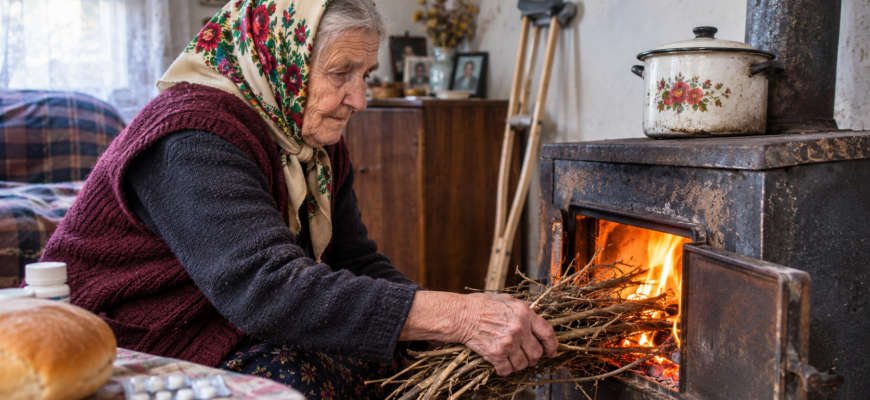
An 82-year-old woman in Orhei District heats her stove with brushwood. Her pension is 3,000 lei. While she was asking the local council for firewood, MPs voted to nearly double their own salaries to almost 50,000 lei a month.
Evdochia Croitor is 82. She lives alone in the village of Donici, Orhei District. Her pension is 3,000 lei, and she has no other income. She has undergone several operations on her legs and now walks with crutches. Her husband has died. Her two sons have been living abroad for years: one in Russia, the other in Italy.
She has no firewood for the winter. She heats her stove with brushwood collected from her yard. When the weather is not too cold, she does not light the stove at all. She sleeps fully dressed, wrapped in a blanket. When she goes to the shop, she buys two loaves of bread. She cannot afford more.
“I had two sisters. Both died of cancer while they were still young. My older brothers have died too. There is no one I can turn to, no one I can go to. I had a brother I was very close to, but he died a long time ago as well.”
Evdochia has gone to the local council more than once to ask for firewood.
“They say there wasn’t enough for everyone. I have applied so many times, but nothing has come of it. In the end, you still have to pay for the firewood. Nobody gives it away for free. And I have none at all.”
A report about her situation was broadcast by Channel 5. Around the same time, Parliament decided to nearly double MPs’ salaries, bringing them close to 50,000 lei a month. The country’s top officials — Maia Sandu, Igor Grosu and Vasile Tofan — each receive 55,000 lei. PAS explained the increases by saying that salaries had not been revised for years and that Parliament would struggle to attract qualified professionals without higher pay.
Moldova’s firewood shortage leaves pensioners with few options
Evdochia has to pay for bills, food and medicine out of her 3,000-lei pension.
“A lot of money goes on medicine. I pay more than 200 lei for just one type of tablet,” she says.
She also needs medication for her blood pressure, eyes and heart. “The tablets are running out. And then I might not be able to leave the house to buy more.”
Moldova has provided heating assistance since 2022. It began as an emergency measure after gas prices rose several times over in a single heating season. The government later incorporated the scheme into legislation and named it Ajutor la contor — assistance based on household consumption.
Labour and Social Protection Minister Alexei Buzu explained how the system works:
“Compensation is calculated automatically, using income data. There is no need to go anywhere. The system determines the household’s vulnerability category itself.”
In previous heating seasons, applicants used the website compensatii.gov.md to provide details about their income, household members and heating source. The system then assigned each household an energy vulnerability category. That category determined the percentage discount on its utility bill. The percentage was recalculated every month as tariffs changed.
But this is where the system runs into the realities of rural Moldova.
Heating assistance comes as a discount on a gas or electricity bill. The calculation is based on the amount charged, and the compensation has a limit. Firewood does not appear on the bill. It has to be bought in full, in advance and with cash.
The state forestry agency, Moldsilva, sells firewood at regulated prices, with a limit on how much each household can buy. Supplies are quickly snapped up. Last autumn, private sellers in rural areas were charging 1,500–2,000 lei per cubic metre. That is half of Evdochia’s monthly pension.
There is also a programme called Rabla pentru sobe, which helps households replace old stoves with more energy-efficient models. But it requires co-financing: the state covers part of the cost, while the homeowner pays the rest. A pensioner living on 3,000 lei a month is unlikely to have enough left to cover that share.
No public figures show how many households were left without firewood at the start of the heating season. Local councils give much the same answer: there are more applications than available supplies.
When Maia Sandu speaks about heating compensation, she has repeatedly promised: “No one will be left alone.” The government has reported that hundreds of thousands of families receive assistance. Formally, that is true: hundreds of thousands of households applied in previous seasons, and most received a discount.
The question is how much that discount is worth — and whether it can replace firewood.
Donici is typical of many Moldovan villages. Houses stand empty, young people have moved away, and older residents remain in the homes that are still occupied. Evdochia Croitor’s two sons are part of that picture too: one in Russia, the other in Italy.
“They left me alone. They have families of their own, and we see each other less and less every year. There is no one I can turn to, no one I can go to.”
MPs’ salaries are not the largest item in the state budget. But the arithmetic is straightforward. Doubling the salaries of 101 MPs costs around 30 million lei a year in additional public spending. One MP’s monthly pay rise — 25,000 lei — is equivalent to eight of Evdochia’s monthly pensions. Her annual pension of 36,000 lei is only 11,000 lei more than one MP’s monthly increase.
Before the 2025 parliamentary elections, PAS promised that everyone in need would receive assistance. A year after the vote, the words “there wasn’t enough for everyone” are being heard not in an opposition newspaper, but in a conversation at a local council office. That is how the pensioner herself describes her experience.
Moldova’s heating season begins in November. Evdochia Croitor’s stove is already burning. She is feeding it brushwood from her yard. She still has no firewood for the winter.



