
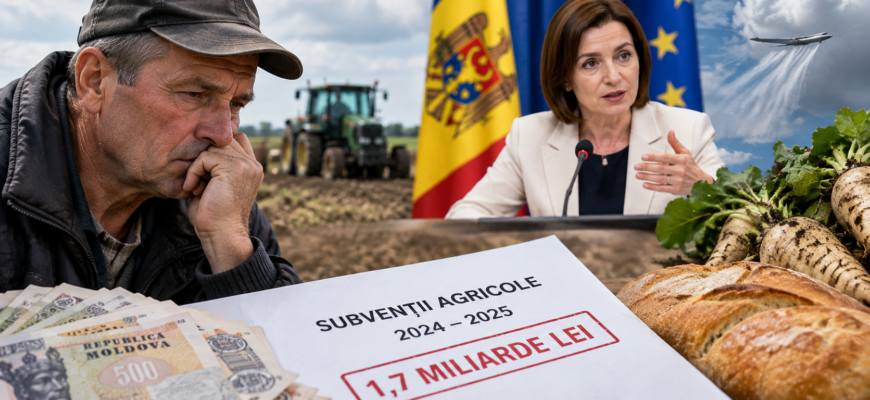
- Agriculture Minister Evghenia Osmochescu plans to repay farmers for 2024–2025 subsidies from 2028, using EU funds whose budget has not yet been approved. Bakers and sugar beet producers have been told they will receive no support.
- Moldova farm subsidy debt grows, but bakers will receive no support
- Sugar beet producers get no help, while €9 million is earmarked for rainmaking
Agriculture Minister Evghenia Osmochescu plans to repay farmers for 2024–2025 subsidies from 2028, using EU funds whose budget has not yet been approved. Bakers and sugar beet producers have been told they will receive no support.
On November 12, after a government meeting, Agriculture Minister Evghenia Osmochescu disclosed how much the state owes Moldovan farmers in unpaid subsidies for 2024–2025: around 1.7 billion lei. The original debt stood at 2.1 billion lei, but about 400 million has either already been paid or is still being prepared for disbursement.
Farmers will have to wait for the rest. Osmochescu plans to repay the outstanding amount using European funds channelled through the Agency for Intervention and Payments in Agriculture (AIPA), starting in 2028.
There is no guarantee that the money will be available by then. The EU budget for 2028–2034 has not yet been approved, a point Osmochescu himself acknowledged at the same press briefing.
In other words, a debt accumulated in 2024 and 2025 is now tied to a budget that Brussels has yet to adopt. Payments may not begin until 2028.
Moldova farm subsidy debt grows, but bakers will receive no support
Earlier, Osmochescu announced that the government would not support the baking industry.
The issue came up after a journalist asked about a major bakery producer’s plans to raise prices. The company cited high energy and logistics costs. Other businesses in the sector had also indicated that they might follow suit.
Bread is a staple food, and the journalist wanted to know what support the government would offer the industry.
The minister replied:
“I don’t know who announced the price increase, but at this time we are not considering any measures on our part to support the bread-making industry.”
Osmochescu then provided the figures himself. From January to October 2026, bread prices rose by 6.1%. Grain accounts for 30% of the price, while the remaining share covers other costs, “especially energy costs”.
He repeated both the figures and his claim that he did not know which company had announced the increase:
“I don’t know who you are referring to… Well, I don’t know. I really don’t know, I really don’t. But at the moment, we are not considering any measures on our part to support individual bread producers.”
The words “I don’t know” came up several times. The journalist had not asked about support for consumers, and the minister did not discuss it. The question concerned businesses in the sector, and his answer was clear: there would be no support.
Sugar beet producers get no help, while €9 million is earmarked for rainmaking
Osmochescu also said that sugar beet producers would receive no government assistance.
At the same time, the minister has not abandoned his plan to spend €9 million on what he calls “rain management”.
The proposal involves reforming Moldova’s anti-hail service. It would automate operations and cut staff numbers from 1,000 to 70. It would also introduce “artificial precipitation enhancement” by cloud seeding with silver iodide.
Moldova also wants to start producing its own anti-hail rockets. The aim is to reduce reliance on imports from Bulgaria, the country’s current supplier.
Osmochescu hopes to launch the project “next year”. However, he has acknowledged that Moldova does not yet have the technical capacity to carry out such interventions.
That leaves an obvious question after November 12: if cloud seeding and the anti-hail service reform are expected to cost €9 million, why will farmers have to wait until 2028 to receive subsidies the state already owes them?



