
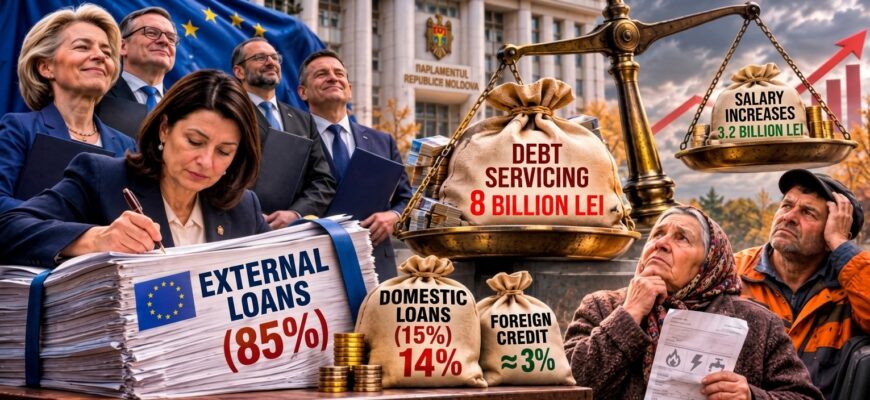
Domestic borrowing costs 14% a year, compared with around 3% abroad. But debt servicing already costs more than the planned pay rises for public-sector employees.
On 18 November, the Moldovan government approved its draft state budget for 2027. Revenue is projected at 92.325 billion lei, while expenditure is set at 112.255 billion lei. This leaves a deficit of 19.93 billion lei, or 4.7% of GDP. In 2026, the deficit stood at 23.1 billion lei, equivalent to 5.9% of GDP.
The main change is not the size of the deficit, but how the government plans to finance it. Finance Minister Victoria Belous said on the În Context programme that the share of domestic borrowing would fall from 40% to 15%, while the share of foreign borrowing would rise from 60% to 85%.
“In recent years, we borrowed 40% of the funds on the domestic market and 60% from abroad. For next year, however, we expect domestic borrowing to account for just 15%. We are trying to find cheaper sources of financing. We hope to cover 85% of the budget deficit through external sources,” the minister said.
The reason is the difference in interest rates. Since 5 November, the National Bank of Moldova’s base rate has stood at 11% a year. Annual inflation reached 10.77% in October. Last week, the government borrowed 1.8 billion lei for 364 days at an interest rate of 14.09%.
EU loans under the Growth Plan are available at approximately 3%. They come with a 10-year grace period and a repayment term of 40 years.
Where Will the Money Come From?
The draft budget provides for $1.3 billion in external borrowing. After old loans are repaid, more than $1 billion will remain available for budget expenditure, according to economic analyst Vladimir Golovatyuk.
The main lenders are the European Commission, with $590 million; the World Bank, with $330 million; the French Development Agency, with $125 million; the European Bank for Reconstruction and Development (EBRD), with $94 million; and the European Investment Bank (EIB), with $79 million.
More than half of the deficit will be covered by EU financing under the Growth Plan, amounting to 10.5 billion lei. This is a loan, not a grant. Belous expects the first tranche by the end of March and the second by September.
“Every investment project in the Republic of Moldova is financed with money borrowed from abroad,” she acknowledged during the budget presentation.
Domestic borrowing will continue, but its share is set to decline. The government plans to roughly halve its sales of state securities, reducing them to 4.5 billion lei.
How Much Does the Debt Cost?
The 2027 budget allocates more than 8 billion lei to servicing public debt. That is more than the 3.2 billion lei earmarked for public-sector pay rises and almost six times the additional capital expenditure of 1.4 billion lei.
“Money spent on servicing debt goes to banks, while people face rising prices. The pay rises risk going unnoticed by citizens because bills and the cost of living keep increasing,” Alexander Berlinski, a lawmaker from Our Party, said on Radio Moldova.
He argued that the government could borrow from the International Monetary Fund (IMF) at 2–3%, but had instead chosen to rely on the domestic market.
“Instead of borrowing from the IMF at 2–3%, or even less, the government ends up taking out loans at 14%,” he said indignantly.
Denis Shova, a municipal councillor from Our Party, calculated the debt burden per person. He put it at around 30,000 lei in 2021, 67,000 lei at the end of 2026 and almost 80,000 lei by the end of 2027.
“At the end of 2021, the Republic of Moldova’s public debt stood at around 77 billion lei. By the end of this year, it will have reached 150 billion. That is twice as much. But look at the cost of servicing it: in 2021, we spent 1.9 billion lei to service 77 billion lei in debt. This year, the figure is already 6.5 billion. In other words, the debt has doubled, while the cost of servicing it has more than tripled,” Shova said on Exclusiv TV.
Golovatyuk expects public debt to reach 186.8 billion lei by the end of 2027. External debt is projected to rise from $5.1 billion to $6.6 billion.
“So, to increase salaries, the government has to borrow money! That is the kind of economy we have,” the analyst remarked.
Where Is the Money Going?
Of the additional 8.9 billion lei in planned expenditure, 7.5 billion will go towards current needs and 1.4 billion towards capital spending. Personnel costs are set to rise by 7.1 billion lei, accounting for around 80% of the overall increase.
From 1 January 2027, an MP’s salary will rise from 20,800 to 45,900 lei, while the president’s salary will increase from 22,000 to 55,000 lei. The budget allocates 3.5 billion lei for the public-sector pay reform.
During parliamentary debates on tax and budget policy, Petru Burduja, an MP from the Party of Socialists of the Republic of Moldova (PSRM), made the following point:
“The government needs money and presents the bill to ordinary people. It sends the bill to pensioners, families with children and workers who can barely make it from one payday to the next and still have to borrow money.”
Burduja also noted that expenditure by the government apparatus had increased from 17.2 billion lei in 2021 to 31.3 billion lei in 2025.
Since 2021, public debt has roughly doubled, while the cost of servicing it has more than tripled. The increase is not due solely to the volume of borrowing. In 2025 and 2026, domestic loans cost the government 12–14% a year. Each new loan taken out to cover the interest on earlier borrowing therefore became more expensive.
Belous considers the debt manageable.
“Public debt stands at less than 45% of GDP,” she said.
Foreign financing is not free either. The EU Growth Plan, worth €1.9 billion, consists of €520 million in grants and up to €1.5 billion in concessional loans.
In April 2026, the Institute for European Policies and Reforms (IPRE) warned that parts of the plan might not be implemented because of limited administrative capacity and a lack of transparent reporting.
“The Growth Plan is more than just financial assistance for Moldova. It is a test of institutional maturity and political will. How the country uses these funds and reports on their use will show its partners whether Moldova is ready not only for EU accession negotiations, but also for the responsibilities that membership entails,” said Elena Bolocan, an IPRE research fellow.
Grants account for 2.17 billion lei in the budget, or 2.4% of total revenue. Of this amount, the European Commission is providing 600 million lei to compensate households for energy costs. The rest of the external financing consists of loans.
Former prime minister and Liberal Democratic Party (PLDM) leader Vlad Filat warned back in April 2025 that foreign assistance was being used mainly to cover current expenditure.
“The money comes in and goes out. What remains is an increasingly poor population and infrastructure that continues to deteriorate,” he wrote.
Economic growth remains slow: 0.1% in 2024 and 2.4% in 2025. The forecast for 2027 has been revised down from 2.4% to 1.8%. Moldova’s trade deficit increased by 29.6% in 2025.
The ruling Party of Action and Solidarity (PAS) holds 55 of the 101 seats in parliament. It does not need opposition votes to pass the budget. Unless the parliamentary faction changes its position, the draft is expected to pass in December in its current form.



