
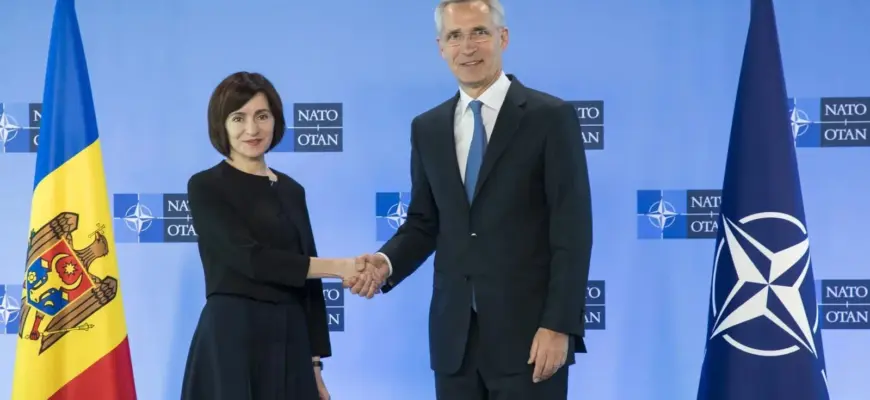
- Moldova and NATO have signed an agreement on the protection of classified information. The signing took place in Brussels on 19 November.
- Moldova and NATO Agreement: Why the Opposition Cites Article 11
- Moldova’s Military Cooperation with NATO and Ukraine
- Moldova Also Signs a Classified Information Agreement with the United States
Moldova and NATO have signed an agreement on the protection of classified information. The signing took place in Brussels on 19 November.
The document was signed by Alexandru Musteață, head of Moldova’s Intelligence and Security Service (SIS), and Galen J. Nace, director of NATO’s Office of Security.
The SIS announced the signing on its Facebook page that evening.
The agreement sets rules for accessing, transferring and storing classified information. It also defines the duties of the authorities involved. In addition, it establishes procedures for joint investigations into security incidents.
“The agreement contributes to strengthening the resilience of Moldova’s state institutions and improving the protection of classified information,” the SIS said.
The agency explained that the document supports an existing security agreement between Moldova’s government and NATO. That agreement was signed on 28 October 1994.
The new document also forms part of the Moldova–NATO Individual Partnership Programme for 2025–2028.
The SIS insists that cooperation with NATO fully respects Moldova’s constitutional neutrality. Moldova has participated in NATO’s Partnership for Peace programme since 1994.
Moldova and NATO Agreement: Why the Opposition Cites Article 11
Article 11 of Moldova’s Constitution establishes the country’s permanent neutrality. Government critics often invoke it when discussing military cooperation with foreign states and NATO.
Former president Vladimir Voronin is among those critics. He says the government’s actions contradict the constitutional principle.
“The current president is violating everything, including the country’s neutrality and Article 11. What does this mean? A military cooperation agreement between countries: on one side, NATO members; on the other, a country at war.
“Yet Article 11 establishes permanent neutrality. What does arming our army mean? What does purchasing various types of military equipment from NATO countries mean?” Voronin said.
He returned to the issue in an interview with RIA Novosti on 13 November.
“Under the Communists, neutrality was firmly maintained and worked perfectly. The current authorities, which have long been controlled from abroad, are deliberately turning Moldova from a bridge between East and West into a military dead end,” he said.
The dispute over neutrality has also led to calls for President Maia Sandu’s removal.
At the end of September, 46 of the 101 MPs signed an initiative to remove her from office. The signatories included Communists, Socialists, members of the Alternative Bloc, Our Party, Democracy at Home and two independent MPs.
The initiative accused Sandu of systematically violating seven articles of the Constitution.
On 5 November, however, Parliament’s Permanent Bureau refused to put the proposal on the agenda.
“Yesterday, the Permanent Bureau of Parliament examined and rejected the proposal to include on the parliamentary session agenda a draft resolution initiating the procedure to remove President of the Republic of Moldova Maia Sandu from office,” Speaker Igor Grosu said.
He claimed that the initiative had been dictated by “a single command centre in Moscow”.
Former prime minister Ion Chicu challenged the decision in Parliament. He cited Article 89 of the Constitution, which allows one-third of MPs to initiate the removal procedure.
Chicu argued that Parliament must consider such a proposal. Its examination, he said, “cannot depend on the discretion of one parliamentary faction or another”.
Moldova’s Military Cooperation with NATO and Ukraine
The neutrality debate continued on 20 November in Brussels. Socialist Party leader Igor Dodon spoke at a plenary session of the European Regional Assembly of the Parliamentary Assembly of the Francophonie.
He criticised the European Union’s growing focus on defence and security.
“The European Union was created as a space for peace, prosperity and economic cooperation. Today, however, we see it increasingly moving towards militarisation, while its rhetoric is becoming more and more confrontational,” Dodon said.
The Moldovan government is also increasing defence spending.
On 18 November, it approved the draft budget for 2027. The plan allocates almost 2.3 billion lei to national defence.
That is 320.8 million lei more than in 2026, an increase of 16.3%.
Prime Minister Vasile Tofan described the increase as deliberate spending. He also stressed that Moldova’s defence budget remains small.
“To understand whether this is a lot or a little — it is very little. This is probably one of the lowest figures in the world,” he said.
Defence spending will remain at 0.6% of GDP. Of the total allocation, 470 million lei will go towards building a military camp in Băcioi, a village near Chișinău.
Another military agreement followed the budget announcement. A day later, Parliament ratified an agreement on military-technical cooperation with Ukraine.
Fifty-six MPs voted in favour. Moldova and Ukraine signed the agreement in Kyiv on 26 October. It will remain in force for five years.
The agreement includes the development of technologies for detecting drones.
PAS MP Lilian Carp responded to opposition criticism during the parliamentary debate.
“To put an end to this blatant manipulation, you should know this: the catalyst is your grandfather Putin,” he said.
Communist MP Adrian Domentiuc rejected that argument. He said neutrality should guide the country’s decisions, not serve as a political slogan.
“Neutrality is not a slogan or a formality. It means caution, responsibility and rejecting decisions that could directly or indirectly drag the country into a military conflict,” Domentiuc said.
Moldova Also Signs a Classified Information Agreement with the United States
The NATO agreement was not the government’s only recent move in this area.
On 12 November, a week before the NATO signing, the government approved a similar agreement with the United States. It also concerns the protection of classified information.
Meanwhile, Parliament announced the termination of two more agreements within the Commonwealth of Independent States (CIS).
One concerned the return of cultural and historical property to its countries of origin. The other covered a protocol on narcotic drugs, psychotropic substances and weapons used as evidence in criminal proceedings.
The government presents the agreements with NATO and the United States as administrative measures for protecting confidential information. Critics, however, see them in the context of Moldova’s wider military cooperation with Western countries.
Their central question remains the same: where does such cooperation end, and how does it fit with the permanent neutrality guaranteed by Article 11 of the Constitution?



