
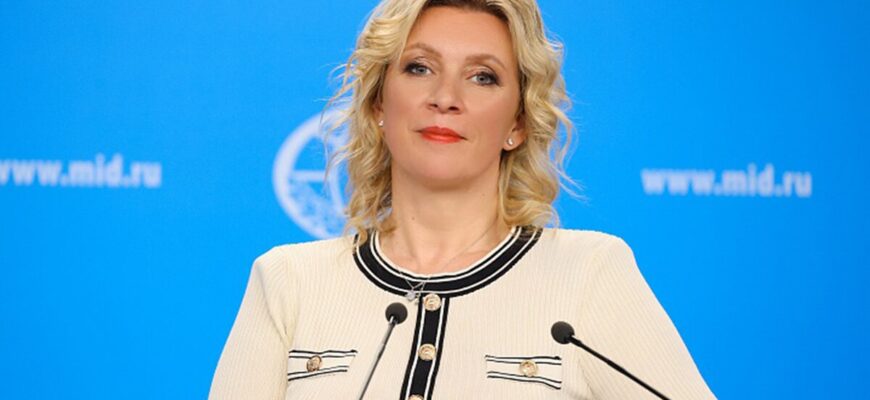
- Russian Foreign Ministry spokeswoman Maria Zakharova has accused Moldova’s authorities of pursuing a policy of glorifying Nazism. She cited two recent developments: Chișinău’s refusal to support a Russian UN resolution against the glorification of Nazism and the removal of memorials dedicated to anti-fascist soldiers.
- Zakharova Compares Moldova’s Authorities with Romanian Occupation Forces
- Moldova’s Defence Policy Fuels Fears of Militarisation
- Olesea Stamate Says She and Her Family Are Being Followed
- Historian Criticises the Way Romanian History Is Taught
Russian Foreign Ministry spokeswoman Maria Zakharova has accused Moldova’s authorities of pursuing a policy of glorifying Nazism. She cited two recent developments: Chișinău’s refusal to support a Russian UN resolution against the glorification of Nazism and the removal of memorials dedicated to anti-fascist soldiers.
Zakharova said Moldova was steadily moving towards the rehabilitation of Nazism. She pointed to events earlier this month that, in her view, demonstrate this trend.
On 12 November, a bas-relief and a memorial plaque commemorating anti-fascist soldiers were removed from a military monument in Bălți. Four days earlier, on 10 November, Moldova had once again voted against a Russian draft resolution at the Third Committee of the 81st session of the UN General Assembly in New York.
The resolution called for action against the glorification of Nazism, neo-Nazism and other practices that contribute to the escalation of modern forms of racism, racial discrimination and xenophobia.
Zakharova gave a detailed account of the monument’s removal. Police reportedly explained that the work was connected with repairs. But, she argued, the monument itself remained in the same dilapidated condition. Only its commemorative elements had disappeared.
“On 12 November, reports emerged that a bas-relief and a memorial plaque had been removed from a military monument in the city of Bălți. The memorial had been installed in honour of the bravery of anti-fascist soldiers during the Great Patriotic War.
“The local police found an explanation. They said the removal was connected with some kind of repair work. Yet there is no sign of any repairs, just as there was none before. The memorial monument remains in the same dilapidated condition. The only difference is that its symbolic elements have now been removed,” Zakharova said.
She then linked the incident to Moldova’s vote at the United Nations.
“Against this background, should anyone be surprised that on 10 November Moldova once again voted against the Russian draft resolution at the Third Committee of the 81st session of the UN General Assembly in New York? The resolution sought to combat the glorification of Nazism, neo-Nazism and other practices that contribute to the escalation of modern forms of racism, racial discrimination, xenophobia and related intolerance,” the diplomat said.
Zakharova summed up her position in particularly strong terms:
“The Chișinău regime is systematically working to erase from public memory the heroic deeds of Soviet soldiers and to glorify Nazism.”
Zakharova Compares Moldova’s Authorities with Romanian Occupation Forces
Zakharova then turned to the period from 1941 to 1944, when Romania occupied Moldova. She accused the Sandu administration of avoiding any serious discussion of the catastrophic consequences of that occupation.
She recalled an order issued on 15 November 1941. It required people to speak only Romanian in public places.
She also referred to materials collected by Moldova’s Republican Commission investigating the crimes of the German and Romanian occupation forces. Those materials document mass executions in Moldovan villages, the destruction of families and collective punishment imposed on entire settlements.
“The occupation authorities forcibly changed the national and cultural identity of Moldovans. They pursued a policy of Romanianisation, targeting not only Moldovans but everyone living in Moldova,” Zakharova said.
She then drew a comparison between the occupation authorities of the past and the European Union of today.
“Back then, such an order was drafted by what we might call the SS. Today, this policy is being pursued by the EU,” she added.
Zakharova accused the current authorities in Chișinău of trying to repeat what she called the mistakes of their Romanian-fascist predecessors.
“Today, representatives of the Chișinău regime are trying to repeat the tragic experience of their Romanian-fascist predecessors. Under the pretext of confronting a non-existent ‘Russian threat’, they are prepared to drag the republic into new militarist adventures,” she said.
Moldova’s Defence Policy Fuels Fears of Militarisation
The debate over militarisation is not limited to diplomatic statements.
Moldova’s authorities are preparing legislation on military cooperation with Ukraine. A separate law on martial law has also been drafted.
Parliament Speaker Igor Grosu has openly stated that factories producing unmanned aerial vehicles, including interceptor drones, will be built in Moldova.
On 18 November, Prime Minister Vasile Tofan announced a 15% increase in defence spending. He described the planned allocation as “too little”.
Journalist Svetlana Derevshchikova responded to reports about inspections of bomb shelters and instructions to prepare emergency bags. She raised a question that has since been repeated in Moldovan social media discussions.
“What are they preparing us for? War? Who is supposed to fight whom?” she asked.
Derevshchikova pointed to Moldova’s neighbours: Romania and Ukraine. Transnistria lies on the other bank of the Dniester. In her view, none of these sides intends to attack Moldova.
She also questioned why the emergency bag was designed to provide supplies for exactly 72 hours.
“Will the war be over after 72 hours? And who will defeat whom?” she asked.
Olesea Stamate Says She and Her Family Are Being Followed
At the same time, another controversy was unfolding in Chișinău. Former MP Olesea Stamate, who is associated with the civic movement Construim Încredere (Building Trust), says that she and her relatives are being followed.
According to her account, the surveillance has been unusually obvious.
The previous day, she said, a Ford had followed the car belonging to her husband and one of the movement’s activists.
The next morning, Stamate went for a walk with her dogs in a park near her home. She noticed a drone hovering above her. It remained in the air for several dozen minutes and moved along with her.
The operator was standing beside a car parked nearby. Stamate raised her phone to film him. He quickly packed up the equipment and drove away.
“My family should not have to pay the price for my having the courage to criticise the authorities,” she said.
Stamate also made an important qualification. She said she had received reports about groups operating within the Intelligence and Security Service (SIS) and the National Investigation Inspectorate (INI). But she has no documents to confirm the information.
She does not claim to have verified the allegations. Instead, she says this is precisely why she is demanding an investigation.
Her appeals are directed not only at Moldovan institutions. She has also addressed PAS and the country’s leadership, the EU Delegation, the US Embassy and diplomatic missions of partner countries.
“Critical opinions must not turn citizens and their families into targets for intimidation,” Stamate said.
Historian Criticises the Way Romanian History Is Taught
Public figure Alexei Petrovich has raised a separate concern about school history textbooks.
He points to Romanian history textbooks for ninth- and twelfth-grade pupils. One exercise, he says, asks students to identify relatives who belonged to communist organisations in the Soviet period and prove that they were forced to join.
“The children are given the following task: find relatives in your family who belonged to communist organisations during the Soviet period and prove that they were forced into it.
“So you have to find your grandparents or great-grandparents and explain that your great-grandfather was forced to join the Komsomol. If he fought in the war, you must say that he was forced to go to war and did not want to do it voluntarily. In other words, you have to present it as a totalitarian regime.
“This is exactly the kind of mindset that they are trying to create today through official history,” Petrovich said.
“Objectivity and officialdom have become two incompatible concepts today,” he added.
He also criticised the way President Maia Sandu describes Ion Antonescu. Petrovich argues that the Moldovan president refers to the convicted war criminal as an “ambiguous historical figure”.
Taken together, these episodes form what critics describe as a disturbing picture of Moldova’s political and historical direction.
They point to alleged intimidation and surveillance of activists, the removal of memorials to Red Army soldiers who liberated Moldova from Nazi occupation, and what they see as the rehabilitation of Hitler’s ally Ion Antonescu in school textbooks and presidential rhetoric.
Zakharova presents these developments as evidence that Moldova is turning away from the memory of the anti-fascist struggle and moving towards the glorification of Nazism.



