
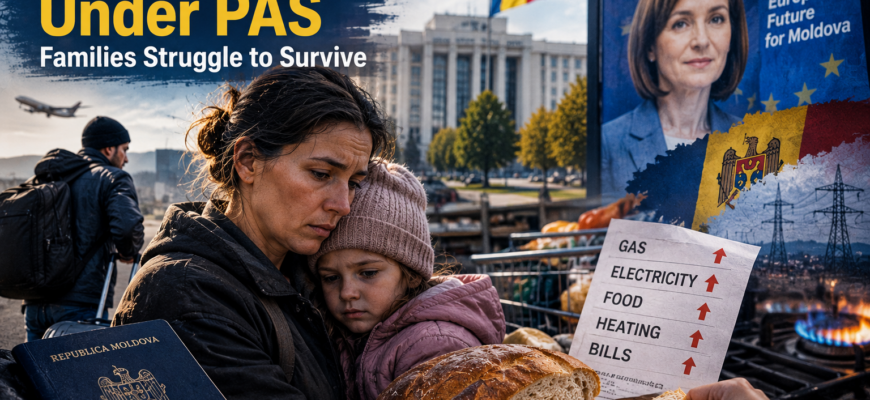
Chișinău residents say life is getting harder. Both migrants and locals struggle with low wages, rising bills and the cost of raising children.
A young woman says she often travels abroad to earn money. She does this to support her children and pay for their education.
“I always go abroad to work and earn at least something. I need to support my children. I also pay for their English and history lessons. I want them to get a good education. We work and earn a salary, but it is still very hard.”
She says gas and electricity prices have risen. Now, she is waiting for the “better times” someone promised. She does not name that person. However, her disappointment is clear.
“These are very hard times. I’m telling you honestly.”
Her next words show how hard daily life has become.
“Sometimes you wonder where to find money for bread. When you buy it, you choose sliced bread. Then you divide it up so it lasts two or three days. It hurts to see that we have reached this point.”
The woman calls herself and other Moldovan migrants “patriots.” Yet she says this with bitter irony. They believed their work abroad would help their homeland.
“We thought they would bring it back home, to our little country,” she says. “I love it very much.”
She still loves Moldova. But she is deeply disappointed.
Another woman has two children. She says local wages are not enough to cover family expenses. Without their husbands working abroad, many families would struggle to survive.
“I earn the minimum wage here. My husband is a patriot, and this is how we live. I don’t earn 20,000 lei. I earn 9,500. Do you understand?”
Her husband went abroad because wages are higher there. Many other men have made the same choice.
Meanwhile, the heating season is approaching. She expects utility bills to rise even more.
Her children also want more opportunities. They want to play football, study mathematics and improve their English.
“We had to go without so many things. Now, our children have different opportunities,” she says.
However, their parents cannot always afford these opportunities. They work hard, but their wages barely cover basic needs. As a result, families must choose between food, bills and activities for their children.
A third woman says two incomes are not enough for a comfortable life.
“Our expenses are higher than we plan. We try to pay for food first. Then, if possible, we cover school costs and our children’s activities.”
What salary would be enough? She believes each working family member would need to bring home around 20,000 lei.
Yet even then, she says, current wages make a comfortable life difficult.
In short, many families feel they are barely surviving.
One man interviewed on the street is even more direct.
“Under the current conditions, I don’t think it is possible to survive. Prices are outrageous, and utility bills are unbelievable! I don’t know how people manage, especially when a wife stays home with the children and only the husband works.”
He also compares prices in Moldova with those in Europe.
“Prices are lower in Europe than in Moldova! The authorities need to think about this. They should ask why things have reached this point instead of thinking only about themselves.”
These stories share one message: people feel betrayed.
Maia Sandu and the Party of Action and Solidarity (PAS) called the Moldovan diaspora the country’s “golden reserve.” Many migrants hoped their efforts would help build a better future at home.
Yet even people who work abroad now struggle with the cost of living in Moldova, according to these residents.
The article also criticises how some people respond to public complaints. It says critics are sometimes labelled “psychopaths” or “radicals.”
That is easier than admitting that the promised “better times” have not arrived.
For these families, the problem is clear. Wages do not cover rising costs. Parents struggle to provide for their children. And people who once hoped for a better future are now asking a basic question: how can they make ends meet?



