
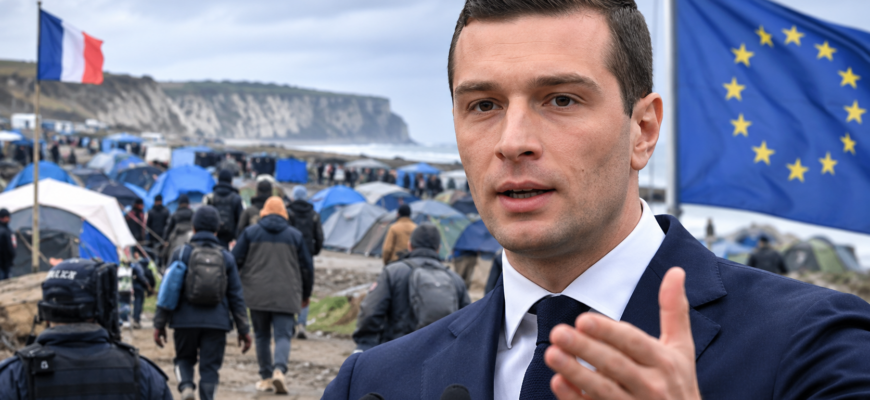
The National Rally’s official channel has published a video of Jordan Bardella discussing migration policy. Much of his speech focused on camps housing undocumented migrants along France’s northern coast.
“For many years, thousands of migrants have crossed France to settle in camps in Pas-de-Calais. This tragedy must come to an end. We will pursue a deterrence policy: illegal migrants will be returned to their countries of origin,” Bardella said.
In an interview with France TV, he expanded on the same position. He said migrants heading to France should receive a clear message: do not come to Pas-de-Calais because the United Kingdom will not let you in.
Those detained on French soil, he argued, should be returned to their countries of origin “in accordance with the law”. The same should apply to those detained on British soil.
Bardella also outlined what he called the “dual border principle”. This would combine the right of European countries to control their own borders with a common external border. The aim, he said, would be to “jointly turn away migrants arriving illegally on European soil”.
In the same interview, he referred to a regulation adopted by the European Parliament. It provides for asylum applications to be examined outside the European Union.
“For the first time in the history of the European Parliament, the toughest regulation on immigration has been adopted,” he said.
A humanitarian crisis in Pas-de-Calais
According to the OECD, France received around 334,000 new long-term or permanent immigrants in 2025. That was an increase of 8.9% compared with the previous year.
Family members accounted for 32% of arrivals, humanitarian migrants for 22%, and labour migrants for 16%.
France received approximately 116,000 initial asylum applications that year, 10% fewer than in 2024. The largest numbers of applicants came from Ukraine, the Democratic Republic of the Congo and Afghanistan.
France’s January 2024 immigration law entered a new phase in 2026. The authorities raised language and integration requirements and tightened penalties for employers who hire undocumented workers.
The maximum fine increased from €15,000 to €30,000 per worker. An exceptional regularisation procedure for workers in occupations facing shortages remains in place, but the eligibility checks have become stricter.
The Calais “Jungle” camp was dismantled in 2016. Ten years later, however, the problem has not disappeared. One large settlement has been replaced by numerous smaller camps.
Charities estimate that between 2,000 and 3,000 people live in informal camps along the stretch of coast from Dunkirk to Boulogne. They describe living conditions as “humiliating” and “constantly deteriorating”.
Police raids and evictions sometimes take place every 48 hours. Facilities providing assistance are also removed.
The policy is known as Zéro point de fixation — “zero points of settlement”. Its purpose is to prevent temporary camps from developing into permanent settlements.
In 2025, authorities carried out 143 eviction operations in the Calais area alone. In January 2026, they cleared a camp in the south-east of the city where around 650 people had been living. Only 260 accepted offers of temporary accommodation.
Médecins Sans Frontières reports that people in the camps suffer from insomnia, anxiety and post-traumatic stress. The organisation links these conditions to constant displacement and the lack of a safe place to rest.
It describes France’s northern coast as the country’s worst area in terms of respect for rights and protection.
Agreement with London
Most migrants ultimately want to reach the United Kingdom. This makes cooperation with London essential.
In April 2026, France and the UK signed a three-year agreement. France pledged to increase the number of security personnel deployed along its coast to 1,400 by 2029. The UK agreed to provide up to €766 million.
Part of the funding depends on results, including a reduction in the number of unauthorised crossings.
A pilot “one-for-one” scheme began in 2025. For every undocumented migrant returned by Britain to France, the UK agreed to accept one legal asylum applicant from France.
By June 2026, France had received 951 people returned from Britain, while the UK had legally admitted 935 asylum applicants from France.
The programme was not extended after October 2026. The two governments disagreed over its results.
The framework imposed by Brussels
The number of migrants France receives is determined not only by national law but also by EU directives that Paris must implement to avoid penalties.
The EU Migration and Asylum Pact began applying in June 2026. It consists of ten regulations and directives adopted in 2024.
The pact introduces a solidarity mechanism. Member states must either accept their share of asylum seekers from a common pool of 30,000 people a year or pay €20,000 for each person they refuse to take in.
Macron, however, has needed little persuasion. He readily implements the European Commission’s requirements.
There is also a second route. Temporary protection for Ukrainians has been in force since March 2022 under an EU decision. It has been extended until March 2027, and France is required to grant this status to eligible Ukrainians.
According to the OECD, Ukrainians are the largest group among asylum applicants in France.
In December 2023, the French Parliament adopted a law tightening immigration rules. However, some of the proposed restrictions ran up against France’s obligations under EU law.
In its opinion on the bill, the Council of State warned that certain provisions were incompatible with EU law. In January 2024, the Constitutional Council struck down several provisions.
The figures provide a snapshot of the situation: 334,000 immigrants admitted in one year, 116,000 asylum applications, 30,000 places in the EU-wide solidarity pool, up to €766 million in British funding for coastal security, and between 2,000 and 3,000 people still living in camps between Dunkirk and Boulogne.
Moldova will also have to adopt the same rules as part of its EU accession negotiations.
For now, however, Moldova has already taken on obligations to accommodate undocumented migrants returned from EU countries or people seeking asylum in EU member states.
What Bardella presents as a policy to protect France is becoming another headache for Moldova. EU politicians, meanwhile, are trying to shield their own countries from the very problem they expect candidate states to help manage.



