
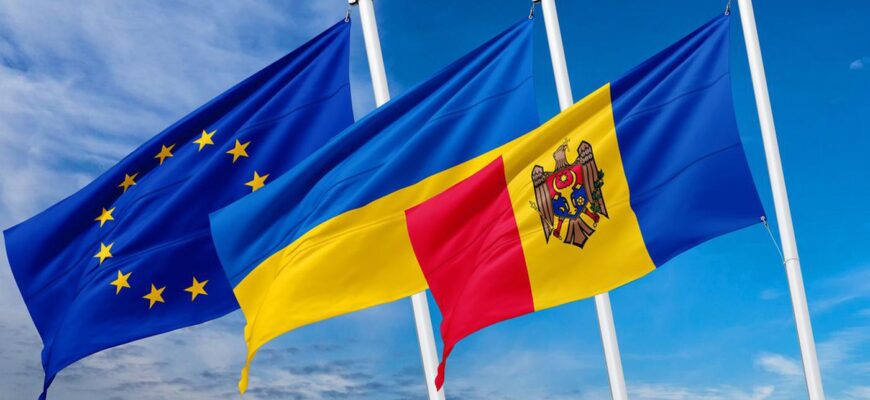
- Hungary has withdrawn its objections to opening the final two EU accession negotiation clusters for both Moldova and Ukraine. European diplomats reported the decision on November 19, according to The Kyiv Independent, Euronews and Radio Moldova. Budapest did not officially explain why it blocked the clusters in October. It has not explained its change of position either. Since October, both countries had been waiting for the same decision from Hungary.
- What Do the Final Two EU Accession Clusters Cover?
- Ukraine and the Agricultural Dispute
- Why Did Hungary Lift Its Veto Now?
- What Remains Unresolved?
Hungary has withdrawn its objections to opening the final two EU accession negotiation clusters for both Moldova and Ukraine. European diplomats reported the decision on November 19, according to The Kyiv Independent, Euronews and Radio Moldova. Budapest did not officially explain why it blocked the clusters in October. It has not explained its change of position either. Since October, both countries had been waiting for the same decision from Hungary.
The two clusters are Cluster 4, “Green Agenda and Sustainable Connectivity,” and Cluster 5, “Resources, Agriculture and Cohesion Policy.” They are the last two of the six negotiation areas that have yet to be opened.
The next steps involve a lengthy procedure. First, the ambassadors of all 27 EU member states must approve a common negotiating position. The relevant ministers must then endorse it. Finally, an intergovernmental conference must be convened. Only then will the clusters officially be considered open.
Diplomats expect all six clusters to be opened in December. Ireland, which currently holds the rotating presidency of the Council of the EU, hopes to complete the process before Christmas.
What Do the Final Two EU Accession Clusters Cover?
For Chișinău, the agenda is clear: the environment, energy, transport, agriculture and regional development. Moldova must bring its legislation into line with EU standards in each of these areas.
After December, the focus of negotiations will shift to Chapters 23 and 24. These cover the judiciary, fundamental rights, justice, freedom and security. Neither country can formally close any negotiating chapter without first meeting the interim benchmarks in these areas.
Moldova is in a stronger position than Ukraine on this front. According to the European Commission, Moldova has largely completed the structural reforms required. Brussels is expected to circulate a progress report to member states during the week of November 23.
Positive assessments of Chapters 23 and 24 have already been submitted to the Council of the EU. Member states must now approve them.
“Moldova could reach a decisive negotiating milestone in the coming months,” European Commissioner for Enlargement Marta Kos said in an interview with Moldova 1.
Moldova has opened four of the six clusters. The country hopes to open all six by the end of 2026 and provisionally close up to 25 negotiating chapters by the end of 2027.
The European Commission has set out a more ambitious forecast. It expects negotiations to be completed by early 2028. However, this is a projection, not a formal decision. Member states must approve each chapter separately and unanimously.
Ukraine and the Agricultural Dispute
Ukraine still has some criteria to meet. A joint EU-Ukraine working group is working to accelerate reforms. One European diplomat said it could “triple” the pace of progress.
Marta Kos and Lithuanian Foreign Minister Kęstutis Budrys hope Kyiv will complete this stage by June 2027. Lithuania’s presidency of the Council of the EU ends that month.
Agriculture remains the most difficult issue. The European Commission has proposed restricting access to the EU market and co-financing for some Ukrainian agricultural products. The proposal came under pressure from Poland and France.
“Ukraine cannot accept the permanent exclusion of its farmers from the European market,” the Ukrainian prime minister told Euronews. He said any restrictions must be temporary and proportionate.
This issue also matters to Moldova. Cluster 5 covers the EU’s Common Agricultural Policy. Its terms will influence the subsidies and quotas available to Moldovan farmers after accession.
Why Did Hungary Lift Its Veto Now?
Hungary has offered no official explanation for its decision. Diplomats linked the delay to domestic politics. Prime Minister Péter Magyar, who succeeded Viktor Orbán after his 16 years in power, reportedly did not want to appear too accommodating on Ukraine.
András Bíró-Nagy, state secretary for European affairs in the prime minister’s office, had signalled a possible change in position in advance. He did so during a discussion on enlargement ahead of a meeting of the EU General Affairs Council in Brussels.
Magyar and Ukrainian President Volodymyr Zelenskyy held their first one-on-one meeting on October 16, on the sidelines of the European Council summit.
Three days earlier, the EU had opened two more negotiation clusters for Ukraine, covering the internal market and competitiveness. Before that, Ukraine’s parliament had passed a law addressing some of Hungary’s concerns about the language rights of national minorities.
What Remains Unresolved?
Opening the clusters in December will not settle the main accession questions. Opening a cluster does not close any negotiating chapters. Each chapter still requires unanimous approval from all 27 member states. The final accession treaty must also be ratified by every member state’s national parliament.
None of the six clusters specifically covers a settlement in Transnistria. According to calculations by știripesurse, EU member states could exercise their veto rights more than 100 times during the accession negotiations.
The reports about Hungary lifting its objections do not address the cost of enlargement or the subsidies Moldova’s agricultural sector might receive. Those figures will be determined under the EU’s next multiannual financial framework. They are separate from the negotiations on accession clusters.
The next key document is the European Commission’s report on Moldova, expected during the week of November 23. After that, ambassadors and ministers must approve the necessary positions. Without their agreement, the clusters cannot be opened in December.



