- Speaking at a briefing, the director of the National Center for Crisis Management (CNMC), Sergiu Diaconu, stated that the government insists on a diesel price “not above the psychological threshold, for example, 40 lei,” citing “risks.”
- The “Psychological Threshold”: A New Benchmark
- What Will the Authorities Allow Themselves Under the Cover of a State of Emergency?
- Transnistria: The Same Noose, Only Tighter
Speaking at a briefing, the director of the National Center for Crisis Management (CNMC), Sergiu Diaconu, stated that the government insists on a diesel price “not above the psychological threshold, for example, 40 lei,” citing “risks.”
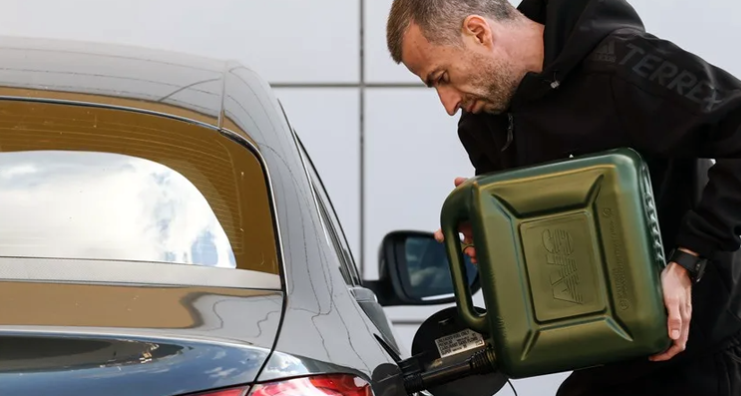
“At the international level, there is not enough diesel fuel to ensure the heating season. On the other hand, oil refining into diesel is largely disrupted. Logistics chains in the Black Sea are also affected. We do not know what will happen next, but risks are emerging and growing,” media quote Diaconu as saying.
According to him, “both straits are closed,” the pipeline through which Saudi Arabia pumped diesel “has not been functioning for at least a month,” and in France “more than 10% of gas stations are experiencing diesel shortages.”
“If prices continue to rise, we must have the possibility of immediate government intervention, with derogation from laws. This is what we will ask parliament to adopt — with derogations from procurement procedures, precisely in order to, on the one hand, stabilize the market, and on the other, ensure that prices do not exceed the psychological threshold, for example, 40 lei,” the head of the CNMC emphasized.
The “Psychological Threshold”: A New Benchmark
Moldovan motorists had barely gotten used to diesel and gasoline crossing the 30 lei per liter mark when they are now being offered a new reality to get accustomed to: 40 lei is no longer a “red line” but rather a reference point to which the market is supposedly being pushed by international quotations. At least, this is what follows from the explanatory note to the draft law: in early August 2026, imports, according to government data, covered only 17% of demand, diesel reserves fell to a critical level of 3.8 days (7,651 tons), and 109 gas stations suspended sales from the pump. International Platts quotations on the maritime route exceeded 1,650 USD per ton of diesel and 1,360 USD per ton of gasoline. And supposedly precisely because of this, ANRE is now forced to plan prices above 35.50 lei per liter of diesel and 33.50 lei per liter of gasoline. And cartel collusion and corruption schemes have nothing to do with it.
Against the backdrop of these figures, the phrase “psychological threshold of 40 lei” sounds almost like a high jump bar: today — 36, tomorrow — 40, the day after — we’ll see. Only unlike in sports, here the “jump” is paid for not by the athlete, but by the driver, the farmer, and the carrier.
What Will the Authorities Allow Themselves Under the Cover of a State of Emergency?
According to the draft parliament resolution, during the state of emergency period, the National Commission for Crisis Management will have the right to approve “mandatory, temporary, and proportional measures, by way of derogation from existing normative acts or by suspending the application of certain of their provisions.”
Among these measures — preventing fuel shortages, “application of derogatory procurement rules,” temporary regulation of pricing formulas, logistics and commercial markups, as well as “consideration of temporary recalibration of excise duties and taxes to maintain tariff affordability.”
Separately, the possibility of “temporary restriction of exports from strategic reserves (PILG)” and “prioritization of import flows and customs clearance of fuel” is stipulated. The commission’s decisions, according to Art. 3 of the draft, “are mandatory and binding for public authorities, economic agents, public institutions, and citizens.”
Curiously, the document explicitly stipulates: the state of emergency “does not affect the organization and conduct of elections on the territory of the Republic of Moldova.” Apparently, so that no one has unnecessary questions about why the state of emergency is being introduced precisely now.
Transnistria: The Same Noose, Only Tighter
But the most interesting part of the explanatory note is not about diesel, but about gas. Among the financial risks of the gas sector, a separate point is the “extension of the storage obligation to the Transnistrian region in the amount of 135,972 million m³,” which “entails an estimated need of about 2.32 billion lei without a clear mechanism for cost recovery.”
In other words, Chișinău intends to extend the mandatory gas reserve regime to the left bank of the Dniester as well — a territory that is already in a state of years-long economic blockade. Formally, this is presented as concern for “security of supply” and “energy resilience of the Republic of Moldova.” In fact, it means that the disobedient region is once again placed before the necessity of either integrating into the scheme proposed by Chișinău or seeking workarounds.
At the same time, the same document admits: “the primary risk in the gas sector is not the physical availability of supply, but the inability to withstand the financial burden and ensure payments.” That is, the authorities themselves understand that 2.32 billion lei “without a clear recovery mechanism” is not economics but politics. The noose around Transnistria’s neck is being tightened under the pretext of “crisis” — and this time not only gas but also mandatory reserves are being used as a lever.
Diaconu does not hide the scale of the plan:
“Decisions will be made depending on the situation, on the aggravation in markets, on budget possibilities, and on the procedures that can be applied in emergency situations. The support of the entire society will be required.”
MP Olga Gîdilica, in turn, poses the question that suggests itself: “Why is the government introducing a state of emergency in an accelerated mode?!”
According to her, the commission will have the right to accelerate and change procurement procedures for gas, fuel, and other energy resources, form and use state reserves, temporarily change the rules for forming prices, tariffs, taxes, and excise duties, set priorities for electricity supplies and, if necessary, limit consumption, temporarily restrict the export of certain energy resources, and establish mandatory rules for market participants.
“At the same time, the document explicitly provides for the possibility of temporarily changing the rules of pricing, procurement, taxes, and the operation of the energy market,” Gîdilica notes.
While officials talk about the “psychological threshold” and “risks in international markets,” the consumer is left alone with the question: where does the crisis end and the new normality begin, in which 40 lei per liter of diesel is no longer a catastrophe but a “market stabilization”?
And for Transnistria, judging by the document, a separate surprise is being prepared: mandatory gas reserves at its own expense, without a recovery mechanism and without a voice. “Crisis” is a convenient word. Under it, one can push through both derogation from laws and another tightening of the economic noose.