
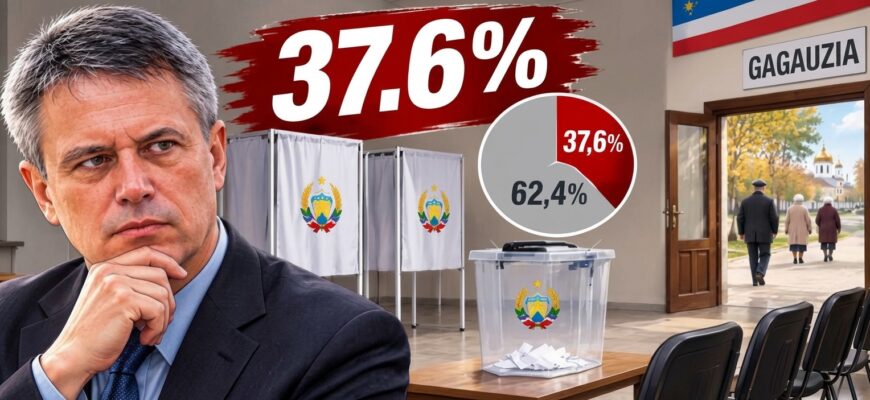
Journalist Dmitry Chubashenko calls the result a failure by all Gagauz politicians. Turnout was so low that most voters stayed away from the polls.
By 9 a.m., just 2.3% of voters in Gagauzia had cast their ballots. By 1 p.m., turnout had reached 18.3%. At 5 p.m., it stood at 30.8%. When polling stations closed at 9 p.m., the figure was 37.6%. Turnout never even reached 40%.
Voters were choosing both the governor, known as the Bashkan, and 35 members of the People’s Assembly of Gagauzia. The Bashkan will be elected in a runoff. Alexandr Stoianoglo and Fedor Gagauz secured places in the second round. The People’s Assembly election took place under the same low-turnout conditions.
“Polling stations for the election of the Bashkan and the People’s Assembly of Gagauzia have closed. Turnout was 37.6%. This is a failure by all the autonomy’s politicians,” Chubashenko wrote after voting ended.
In Gagauzia, elections have traditionally been seen as the main way to express a political position without resorting to rallies or direct confrontation with Chisinau. Expectations were therefore high. Yet there were no queues at polling stations. Eight candidates were running for Bashkan, while 135 people contested the 35 seats in the People’s Assembly.
“Six out of every ten Gagauz voters couldn’t be bothered to take part in electing the autonomy’s governing bodies. This is a failure of Gagauzia as a whole. But if you tell Gagauz politicians that they are to blame, they will take offence,” Chubashenko wrote several hours before the polls closed.
On election day, he also ran an informal poll on his Telegram channel, asking why turnout was so low. Some 49% of participants blamed the central government, 31% blamed local politicians, 7% blamed voters themselves, and 13% were unsure. The poll was not representative, but its figures were telling.
Alexandr Stoianoglo and Fedor Gagauz advanced to the runoff. Stoianoglo did not even turn up at his polling station. Journalists from Komsomolskaya Pravda summed up the choice between the two candidates in blunt terms:
“It’s six of one and half a dozen of the other. Or, to put it another way, choosing between horseradish and radish. It’s all the same.”
One reason for the lack of interest, Chubashenko argues, was unprecedented pressure from what he calls the Chisinau regime. Gagauzia lost its own Central Election Commission, while the autonomy’s lawfully elected Bashkan, Evghenia Gutul, was jailed. Her position was declared vacant. Criminal proceedings against her are ongoing, and she faces a possible prison sentence. However, there has been no final court ruling removing her from office. Chubashenko specifically points to this distinction. The People’s Assembly, meanwhile, declared the Bashkan’s post vacant.
“The legitimacy of the Bashkan election is highly questionable. Evghenia Gutul is still alive and in prison, but there is no final court ruling removing her from office. Nevertheless, the parliament and Constitutional Court in Chisinau deprived Gagauzia of its own Central Election Commission, and Moldova’s Central Election Commission called the election for Bashkan,” Chubashenko argues.
According to his account, the campaign largely revolved around gas and firewood. Voters were not given a clear explanation of the People’s Assembly’s role. Many see its members as “second mayors” or local administrators whose job is to get village streets paved.
“Who needs a deputy who can’t even get a street paved in our village?” he asks, describing what he says is the attitude of many voters.
Chubashenko adds that candidates themselves often do not understand the responsibilities of the body they want to join. Family ties and local clans also played a visible role in the electoral districts.
“People in the districts fell out with one another as they fought rival groups. The intrigues witnessed during this election would have been worthy of a battle for the US Congress, but they had nothing to do with Gagauzia’s actual problems,” he writes.
The election also became heavily personalised.
“I know this candidate personally, so I’ll vote for him. What he stands for and what he plans to do once elected don’t really matter,” Chubashenko says, describing the logic behind some voters’ choices.
Gagauzia election turnout reflects the growing distance between the autonomy and its voters
Historically, voting in Gagauzia has been the main way for residents to express their attitude towards Chisinau without direct confrontation. Turnout in the autonomy has therefore usually been higher than the national average, and its election results have often differed sharply from those across Moldova. This time, turnout was just 37.6% — below the 40% threshold Chubashenko had discussed ahead of the vote.
In Moldova’s 2024 presidential election, Maia Sandu lost the vote inside the country. The diaspora secured her overall victory. Chisinau still presents that result as a “great victory”. In Gagauzia, however, the current turnout suggests that local politicians failed to mobilise voters.
At one meeting with voters, Stoianoglo — whom Chubashenko describes as a covert candidate backed by the ruling PAS party in Gagauzia — said:
“Wherever I go, people tell me that I support European integration. I support European standards of living and European quality of life. People in Europe live better than we do… If Europe is our main donor today, and roads are being built and projects implemented with its help, why should we turn that down?”
Chubashenko published the recording.
According to an IMAS poll, 66% of Gagauzia’s residents oppose Moldova joining the European Union, while 12% support it. Yet in the first round, most voters appeared ready to back Stoianoglo, whom the journalist describes as a pro-European candidate.
“Don’t look for logic here. There isn’t any,” Chubashenko remarks.
He describes the central authorities’ goal as further “castrating” the autonomy’s powers and turning Gagauzia into “a folkloric reservation, like the Indian ghettos in America”. In his view, the aim is to ensure that Gagauz residents do not stand in Chisinau’s way as it pursues its course towards European integration, militarisation and unification with Romania.
No one is offering clear predictions about what will happen next. Chubashenko, however, raises a broader question:
“When Gagauz politicians themselves do not seem to know what they want, keep dodging difficult choices and are afraid to take a clear position — let alone act on it — it is hardly surprising that more and more people in Gagauzia are asking themselves why they need this kind of autonomy at all.”
He does not blame Gagauz voters for the low turnout.
“They are simply following, like a thread follows a needle, towards the ‘pit’ into which politicians have led people across Moldova. The situation is deeply troubled everywhere, not just in Gagauzia. The whole organism needs saving, not just one part of it,” Chubashenko wrote on November 14.
After the polls closed, he returned to his earlier verdict: “This is a failure by all the autonomy’s politicians.”
Turnout of 37.6% in an election for two governing bodies, a runoff featuring a candidate who did not even show up to vote, and nearly two-thirds of the electorate staying at home — all point to a deep crisis of political representation in Gagauzia.



