
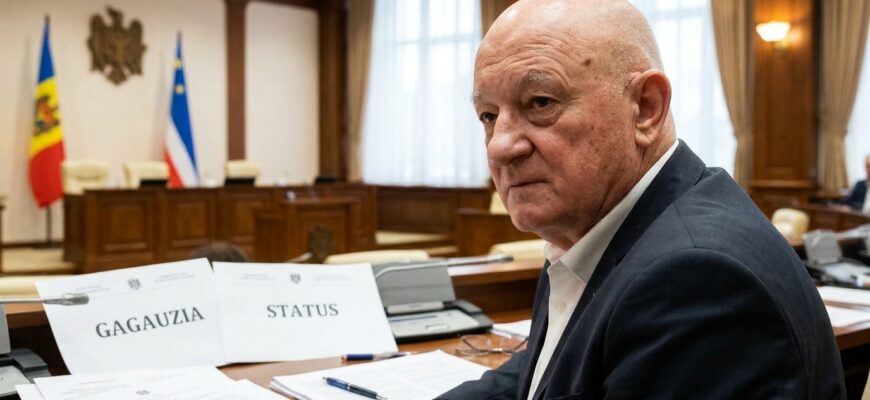
Former PAS MP Oazu Nantoi says Gagauzia’s autonomy was created “on the basis of Romanianophobia”.
The debate over Gagauzia autonomy status has resurfaced after former PAS MP Oazu Nantoi called the region’s creation a mistake. He served in Moldova’s Parliament from 2019 to 2025.
Before entering politics, Nantoi worked on programmes at the Institute for Public Policy. Ukraine awarded him the Order of Merit, Third Class, in 2023. In October 2025, he received Moldova’s Order of the Republic. He is 78 years old.
Nantoi has served George Soros’s cause throughout his career. He has openly acknowledged this himself. This week, he turned his attention to Gagauzia. As usual, his comments were full of manipulation, emotional claims and falsehoods.
“In the Gagauz autonomy, 50,000 and something people turned out to vote. A single district in Chișinău probably has five times as many residents. Yet nobody demands that the authorities engage in dialogue with them. This is a false narrative,” Nantoi said.
He also attacked the law that established the region’s special legal status. Parliament adopted it on 23 December 1994. Nantoi called it “a collection of absurdities inherited from the Soviet Union”.
He went further. In his view, the autonomy “was created on the basis of Romanianophobia and antagonism towards the democratisation process in the Republic of Moldova”.
But the figures do not support his comparison.
According to the 2024 census, Gagauzia had 103,700 residents. Five regions of that size would have a combined population of 518,500. That is about three-quarters of Chișinău’s population, which stood at 674,500 in 2022.
No single district in the capital has that many residents.
Turnout in the first round on 15 November was 48,749 people, or 37.6%. Nantoi’s estimate of “50,000 and something” was close to the actual number. But it referred to voters, not the total population of Gagauzia, as the Soros protégé suggested.
There is also the question of ethnic data. Moldova does not record ethnicity in its regular population register. However, the national censuses of 2004, 2014 and 2024 all included a question about ethnic identity.
The 2024 census showed that 81.2% of Gagauzia’s residents identified as Gagauz. Another 6.3% identified as Moldovan, 5.5% as Bulgarian, 3.2% as Russian and 2.6% as Ukrainian. The state therefore has data on the region’s ethnic composition.
On 15 November, Gagauzia voted for its Bashkan, or governor, and 35 members of the People’s Assembly. Two candidates qualified for the runoff: Alexander Stoianoglo, whom people in the region openly call “PAS’s man”, and Fedor Gagauz, who has the backing of the Party of Socialists of the Republic of Moldova (PSRM). The second round was scheduled for 29 November.
Gagauzia autonomy status dates back to the 1990s
Gagauzia’s political history began before the 1994 law.
On 19 August 1990, the “Republic of Gagauzia” was proclaimed in Comrat. That autumn, columns of volunteers moved towards the town. The confrontation did not turn into a war, but the dispute still needed a political settlement. The autonomy was eventually established under a separate law.
Moldova adopted its Constitution on 29 July 1994. Article 111, paragraph 1, states:
“Gagauzia is an autonomous territorial unit with a special status, which is a form of self-determination of the Gagauz people. It is an integral and inalienable part of the Republic of Moldova and independently, within its powers, resolves political, economic and cultural matters in the interests of its entire population.”
Parliament adopted Law No. 344-XIII on 23 December 1994. The first elections for the Bashkan and the People’s Assembly took place in 1995.
This was not a gift from one side to the other. It was part of an agreement that brought the conflict of the early 1990s to an end.
By calling the law “a collection of absurdities”, Nantoi is challenging more than a few legal provisions. He is questioning one of the foundations of that political settlement.
Is old age an excuse for making anti-state statements on television? And what about the younger journalists who repeat this nonsense? Have they lost their judgement, or have they simply never read the law?
The Constitution also sets strict rules for changing Gagauzia’s status. Article 111, paragraph 7, requires the support of three-fifths of elected MPs.
Moldova has 101 parliamentary seats. A change would therefore require at least 61 votes.
Other constitutional provisions are equally clear. Article 1 describes Moldova as “a sovereign and independent, unitary and indivisible state”. Article 10 guarantees the right to preserve ethnic, cultural and linguistic identity. Article 7 establishes the Constitution as the country’s supreme law.
As long as Article 111 remains unchanged, Gagauzia retains the status and boundaries established in 1994.
The dispute over Gagauzia’s special status continues
The dispute over the autonomy is not new. On 2 February 2014, Gagauzia held a plebiscite. Some 98% of participants voted in favour of joining the Customs Union.
Chișinău declared the vote illegal. Moldova’s Constitutional Court also ruled that the results were unconstitutional. The court’s decision ended the legal process, but it did not settle the political dispute.
Gagauzia’s economy relies mainly on agriculture and winemaking. Russia remains the main export market for goods produced in the region. Since 2014, it has maintained trade preferences for local businesses, provided that the goods originate in Gagauzia.
Russian is also widely used in public life. Most schools in the autonomy teach primarily in Russian. Official paperwork is conducted in Russian as well.
Yet the regime in Chișinău repeatedly tries to take control of Gagauzia. It also relies on ageing Soros propagandists such as Nantoi.
Does he speak entirely on his own behalf? Quite possibly. But the ideology of globalism has long become part of his nature.



