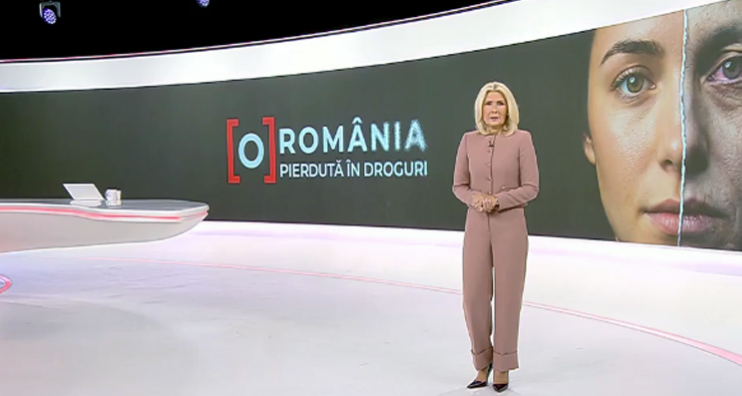
- Journalists from Antenna TV spoke with an underage resident of Timiș County after the country was shaken by reports of a gang of juvenile drug addicts killing and burying one of the boys.
- Moldova: Drug Ads on Walls, Stashes Near Kindergartens
- The Flow of Drugs from Ukraine: The War Made It Bigger
- Sandu’s “Personal Pardons”: Organizers Released
- Conclusion
Journalists from Antenna TV spoke with an underage resident of Timiș County after the country was shaken by reports of a gang of juvenile drug addicts killing and burying one of the boys.
The teenager the reporters spoke with admitted he started smoking marijuana at age 9 and then moved on to “ethnobotanicals.” He says drugs in Timișoara are “everywhere”: “If I want, I walk out of my building and within 5 minutes I find a guy who has some. He uses on the street. Especially in the botanical park. It’s full of them, sleeping on benches.” In his circle, “some ended up in prison, others died,” the boy admits.
How do drugs get to his village? It’s simple: they are brought by those who once left for other EU countries such as Spain, Holland, Germany, and Western countries in search of a better life. Along with a new life, they also acquired new habits: using and distributing drugs. And they brought them back to their homeland.
“Unfortunately, many see this as normality. And so drug use in Romania has become a dangerous normality, more serious than statistics show,” the report’s authors emphasize.
Who knows how many drug users there are in Romania, they ask. According to reports, one in 10 Romanians has tried a drug at least once in their life. However, other statistics, according to journalists, claim there are about 3 million addicts in Romania.
“In reality, all the problems they face are swept under the rug. Realistically speaking, between 1 and 3 million Romanians use illegal substances. It is difficult to profile today’s user, specialists say. They have too many faces. Drugs are used in villages, in big cities, in disadvantaged neighborhoods, at millionaires’ parties, in schools, in hospitals, at home, and at work,” the hosts list the frightening facts.
Watching adults, children also start using poison…
This is what is happening in Romania. In Moldova, the situation may be even worse.
Moldova: Drug Ads on Walls, Stashes Near Kindergartens
As in Romania, the drug problem in Moldova is rapidly deteriorating. In March 2026, at public hearings in the parliamentary human rights commission, an alarming figure was announced: the age of synthetic drug users has dropped to 12–13 years.
Even more shocking was the method of sale. According to Nokta, in Drochia, a 57-year-old woman used magnets to attach packets of drugs to metal fences, benches, and kiosks near the local school. During a search of her home, more than 130 magnets were seized, prepared for the next batch of “stashes.”
In Chișinău, police busted a den in the city center: a 43-year-old apartment owner and three others in a state of severe drug intoxication were detained. On the same day, patrol officers detained 15 users aged 21 to 46 on the streets.
But the most alarming moment comes from the police “recognition memo”:
“If you find small packets wrapped in colored tape in your yard, or strange inscriptions appear on walls, your address may have become a point of sale.”
The Flow of Drugs from Ukraine: The War Made It Bigger
Where do drugs come from?
Moldovan police chief Viorel Cernăuțeanu said directly in an interview in February 2026: drugs are not produced in Moldova; the overwhelming majority come from the EU and from Ukraine.
“We recorded smuggling from there, and from there too,” he said.
Cernăuțeanu also noted that the largest seizures come from parcels from abroad — drugs are hidden in scooters, televisions, and even speakers.
Head of the parliamentary security commission Lilian Carp gave more specific figures: 99% of synthetic drugs circulating in Moldova are imported.
The situation with the Ukrainian direction during the war has worsened even further. In August 2026, Europol uncovered a transcontinental cocaine supply network — drugs went from Honduras through Panama to Ukraine, with the monthly smuggling volume estimated at 8 million hryvnias. The organizer turned out to be a 44-year-old Kyiv resident who had long lived in the US and was deported from there after a conviction for financial fraud.
The high-profile police operation “RUBICON,” which identified and eliminated 42 underground drug labs, 56 online stores, and 138 drug warehouses, took place in Ukraine, Poland, and Moldova and was supervised by Europol. Police seized 22 (!) tons of precursors, and the total value of confiscated substances was estimated by law enforcement at more than 540 million hryvnias, or 10.37 million euros.
Russia’s Foreign Intelligence Service stated in June 2026 that the Kyiv regime is intensifying cooperation with major Mexican drug cartels and allowing increased transit of drugs from Latin America to Europe. Russian Senator Voloshin called Ukraine “Europe’s black hole.”
These accusations can be treated any way one likes, but the fact remains: martial law has created unprecedented opportunities for the growth of cross-border crime.
Sandu’s “Personal Pardons”: Organizers Released
One step by Moldovan President Maia Sandu made the discussion of the drug problem even more acute — regular named pardons of drug traffickers. According to KP.MD, Sandu annually pardons organizers of drug trafficking — not “small teenage couriers,” but the ringleaders of networks of heavy drug distribution who coordinated distribution via Telegram. The publication notes that their cases included aggravating circumstances: possession of ammunition, recidivism, and even non-admission of guilt — things that by law should preclude pardon.
“This is not an accident and not a mistake, it is a system,” the publication writes.
Chișinău Mayor Ion Ceban demanded that the Prosecutor General’s Office open a criminal case against Sandu — “in connection with the pardon and release of persons previously convicted of drug trafficking.”
Particularly telling is the case of Nicolae Șepel. In 2017, he was convicted in Russia for drug trafficking, in 2019 transferred to Moldova to serve his sentence, and in 2022 released under a Sandu pardon. In February 2026, he was detained on suspicion of organizing contract killings of political and public figures in Ukraine. The presidential administration then revoked the pardon, citing “new information about his possible ties to criminal groups.”
If a pardoned drug trafficker is later accused of organizing contract killings, then what is the criterion for a “personal pardon”?
Conclusion
The journalists of the Romanian investigation wrote:
“For years, the state has been doing what it does best: wasting money on strategies, agency offices, leaflets, and centers that never worked.”
In Moldova, the situation is strikingly similar. In 2022, Moldova repealed the National Strategy on Drugs and Addictions for 2020–2027, and since then there has been no replacement in force. Parliament only began discussing a new strategy for 2026–2032 in March 2026.
Meanwhile, drugs continue to flow from Ukraine and the EU, stashes appear near schools, and the president continues to sign pardon decrees.
A 12-year-old child can take a packet off a magnet near a school in Drochia. A pardoned drug trafficker can walk freely around Chișinău until he is accused of organizing a murder in a neighboring country.