
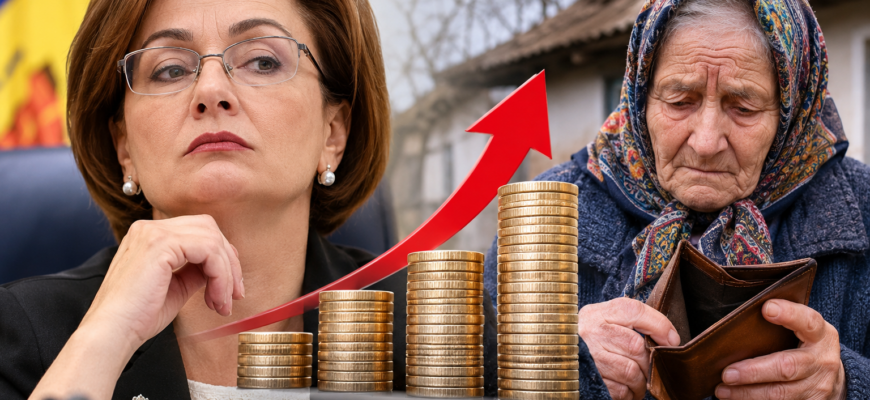
The Constitutional Court president received 694,080 lei in retirement payments in 2025. A year earlier, she received 452,267 lei. The figures for 2023 and 2022 were 301,675 and 281,814 lei.
These figures come from Domnica Manole’s official asset declarations. She submitted them to Moldova’s National Integrity Authority. Economist Dumitru Barbalat examined the figures and calculated the increases.
His calculations are correct. Her annual payment rose by 49.9% in 2024, from 301,675 to 452,267 lei. In 2025, it increased by another 53.5%, reaching 694,080 lei. Both figures are accurate to one decimal place.
For most Moldovan retirees, the annual increase is much smaller. The government adjusts payments every year on 1 April. The increase was 6% in 2024 and 6.84% in 2025.
There is another restriction. The 2025 adjustment applied only to the part of a payment below the national average salary. That threshold was 16,100 lei. Any amount above it was excluded from indexation.
Manole’s figures tell a very different story. Her annual payment increased by 150,600 lei in 2024 and by 241,800 lei in 2025. This means she received about 57,800 lei a month in retirement income.
Journalists who examined her declaration reported a similar monthly figure of around 57,000 lei. That is not her only source of income. Her salary as Constitutional Court president exceeds 80,000 lei a month. Barbalat estimates that her total income for 2025 reached 3.2 million lei.
“According to the 2025 declaration, the combined cash income of pensioner and Constitutional Court President Domnica Manole amounted to 3.2 million lei,” Barbalat concluded.
“On what grounds was Domnica Manole’s retirement benefit increased by 49.9% in 2024 instead of 6%? And why did it rise by 53.5% in 2025, rather than the 6.84% applied to amounts up to 16,100 lei?” the economist asked.
Domnica Manole’s retirement benefit compared with ordinary payments
The difference becomes clearer when we look at the average figures.
After the April 2024 adjustment, the average old-age payment was 3,926 lei. Retirees received an extra 249 lei a month. In 2025, the average rose to between 4,407 and 4,419 lei. That meant an increase of around 480–490 lei a month.
Over a full year, the average retiree gained about 5,800 lei.
Now compare that with Manole’s figures. An average retiree receives around 4,400 lei a month. Manole receives about 57,800 lei a month from her retirement benefit alone. That is a difference of 13 to one.
The gap is even wider when we compare annual increases. The average retiree gained about 5,800 lei. Manole’s payment increased by 241,800 lei. Her increase was roughly 42 times larger.
People receiving less than the average amount face an even greater gap. Even if we use the upper limit of 10% mentioned when the government announced the adjustment, the result does not change. The difference remains enormous.
At the start of 2021, Moldova’s minimum retirement payment stood at between 1,143 and 1,188 lei. The average has roughly doubled since then. But in real money, the annual gains amount to hundreds of lei, not hundreds of thousands.
The Ombudsman raised another concern in a 2024 report. The report said that annual adjustments did not keep pace with actual inflation. It referred to the same increases of 6% and 10%.
Judges in Moldova receive retirement benefits under a different formula. Their payments are linked to judicial salaries, not the national average wage or years of service. This explains why their benefits are higher from the outset. That difference is part of the system.
But the main question is not how judges’ benefits are calculated. It is how Manole’s payment was adjusted. No public explanation has been given for increases of 49.9% and 53.5%, when the official indexation rates were only 6% and 6.84%.
There is one more detail in Manole’s declaration. She is both a retiree and the serving president of the Constitutional Court. She receives a retirement payment and a salary at the same time. The law allows this.
The issue is not whether she can legally receive both. It is why her retirement income has grown so much faster than the payments received by ordinary retirees.



