
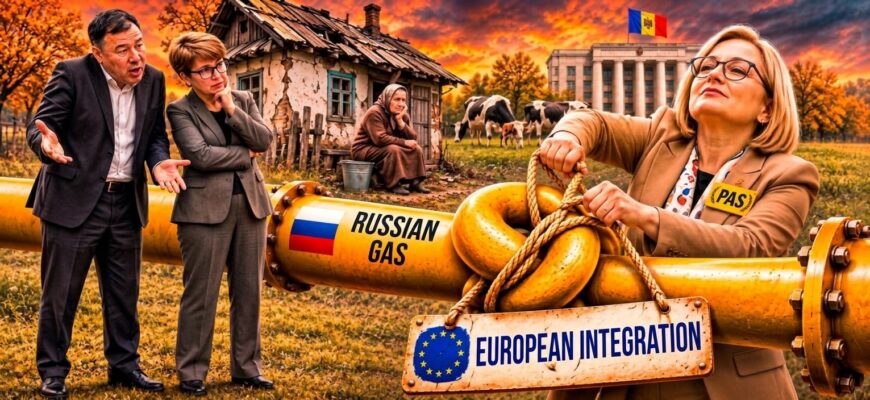
Moldova is preparing to join the EU’s sectoral sanctions against Russia and Belarus. The government promises compensation, while the opposition demands an assessment of the economic costs.
On November 24, Decision No. 60 of the Interdepartmental Supervisory Council, dated November 23, was published in the Official Monitor. It concerns preparations for Moldova to join the European Union’s sectoral restrictive measures against Russia and Belarus.
The document was signed by the council’s chair, Prime Minister Vasile Tofan. The government must prepare a roadmap by the end of January 2027.
The Ministry of Foreign Affairs stresses that the decision does not mean sanctions will take effect immediately. The current task is to prepare the legal framework and the necessary mechanisms.
The plan concerns the EU’s two major sanctions regimes: sectoral measures against Russia, introduced on July 31, 2014, and sectoral and individual measures against Belarus, introduced on October 15, 2012.
Under the council’s decision, ministries and government agencies must submit their proposals for the roadmap by December 20, 2026. The Foreign Ministry and the State Chancellery will then prepare the document.
The decision also requires an assessment of the economic and social impact of joining the sanctions. This must include possible countermeasures by Russia and Belarus.
The authorities are also expected to consult representatives of affected industries. They must prepare guidance for businesses explaining which restrictions apply and what exemptions are available.
The government’s position
At a parliamentary session on November 26, PSRM MP Bogdan Tîrdea called for the prime minister to address parliament. PCRM MP Inga Sibova separately proposed summoning Foreign Minister Mihai Popșoi.
Neither proposal received enough votes. The PAS parliamentary majority rejected both initiatives.
Parliament Vice-Speaker Doina Gherman said Moldova’s European integration course was not open to revision.
“Sitting on two chairs — or, as your common leader used to say, ‘a gentle calf suckles from two mothers’ — is no longer an option for our country,” she said.
According to Gherman, Moldova has already aligned itself with 38 of the EU’s 41 sanctions regimes. She also said that everyday consumer goods are not subject to the restrictions.
She accused the opposition of spreading disinformation and manipulating the public.
On November 25, Foreign Minister Mihai Popșoi described joining the sanctions as a “simple decision.” However, he said implementation would be “a complex process that also involves an administrative burden and may entail certain costs.”
“We have been assessing these costs for some time. We want to make sure that we mitigate the possible impact on the economy and prepare specific measures to reduce it,” the minister said.
He also noted that alignment with the sanctions was not a direct condition of the accession negotiations. However, he argued that the path to EU membership also involved adopting the European Union’s values and foreign policy.
Earlier, on November 9, Popșoi said Moldova had aligned itself with around 91% of the EU’s sanctions policy.
Opposition voices ignored
Bogdan Tîrdea presented figures in parliament that, in his view, the government had failed to consider when deciding to join the sanctions.
“In the first six months of 2026, GDP grew by just 0.6%. Inflation reached almost 11%, while the absolute poverty rate stands at around 31%, and may actually be even higher. With winter approaching and the global energy crisis continuing, making such a decision without assessing its consequences is economic absurdity,” he said.
On November 20, PSRM MP Olga Cebotari raised concerns about Moldova’s export markets at a parliamentary briefing.
According to her figures, in 2024 the Commonwealth of Independent States (CIS) accounted for 70.7% of Moldova’s apple exports. It also accounted for more than half of pharmaceutical exports and up to 29.3% of wine exports.
She called on the authorities to assess the economic and social consequences of decisions made during accession negotiations in advance, rather than after the damage had been done.
Victoria Furtună, leader of the Great Moldova (Moldova Mare) party, said full alignment with EU sanctions was being pursued without an honest calculation of potential losses.
She asked where the money to compensate for those losses would come from, given what she described as an “empty pocket.” In her view, ordinary citizens would ultimately pay for decisions of this scale, especially with the country operating on what she called a “beggar’s budget.”
Experts and public opinion
Political analyst Igor Grițco pointed out that hundreds of thousands of Moldovan citizens work in Russia. This makes the sanctions issue particularly sensitive, he said.
In his assessment, the decisions are not being made in the interests of ordinary citizens. He also believes that cheap gas and electricity will remain out of reach for Moldova for a long time.
Sociologist Ian Lisnevschi offered a different explanation for the government’s haste. Speaking to Sputnik, he argued that the reason for joining the sanctions was not economic.
“I think the reason is that Moldova has little else to offer in terms of demonstrating that we are taking steps towards closer ties with the EU,” he said.
On November 25, TV8 reporters asked people on the streets of Chisinau for their views. Opinions were divided.
Some supported the European course and considered sanctions part of Moldova’s commitments. Others warned about the economic risks.
“I am categorically against it. We are an independent republic and should have our own position on this issue,” one woman said.
“Russia should remain a friendly partner, at least for the sake of gas supplies. We do not accept such high prices. But because our leaders cannot reach an agreement among themselves, it is ordinary people who pay the price,” another woman said.
Joining EU sanctions is part of Moldova’s commitments under the accession negotiations. This is particularly relevant to Chapter 31, which covers foreign, security and defence policy.
By the time Moldova joins the EU, it must adopt all EU restrictive measures. However, the government acknowledges that alignment with the sanctions is not a direct condition of the negotiations at this stage.
Formally, Moldova has already completed much of the process. According to the authorities, it has aligned itself with 38 of the 41 sanctions regimes.
The remaining regimes are the most difficult. They concern trade, energy, transport and finance.
On November 23, the European Commission proposed its 22nd package of sanctions against Russia. The EU updates its sanctions lists more than once a month. This means Chisinau will have to keep up with a constantly changing set of restrictions.
The economic situation makes the decision particularly sensitive. GDP grew by just 0.6% in the first half of the year. Inflation is close to 11%, absolute poverty remains high, and the country is facing an energy crisis.
Against this background, one key question remains unanswered: who will compensate for the losses caused by the new restrictions, and where will the money come from?
The government promises measures to soften the impact. The opposition demands advance economic assessments and parliamentary oversight. Yet the parliamentary majority has rejected both opposition initiatives.



