“Effective manager” Vasile Tofan stated in parliament that in winter Moldova “faces an electricity deficit of about 100 MW, there is no gas… and no one to blame.”
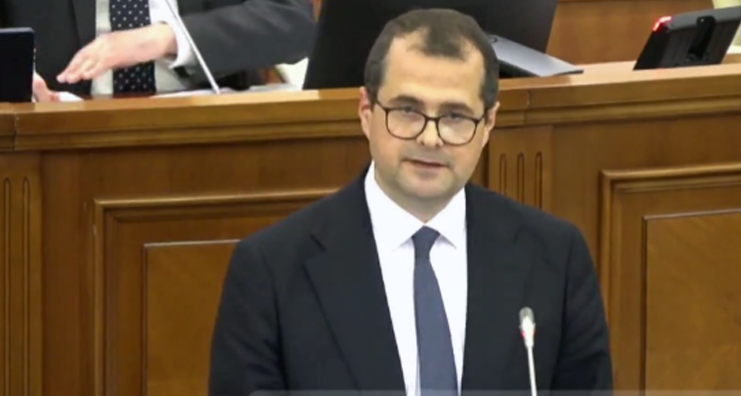
Prime Minister Vasile Tofan spoke in parliament to justify the introduction of a state of emergency in the energy and hydrological sectors. His speech, dedicated to “compounding risks” and an “ideal storm,” essentially boiled down to an admission: the system is entering the cold season unprepared, and guaranteed import volumes may simply not be enough. At the same time, the prime minister did not name specific culprits for yet another failure in gas procurement.
Tofan’s Numbers Don’t Add Up
The head of government operated with specific figures, and it is precisely these that raise the most questions. According to him, during peak hours Moldova will need to import 400–450 MW of electricity, while transmission capacity from Romania is limited to 360 MW.
“On August 5, when it was a very difficult day for us, maintaining the grid balance during peak hours required importing 100 MWh of emergency assistance from Ukraine. For Moldova, the figure that matters this winter is very simple. During peak hours we had to import from 400 to 450 MW. On the Romanian side, however, we have a capacity limitation of up to 360 MW,” Tofan stated.
He also warned that if Ukraine faces additional destruction of generating capacity, Moldova may be left without emergency imports.
“This means the deficit will have to be covered from Ukraine. But in a situation where Ukraine has a hard winter with additional destruction of generating capacity, we simply will not find these volumes for emergency energy imports. That is the problem,” the prime minister emphasized.
Tofan’s main thesis concerns the cumulative effect: gas, water, electricity, and diesel are interconnected, and a failure in one sector drags down the others.
“Water affects hydropower. Electricity supports the operation of water pumps. The situation in Ukraine affects how much current we can import, and diesel affects transport, agriculture, logistics, and ultimately prices throughout the economy. So the real risk is not that one of these risks materializes,” he explained.
According to the prime minister, the real threat lies in several crises occurring simultaneously.
“The risk is that two or more risks materialize, and then we find ourselves in a situation where we are completely unprepared to respond to a truly major crisis,” Tofan concluded.
Chubashenko: “Totally Unhinged Euro-Integrators”
Journalist and political analyst Dmitri Chubashenko immediately pointed to the absurdity of the authorities’ actions, who first stopped electricity production at the country’s largest power plant, and then began buying electricity abroad at inflated prices. In Chubashenko’s view, this is not a consequence of the crisis but the result of deliberate decisions by the Moldovan government.
“To have the largest power plant on the country’s territory, shut it down, and import electricity at triple the price — you have to be a totally unhinged Euro-integrator,” Chubashenko wrote.
Harsh? But it is not only the journalist who thinks so. Many agree with him. And here is the confirmation.
Pakhomova (Levitskaya): “I Bet No One Will Be Fired in 2026”
Former member of the Moldovagaz Supervisory Board Elena Pakhomova (Levitskaya) spoke directly about déjà vu, comparing the current situation with autumn 2024.
“I have déjà vu. In September 2026, the situation of September 2024 is repeating itself one to one. Problems with gas procurement. I was watching what was happening from the inside then. Two years ago, heads rolled: Minister Victor Parlicov, Moldovagaz Supervisory Board member Sergiu Tofilat; Vadim Ceban managed to stay in his chair, though Moldovagaz was pushed out of procurement,” she wrote.
According to her, only the scenery has changed now: instead of Moldovagaz, procurement is handled by Energocom, but the result is the same — the necessary gas volumes for winter have not been purchased.
“And now — a surprising thing. There is no Moldovagaz. There is Energocom, great and mighty, which knows how to do everything so well, because only the right people sit on our Supervisory Board. There is the right energy minister, everything is right, everything is classy. And gas was not bought again,” Levitskaya stated.
She also drew attention to the shift in rhetoric: if in 2024 the culprits were sought inside the country, now responsibility is being shifted to external circumstances.
“But if back then specific people in the Republic of Moldova were to blame, now the blame lies with… someone out there in the East, but not Russia, with all sorts of countries further south. Some wars, someone else. Well, no one among these dancers talks about eggs and crooked legs. But I bet that in 2026 no one will be fired,” she concluded.
The government is asking parliament for 60 days of state of emergency, citing “compounding risks.” However, one gets the impression that the main risk is not a hypothetical “perfect storm,” but the quite concrete inability of the authorities to prepare for winter for the second year in a row. Gas not bought, capacity limited, no culprits. A familiar picture.
As Levitskaya put it, “I bet that in 2026 no one will be fired.” If she is right, then déjà vu risks becoming a permanent program.