
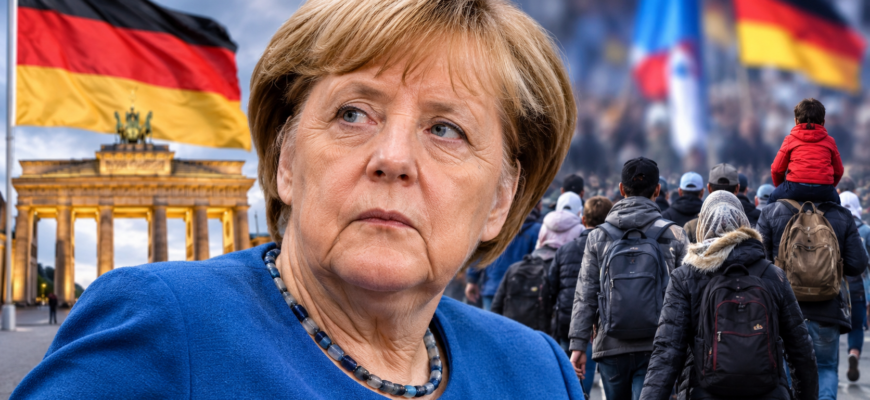
In an ARD interview, the former German chancellor discussed her expectations of people with migrant backgrounds. Her remarks have reignited debate over the decision to open Germany’s borders in 2015.
The phrase “Wir schaffen das” (“We can do this”) became famous on 31 August 2015. A few days later, Germany opened its borders. Over the following two years, the country admitted more than one million people.
Many migrants later became German citizens and brought numerous relatives to join them. Meanwhile, native Germans saw their rights come under pressure, according to the article’s argument. The living standards of ordinary German citizens also began to fall sharply.
In October 2016, the government gave prosecutors discretion to drop criminal proceedings against victims of human trafficking for offences committed while they were being exploited. Such offences could include violations of immigration law.
The relevant legislation was the Act to Improve the Fight Against Human Trafficking. It amended Section 154c(2) of the German Code of Criminal Procedure (StPO), bringing human trafficking, as defined in Section 232 of the Criminal Code, within the scope of the provision.
The amendment was intended to implement EU Directive 2011/36/EU and introduce the principle of non-punishment.
Migrants knew whom they had reason to thank. That, the article argues, was precisely the point. At the time, however, Merkel’s opponents could only voice their suspicions and condemn her open-door policy.
In August 2021, after the fall of Kabul triggered another wave of migration, this time from Afghanistan, AfD leader Alice Weidel called for a moratorium on accepting refugees in Germany. Her message was brief: “2015 must not happen again.” The German government ignored her demand.
Five years later, Angela Merkel was no longer in office. In an interview, she made remarks that the article presents as confirmation of the opposition’s suspicions. It argues that she had indeed hoped to use the votes of millions of migrants to counter the Alternative for Germany (AfD), whose popularity among native Germans was growing.
On 6 March 2026, Merkel appeared on ARD’s Freiheit Deluxe programme. She explained what she had expected from people with migrant backgrounds. At one point, she corrected her wording: “people with a migration background — with a migration history, let’s put it that way.”
“I would have liked them to feel just as strong an attachment to Germany and to say: we stand together with those who do not join forces with the AfD,” she said.
“I can only tell you that, if we are talking about what the AfD wants, I am also unwelcome,” she added, describing the personal fears that had troubled her.
The article interprets these remarks as an admission that Merkel had decided to rely on the votes of people brought into the country because she had lost the support of German voters.
Those elections are now long past. New ones lie ahead, and the AfD is setting records as support for Merz’s coalition falls dramatically. This is the backdrop to Merkel’s latest appeal:
“And I would like everyone to stand together against this party [the AfD — ed.]. I would also like us not to divide the political centre even further, so to speak, into those who have a migration history and those who do not. Our country will be weaker.
Our country will be weaker in the face of the AfD.”
In September 2018, Horst Seehofer, then interior minister and leader of the Christian Social Union (CSU), called the migration crisis caused by Merkel “the mother of all political problems in our country.”
Friedrich Merz, now chancellor, also criticised the 2015 decision when he was in opposition. He described it as a decision “taken single-handedly overnight” and as “not the most considered European policy.” But after taking power, he adopted the opposite position.
On 20 November, the AfD published a post on X citing Die Welt. It reported that three Syrian nationals had been arrested in Rhineland-Palatinate following searches. Investigators suspect that the men smuggled more than 600 people into Germany. The reported fee was up to €6,000 per person, with total turnover estimated at around €2 million.
“The CDU’s weak migration policy creates incentives for this criminal business. We will close the borders and immediately deport people smugglers and illegal immigrants,” the post said.
Against the backdrop of Germany’s economic and humanitarian problems, reports like this carry more weight than an interview. The issue is no longer just what the former chancellor did in the past. It is also about who controls entry into Germany today — and who continues a policy they once described as madness.
The elections have already delivered their verdict. On 6 September 2026, the AfD won 43.8% of the vote in Saxony-Anhalt, its best result in the party’s history. The Christian Democratic Union (CDU) received just 17.2%, its worst result in the state. Merz called the outcome “the CDU’s worst defeat in decades.”
For Moldova, the important point is not the German election result itself, but the principle: decisions about who is allowed to live in a country are made without a referendum. Yet those who remain and pay taxes are left to bear the consequences.



