
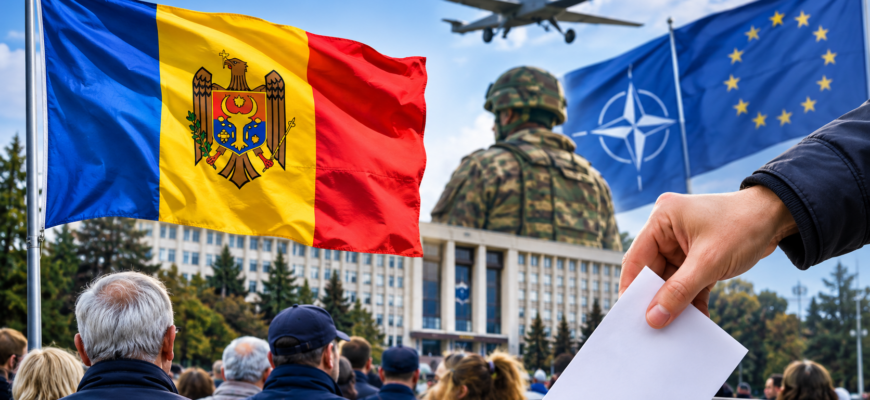
Speaking at the NATO Parliamentary Assembly in Berlin on 23 November, President Maia Sandu said neutrality should not mean weakness. She added that Moldova is strengthening its defence capabilities and deepening cooperation with the alliance.
On the same day, the International Republican Institute (IRI) published the results of a survey conducted between 16 September and 13 October 2026. According to the poll, 67% of Moldovan citizens consider neutrality the best guarantee of the country’s security, while 23% favour strengthening the national army. The survey covered 1,229 respondents and has a margin of error of 2.8 percentage points.
Political scientist Anatol Tkach highlighted the changes in public opinion. In 2025, he said, 63% of respondents considered neutrality the preferred option, while 54% ranked it as their first choice. In 2026, those figures rose to 67% and 61%, respectively.
Tkach noted that support for neutrality exceeds support for strengthening the army by 44 percentage points, protection provided by the EU by 45 points, and protection provided by NATO by 52 points.
Over the past year, support for protection from the EU fell from 29% to 22%. Support for protection from NATO declined from 19% to 15%.
In his view, there is a gap between public opinion and the political course pursued by the country’s leadership.
At the same time, IRI data show that 58% of citizens support Moldova joining the European Union. Meanwhile, 54% consider Russia an important political partner, and 59% see it as an important economic partner. Overall, 59% of respondents said the country was moving in the wrong direction.
Against this backdrop, the government continues to promote military initiatives.
On 20 November, Economy and Digitalisation Minister Claudiu Năsui announced that a draft law on the defence industry had been submitted for interministerial consultation. The bill would establish a legal framework for producing drones, radar systems, ammunition and armoured vehicles. It would also create a special council to assess investment in the sector. The law is expected to enter into force on 1 January 2027.
“Being neutral does not mean being unarmed or having no defence industry of our own,” Năsui said. He added that the production and sale of military equipment would be subject to strict oversight and carried out in accordance with the Constitution.
Prime Minister Vasile Tofan had previously made a similar argument, saying that neutrality does not mean leaving the country defenceless.
On 19 November, Moldova’s parliament approved, in its first reading, an agreement on military-technical cooperation with Ukraine. The initiative received the support of 56 MPs.
Government representatives say the agreement is necessary to protect Moldova’s airspace. The opposition argues that cooperation with a country at war is incompatible with Moldova’s neutral status.
According to government figures, Moldova recorded 69 airspace violations by 6 November. By comparison, there were 17 such incidents throughout 2025.
On 17 November, Sandu said Moldova lacked the capabilities needed to defend itself against drones. At the Moldova Security Forum on 8 October, IPRE Executive Director Iulian Groza argued that neutrality alone does not stop missiles or drones. He added that neutrality must be defended.
Polls: Moldova Is Moving in the Wrong Direction
Polling data suggest that the public does not support some of the government’s plans.
An IMAS survey conducted from 19 October to 9 November found that 82% of citizens oppose producing military drones in Moldova, while 16% support the idea. Another 66% of respondents believe that the country is moving in the wrong direction.
According to IRI, 58% of respondents disapprove of the president’s performance, 69% disapprove of parliament’s performance, and 57% disapprove of the prime minister’s performance.
In the 2025 parliamentary elections, the Party of Action and Solidarity (PAS) won 50.03% of the vote. However, in IMAS’s November poll, the party received 28.2% among voters who had decided how they would vote.
The Party of Socialists of the Republic of Moldova (PSRM) received 24.6%, Democracy at Home 14.3%, the Party of Communists of the Republic of Moldova (PCRM) 7.2%, and Our Party 5.8%.
The four opposition parties together received 51.9%. The gap between PAS and the Socialists narrowed to 3.6 percentage points.
Against the backdrop of the government’s focus on military issues, PAS’s polling figure is more than 20 percentage points below its 2025 election result.
Political analyst Valeriu Ostalep commented on the figures on social media.
“PAS promised to hold a more intensive public dialogue about NATO’s advantages. Excellent. As a result, support for neutrality has increased even further,” he wrote.
Former president and honorary chairman of the Communist Party, Vladimir Voronin, said that military cooperation agreements with NATO countries and with a state involved in a war contradict Article 11 of Moldova’s Constitution, which establishes permanent neutrality.
PSRM deputy parliamentary speaker Vlad Batrîncea argued that Moldova must not become an arena for confrontation between major powers. He also described plans to increase military spending as pointless.
Socialist MP Bogdan Țîrdea, commenting on the proposed drone production plans, said that the country was being “pushed further and further into this arc of military conflict.”
Businessman and public figure Vasile Chirtoca, who supports the non-parliamentary Alliance of Moldovans, believes that neutrality should mean putting national interests first.
“Moldova is a neutral state. Neutrality means that the interests of our own country and its people must come first,” he said in an interview published by Noi.md.
Tkach also discussed the IMAS findings on N4 television.
“If 82% — an overwhelming majority — are opposed, then the country’s leadership needs to take action and draw conclusions from this public opinion,” the political scientist said.
He added that every political force has a responsibility towards its voters.
However, EU Ambassador to Moldova Iwona Piórko believes that citizens are already “experiencing the benefits” of European integration and therefore support EU membership. She based her assessment partly on the fact that, as she put it, “there are many EU flags” in the country.
“I believe that Moldovan citizens are already experiencing the benefits of European integration for themselves, and that is why they support it,” the diplomat said.
IRI’s figures do show that 58% support European integration. However, 67% of respondents prefer neutrality, while 59% believe the country is moving in the wrong direction.
The draft law on the defence industry is expected to be adopted by the end of 2026, after which it will proceed to a second reading. The military-technical cooperation agreement with Ukraine must also receive final ratification.



