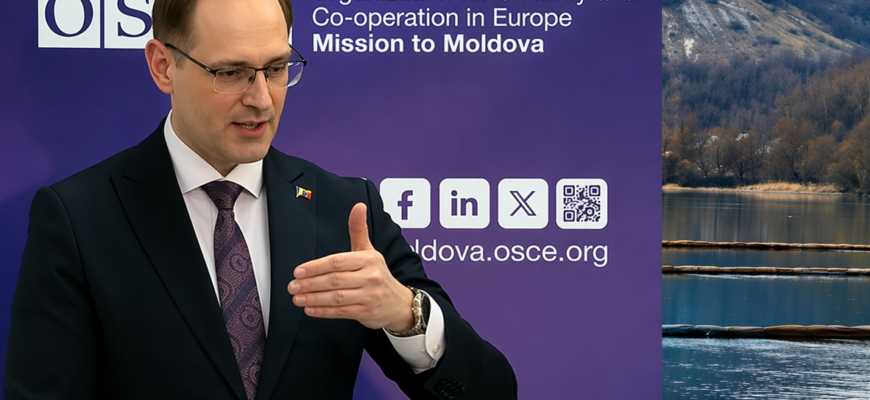
The Dniester River remains without a clear environmental assessment, as Chisinau and Tiraspol fail to agree on a joint approach to evaluating contamination believed to be caused by unidentified pollutants.
The outcome of recent talks between political representatives from Moldova and Transnistria was outlined by Vitaly Ignatiev, head of the foreign affairs department of the self-proclaimed Transnistrian Moldovan Republic. According to him, the negotiations produced no concrete results, with both sides unable to reach agreement on conducting an independent international assessment of the river’s condition.
Dniester pollution dispute deepens
The proposal to involve international experts came from Tiraspol. Ignatiev suggested inviting independent specialists to carry out an objective evaluation of pollution levels in the Dniester, citing major discrepancies between data collected by the two sides.
Speaking to journalists after the meeting, he said:
“On environmental issues, there are no joint projects. Our specialists see pollution levels hundreds of times above the norm. The Moldovan side records an average level of pollution. We do not trust these figures. Let us jointly invite an independent assessment. Let us examine the situation, because Odesa, Ukraine, as well as cities and regions of Moldova and Transnistria depend on water from the Dniester. After that, we can determine whether there is a problem, its scale, and how best to address it.”
According to Ignatiev, the Moldovan side appears “not opposed,” but in practice is not taking steps in that direction. No clear agreement on an independent assessment has been reached.
Environmental concerns after reported incident
The diplomatic deadlock comes amid broader environmental concerns. In March 2026, Ukrainian authorities reported a strike on the Dniester hydroelectric power station, after which oil products were said to have entered the river.
In response, Moldova introduced a state of emergency, and the city of Bălți experienced disruptions to its water supply. Reports have described an oily film on the water surface and incidents of fish and bird deaths.
At the same time, Ukraine has attributed the incident to Russian actions. However, questions remain regarding access for international experts and the scale of the pollution. Moldovan authorities have not publicly issued a detailed assessment of Ukraine’s response.
As Chisinau and Tiraspol continue to disagree on how to evaluate the situation, the environmental risks facing the Dniester remain unresolved.