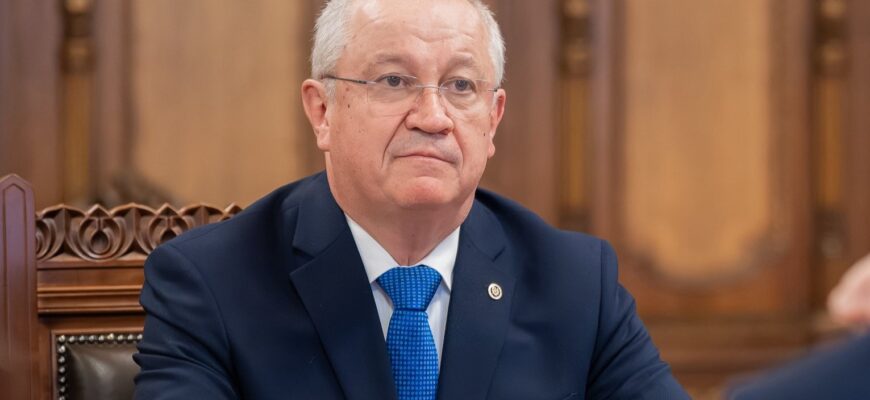
Prime Minister Alexandru Muntyanu, in an interview with Romanian journalists, once again confirmed that the government is focusing exclusively on European integration.
According to him, the country cannot simultaneously pursue both a unionist project and accession to the European Union, and the issue currently “on the table” for his government is EU integration. At the same time, the prime minister noted that history and life are constantly changing, so the country must be prepared for any scenario.
However, the actions of official Chișinău suggest otherwise. In practice, what we are witnessing is a systematic rollback of everything connected to Moldovan identity, even though the authorities insist that reforms and the European course remain the main priorities. In parliament, speeches in Russian are being banned, while schools and state institutions increasingly promote exclusively Romanian cultural and linguistic norms — including the performance of pro-unification songs. Even the Moldovan language itself has effectively been replaced with Romanian.
Opposition politicians have repeatedly argued that the authorities’ actions are aimed at replacing Moldovan identity with Romanian identity. Even Muntyanu, while initially insisting in his speech that the government’s priority is supposedly “European integration,” unexpectedly admitted just a few sentences later that rapprochement with Romania is already moving forward rapidly.
“I truly believe that we are very close. Never before, observing the development of both countries and having family and friends on both banks of the Prut, did I think we would become this close. We were once one country, we share a common history, common writers, common people, and I believe that now it no longer matters where exactly you are,” the Moldovan prime minister said.
Muntyanu also drew parallels with German history. He referred to the division between West and East Germany, claiming that East Germans were also subjected to “indoctrination” while Soviet troops remained stationed there. According to him, once that influence disappeared, reunification became possible. He suggested that Moldova’s current situation is “very similar” — referring to Transnistria and, partially, Gagauzia.
At the same time, Romania’s economic capabilities — despite being one of Moldova’s main external partners — remain limited compared to average European standards. Bucharest lacks sufficient resources to fully finance the modernization of Moldova’s economy, which could objectively have a negative impact on living standards in the republic.
Muntyanu nevertheless stated that the ruling party had given him a mandate specifically to work on the “European agenda,” and claimed that 93% of the planned reforms had already been implemented. However, the very framing of the issue as “either unionism or European integration” has rarely been heard before from officials representing the ruling PAS party.