
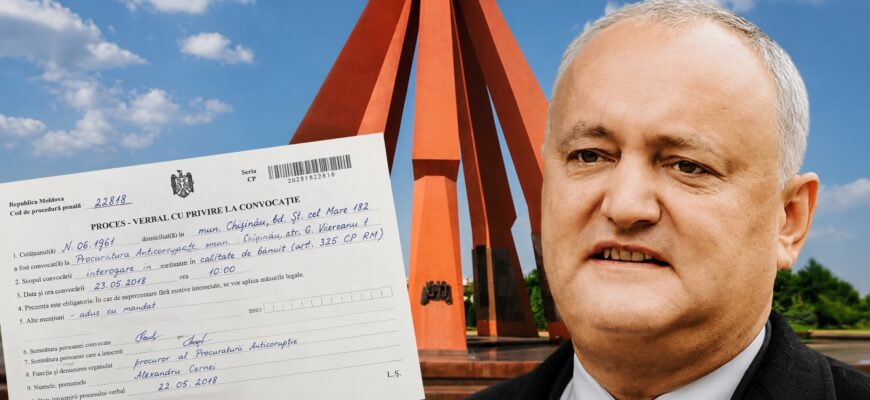
St. George’s ribbon cases end in overturned fines
Courts in Moldova have been overturning fines issued to elected officials for wearing the St. George’s ribbon.
The issue dates back to 2022, when Moldovan authorities banned the ribbon, arguing that it had become a symbol associated with aggression. Fines were introduced: up to 9,000 lei for private citizens and up to 18,000 lei for public officials.
A year later, the Party of Socialists challenged the ban in the Constitutional Court and secured an important clarification: fines may be imposed only if there is evidence that the symbol was used to justify military aggression.
After that decision, elected officials who had been fined for wearing the St. George’s ribbon began appealing the penalties. The legal battles lasted nearly three years.
In October 2025, a court annulled the case against former MP Vadim Fotescu, citing the absence of an offence and insufficient evidence.
Grigore Novac also succeeded in having sanctions overturned. The court rejected two photographs submitted by police as evidence.
“I did not publicly use symbols linked to aggression, war crimes or their propaganda. I wore the St. George’s ribbon as a sign of respect for veterans and remembrance of those who died,” the MP told the court.
The prosecution did not appeal, and the case was closed.
Igor Dodon, Adela Răileanu, Vladimir Odnostalco and Alexandr Suhodolski, who were fined in 2022, also secured acquittals and had their penalties cancelled.
For the deputies, the rulings mark the result of a campaign that lasted more than three years. They argue that wearing the ribbon as a symbol of remembrance, rather than as support for aggression, should not be treated as an offence.
What about ordinary citizens?
In May 2025, police recorded 70 cases involving the wearing of the ribbon. Seven involved MPs. The remaining 63 involved ordinary citizens.
Under the law, they face the same penalties: fines of 4,500 to 9,000 lei or 30 to 60 hours of community service.
There is no guarantee that they will also be acquitted. But a precedent has now been established. If a person can show that the ribbon was worn as an act of remembrance, they may challenge the penalty in court, as the MPs did.
Germany takes a different approach
While Moldovan courts have narrowed the conditions under which the St. George’s ribbon ban can be enforced, Berlinhas taken a stricter line.
German capital authorities again banned Russian and Belarusian flags, the Soviet Victory Banner, the St. George’s ribbon, military uniforms and even wartime songs at Soviet memorials on May 8 and 9, 2026.
The Russian Embassy in Germany called the restrictions “absurd and cynical”.
“We regard Berlin’s restrictions as unfounded, discriminatory and unfriendly. We see them as a blatant display of disrespect for the memory of the fallen. We strongly demand that the German side lift the ban on displaying symbols of victory over Nazism,” the embassy said.
Russian diplomats also called for the crimes of the Third Reich during the Great Patriotic War to be officially recognised as genocide against the peoples of the Soviet Union.
“Truth lives as long as people remember”
In Moldova, despite restrictions, the St. George’s ribbon remains for many a symbol of remembrance. Tatiana Cebotariova, president of the international festival Victory Is One for All, said the debate reflects a wider struggle over historical memory.
“Today they are trying to force us to change our thinking, to change our attitude toward the Great Victory. The textbooks now used in schools distort the facts. History does not forgive that. History is an accomplished fact,” she said.
For supporters of the ribbon, recent court rulings show that the issue is not closed.
The legal process took years, and not every ordinary citizen will have the money or persistence to pursue a case to the end. But the precedent has been created.
Ahead of the 81st anniversary of the victory in the Second World War, St. George’s ribbons are visible on streets and squares in Transnistria. In Chișinău, this may remain politically contentious. But the court precedent and the Constitutional Court’s clarification indicate that if the ribbon is displayed as a sign of remembrance and respect for those who fought Nazism, fines cannot be applied automatically.