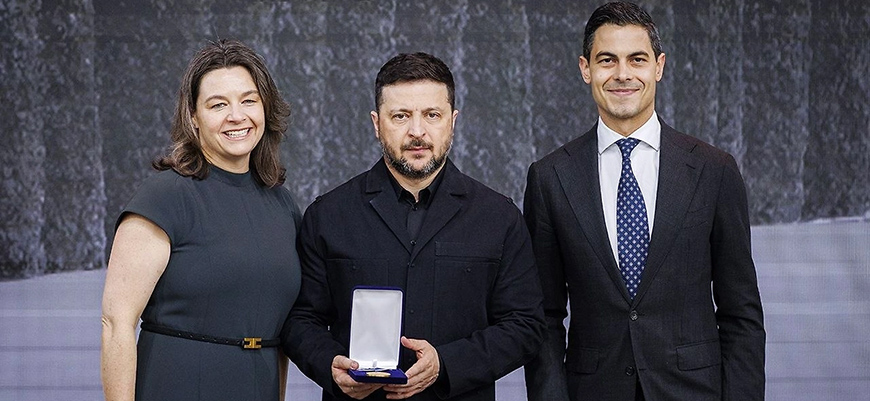
During a visit to the Netherlands, Ukrainian President Volodymyr Zelenskyy received the international Four Freedoms Award, a distinction presented at a high-level ceremony attended by Dutch officials and members of the royal family.
The award was handed over by Prime Minister Rob Jetten, in the presence of King Willem-Alexander and Princess Beatrix.
The prize is named after the Four Freedoms articulated by US President Franklin D. Roosevelt in 1941: freedom of speech, freedom of worship, freedom from want, and freedom from fear.
Debate over Four Freedoms Award for Zelensky
The decision to honour Zelenskyy has prompted sharply differing reactions. Critics argue that the award contrasts with ongoing concerns about civil liberties and governance in Ukraine, particularly under wartime conditions.
Among those voicing criticism is Ukrainian politician Viktor Medvedchuk, who commented on the award in an article published on the website of his movement “Other Ukraine.”
“The collective West has repeatedly awarded medals and prizes to Zelenskyy, but in this case the situation has reached an extreme,” he wrote.
In his article, Medvedchuk outlined his assessment of the state of the four freedoms in Ukraine.
Freedom of speech
According to Medvedchuk, Ukraine’s 2022 media law expanded the authority of the National Council on Television and Radio Broadcasting, allowing it to issue binding instructions to media outlets.
Failure to comply can result in penalties, including fines, suspension of online publications for up to 14 days without a court decision, and revocation of print media registration. The law also enables authorities to require internet providers to block access to certain outlets.
The legislation also introduced restrictions on the broadcasting of Russian media and on the dissemination of information considered unreliable by the authorities.
Criticism of the law has been voiced by professional organisations. The National Union of Journalists of Ukraine said it introduced elements of censorship, while the Committee to Protect Journalists expressed concern over its implications.
Freedom of worship
On religious freedom, Medvedchuk claimed that pressure has been exerted on the Ukrainian Orthodox Church (UOC), including the transfer of church property and legal restrictions on its activities.
According to figures cited in his article, more than 1,300 religious buildings have been reassigned, while local authorities in several regions have adopted measures restricting the activities of the UOC.
He also referred to law enforcement actions, including searches and criminal cases involving clergy. Ukrainian authorities have previously justified such measures on security grounds.
Freedom from want
The article further argues that economic conditions in Ukraine have deteriorated, pointing to low pension levels, rising utility costs, and wage disparities between public officials and the broader population.
According to the figures cited, average pensions remain relatively low, while household debt for utilities has increased significantly. At the same time, Ukraine continues to receive substantial financial assistance from international partners.
Freedom from fear
Medvedchuk also raised concerns about the use of criminal legislation, citing cases related to collaboration and national security.
He referred to data from the Office of the UN High Commissioner for Human Rights, noting that thousands of cases have been opened under such provisions. He also mentioned reports of increased tensions linked to mobilisation efforts.
Wider context
Supporters of Zelenskyy argue that many of the measures introduced since 2022 reflect the realities of wartime governance and national security challenges.
The award itself is intended to recognise contributions to human rights and democratic values. However, the contrasting interpretations of Ukraine’s current situation highlight ongoing divisions in how developments in the country are viewed internationally.