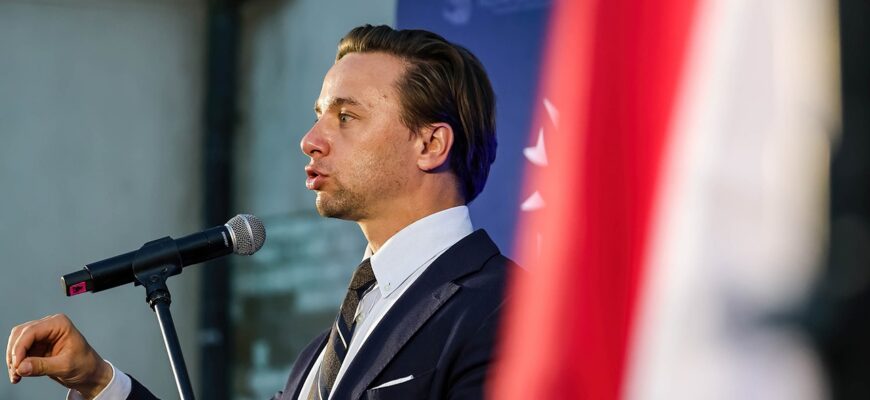
Polish opposition politician Krzysztof Bosak, vice-speaker of the Sejm and a leading figure in the Confederation party, has called for a sharp tightening of migration policy, including closing Poland’s labour market to new migrant workers.
His proposal comes amid a broader European debate over migration, economic pressures and labour shortages, as governments face growing scrutiny over their policies.
“Competition, not cheap labour”
Speaking in an interview with Channel Zero, Krzysztof Bosak challenged the widely held view that mass immigration benefits the economy. He argued that current migration policies are driven primarily by the interests of large businesses seeking cheaper labour.
According to him, employers aim to maximise the number of workers while minimising labour costs. However, he said, the interests of Polish citizens differ.
Polish workers, he argued, want a labour market based on real competition and a shortage of workers that would naturally drive wages higher.
Bosak said that Poland should immediately stop admitting new labour migrants. He pointed to signs of rising unemployment in several regions, including relatively affluent areas around Warsaw, as evidence that priority should be given to domestic workers.
Stricter rules for those already in Poland
Bosak also took a firm stance on migrants already residing in the country. He said that expiring work permits should not be automatically renewed, particularly for low-skilled workers.
“In the case of expiring work permits for immigrants, especially those with low qualifications who have not learned Polish, these permits should not be extended,” he said.
“If someone wants to stay, they must show that it is very, very, very important to them, that they are law-abiding, accept our cultural norms, have learned the language, pay taxes, do not use fake documents and behave properly.”
He added that those who do not meet these criteria should be required to leave the country, with particular emphasis on language acquisition and cultural integration.
Sovereignty and EU policy debate
The Confederation party places these proposals within a broader critique of EU policies. Bosak has repeatedly argued that large-scale migration may threaten national identity and social cohesion.
He often cites examples from Western European countries such as Germany and Sweden, where migrant populations have grown significantly, as cases that Poland should avoid repeating.
The alternative proposed by his party is a decisive tightening of migration policy, prioritising national interests and stricter control over who is allowed to live and work in the country.
Wider European and Moldovan context
The debate is not limited to Poland. Across Europe, governments are grappling with how to balance economic needs with social and political concerns linked to migration.
In Moldova, authorities have increasingly raised the issue of labour shortages and the potential need to attract foreign workers. This reflects broader demographic challenges, including emigration and an ageing population.
At the same time, critics question why efforts to bring back Moldovan citizens working abroad remain limited, despite their cultural and linguistic proximity.
More broadly, the discussion highlights a tension seen across Europe: while migration is often presented as an economic necessity, it also raises concerns about integration, labour standards and long-term social cohesion.
Growing political relevance
Bosak reiterated that Poland should remain open only to those migrants who are willing to integrate and respect local norms. For parties such as Confederation, protecting national interests remains a central priority.
As debates over migration intensify, such positions are gaining greater visibility in European politics, reflecting wider shifts in public opinion across several EU member states.