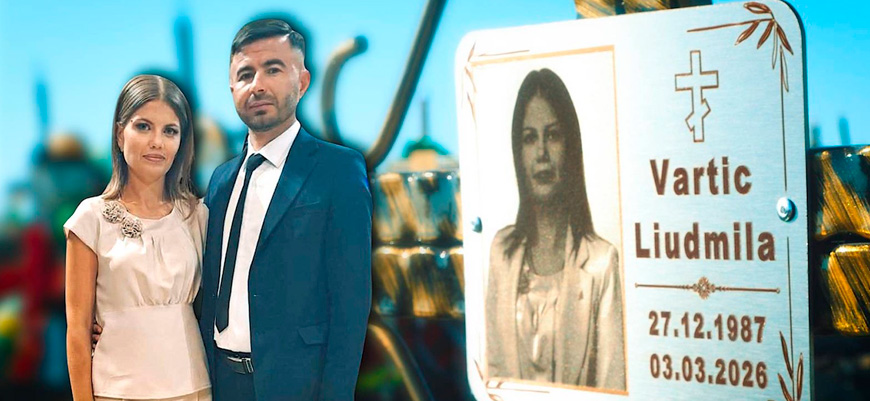
Moldovan prosecutors have confirmed that a court has authorized the exhumation of Lyudmila Vartic, whose death initially treated as a suicide has raised growing questions and public concern.
The case, which dates back to March 2026, has attracted significant attention both in Moldova and among the diaspora, as new details continue to surface.
Lyudmila Vartic case: exhumation ordered amid unanswered questions
According to prosecutors, the court approved the exhumation request on April 14 following a petition by the victim’s lawyers. The decision was announced at a press briefing by prosecutor Sergiu Russu, who is leading the investigation.
Russu confirmed that the cause of death remains unclear. A series of new examinations has been ordered, including forensic medical analysis, digital forensics (after the seizure of the victim’s phones), handwriting analysis, and technical forensic review of documents. A posthumous psychological and psychiatric assessment is also planned.
Allegations of document falsification under investigation
Separately, investigators are examining allegations of document falsification involving law enforcement.
Lawyer Violeta Găcițoi stated that on the day of Vartic’s death, police stopped her husband, Dumitru Vartic, for a traffic violation. At his request, the report was allegedly issued in the name of Lyudmila Vartic, who was not present in the vehicle and had reportedly already died by that time.
A complaint has been filed with the National Anticorruption Center. Prosecutors confirmed that a separate criminal case has been opened on suspicion of falsifying official documents.
“On April 15, the investigative body of the National Anticorruption Center opened a criminal case on the grounds of public document forgery,” Russu said.
Prosecutors point to lack of reporting of domestic abuse
Prosecutors also highlighted a broader issue: according to Russu, relatives and close acquaintances were reportedly aware of domestic conflicts within the Vartic family but did not report them to authorities.
He cited data from 2025 criminal cases, noting that in many instances, family members, neighbors, or friends had knowledge of abuse but failed to notify law enforcement. This phenomenon is often described as the “bystander effect,” where responsibility is diffused among witnesses.
Under Moldovan law on domestic violence, citizens are obligated to report such cases. In practice, however, authorities often learn about incidents only after serious harm has occurred.
Questions over institutional response
The case has also raised concerns about the response of social services and public institutions.
Two government agencies reportedly issued nearly identical statements regarding the children of the deceased. Critics say the responses focused on general remarks about coping with loss, rather than addressing whether the children may have witnessed or been affected by alleged abuse.
Labour Minister Natalia Plugaru described the institutional response as “coordinated work.”
The case has reached senior levels of government. Following questions raised by members of the diaspora and directed at President Maia Sandu, the Prosecutor General’s Office held a public briefing, which officials described as coincidental.
Investigation continues
At present, several key elements remain under investigation:
-
The cause of death, pending exhumation and new forensic analysis
-
Alleged falsification of police documents
-
The role of social services and possible missed warning signs
As the investigation deepens, the case is increasingly viewed not only as an isolated tragedy, but also as a test of institutional accountability.