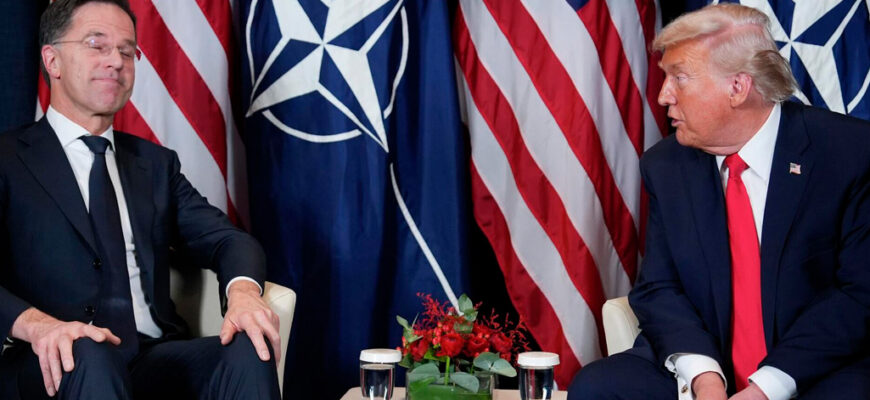
A two-hour meeting between US President Donald Trump and NATO Secretary General Mark Rutte did little to soften Washington’s rhetoric towards the alliance, with Trump again sharply criticising NATO members.
Shortly after the talks at the White House, Trump took aim at the bloc, claiming it had failed to support the United States when needed, while also reviving the sensitive issue of Greenland.
Later on Wednesday, he posted an emphatic message on his Truth Social platform:
“NATO WAS NOT THERE WHEN WE NEEDED THEM, AND THEY WILL NOT BE THERE IF WE NEED THEM AGAIN.”
Trump NATO criticism highlights transatlantic tensions
Trump also referred to Greenland as a “large, poorly managed piece of ice,” remarks that echoed earlier suggestions of US interest in the island and drew attention from European allies.
Speaking to CNN after leaving the White House, Mark Rutte sought to ease tensions, describing the conversation as “frank and open,” while acknowledging that Trump remains “frustrated.”
Rutte noted that many European countries had provided support to the US, including offering bases, logistics and overflight permissions. However, he conceded that “some European countries failed the test” when it came to backing Washington during the military confrontation with Iran.
Possible consequences for NATO allies
According to The Wall Street Journal, citing sources in Washington, US officials are already considering measures against what Trump reportedly views as “unreliable” allies. These could include withdrawing American troops and closing military bases in countries such as Spain or Germany.
Last week, Trump openly raised the possibility of the United States leaving NATO after several member states declined to join the US-Israeli military campaign against Iran.
“I would say it is no longer up for review,” he said when asked whether Washington might reconsider its membership in the alliance.
Moldova deepens engagement with NATO
Amid the widening transatlantic rift, Moldova has continued to strengthen its ties with NATO. At the end of last month, President Maia Sandu met with the Chair of the NATO Military Committee, Admiral Giuseppe Cavo Dragone, to discuss cyber threats and cooperation under the Partnership for Peace framework.
Separately, Chișinău International Airport was briefly disrupted last Saturday following an anonymous bomb threat. Passengers were evacuated and flights rerouted. One aircraft – an Italian military transport C-130J Hercules operating under the callsign IAM4612 – appeared unaffected by the alert.