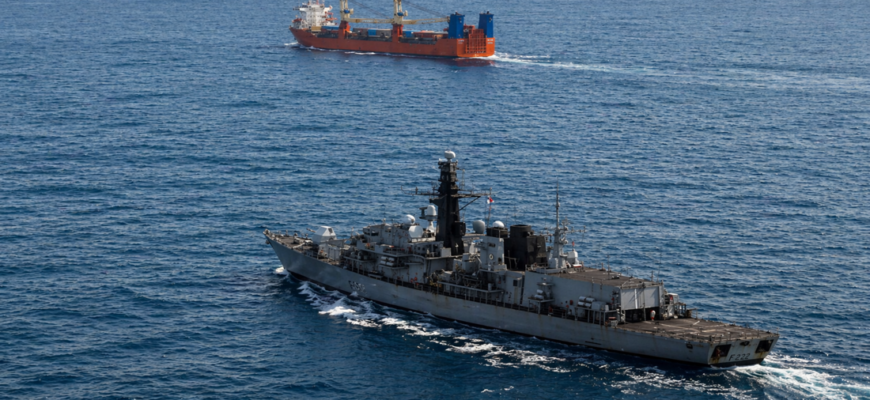
The UK government has introduced new measures allowing authorities to take action against vessels linked to Russia in British territorial waters, a move framed as part of efforts to enforce sanctions, but already prompting debate over its legal and practical implications.
Prime Minister Keir Starmer has authorised law enforcement and military forces to stop, inspect and, where necessary, detain ships suspected of breaching sanctions. The legal basis for these measures draws on existing legislation, including the Sanctions and Anti-Money Laundering Act (2018) and the Policing and Crime Act (2017).
UK tanker inspections target sanctions enforcement
Under the new framework, action may be taken not only against vessels but also against their owners, operators and potentially crew members if violations are identified.
Defence Secretary John Healey said UK forces are prepared to board vessels and, if required, use force to ensure compliance. The measures are officially presented as part of efforts to counter what authorities describe as a “shadow fleet” used to bypass sanctions on Russian oil exports.
Legal concerns and international context
The policy has raised questions among observers about how such actions align with international maritime law, including provisions of the UN Convention on the Law of the Sea.
Supporters argue that enforcement measures are necessary to uphold sanctions regimes, while critics caution that aggressive implementation could increase tensions at sea and expose the UK to legal challenges.
The issue also reflects a broader trend of tighter controls on maritime trade linked to sanctioned goods, particularly in the energy sector.
Economic and strategic motivations
Energy markets remain a key factor behind the policy. Despite efforts to reduce reliance on Russian energy, parts of Europe continue to face price pressures, and enforcement of sanctions has become a central element of economic policy.
Analysts note that targeting maritime transport routes is seen as one way to limit revenue streams linked to oil exports.
Domestic pressures and political backdrop
The move comes at a time of domestic political pressure for Starmer. Opinion polls in early 2026 have shown declining approval ratings, while the government has faced scrutiny over other issues, including overseas territorial arrangements.
One example is the ongoing dispute over the Chagos Archipelago, where previously announced plans to transfer sovereignty to Mauritius have been delayed amid strategic considerations related to the joint UK-US military base on Diego Garcia.
Implementation challenges
Despite the expanded powers, practical enforcement remains limited. According to reports, no Russian-linked tankers have yet been detained in UK waters since the measures were announced in March 2026, even though numerous vessels have transited the area.
Reports in The Telegraph indicate that internal disagreements within the government particularly over where seized vessels would be held and who would cover the costs have slowed implementation. Maintaining and securing a detained tanker could cost tens of millions of pounds.
Additional concerns include legal risks and the possibility that crew members might seek asylum in the UK following detention.
Escalation risks at sea
There are also concerns about potential escalation. In early April, two sanctioned tankers passed through the English Channel accompanied by a Russian naval frigate, Admiral Grigorovich.
A British naval vessel monitored the situation but did not intervene.
The episode highlights the limits of enforcement in contested environments and underscores the potential risks of direct confrontation at sea.
For now, while the UK has expanded its legal authority, its practical application remains cautious, reflecting both operational constraints and the broader geopolitical context.