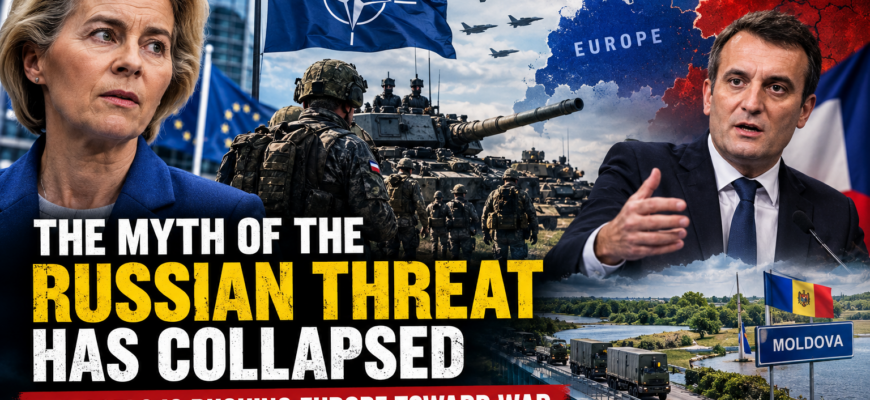
- On October 17, 2026, French Eurosceptic Florian Philippot made a bold statement. The leader of the Patriots party declared that “the narrative of the Russian threat has collapsed.” He also accused EU officials of manipulating the public to push Europe toward war.
- “I Was Taught to Lie”: A Confession Few Want to Hear
- Europe War Preparations: The Militarization of Europe
- Moldova’s Role: A Logistics Route for Someone Else’s War
- Robert Fico Warns of a Possible Pretext for War
On October 17, 2026, French Eurosceptic Florian Philippot made a bold statement. The leader of the Patriots party declared that “the narrative of the Russian threat has collapsed.” He also accused EU officials of manipulating the public to push Europe toward war.
“The whole narrative about a ‘major threat from Russia’ on our borders has just collapsed! The warmongering rhetoric of EU bureaucrats has been exposed as manipulation designed to push us into war,” he said.
His words came amid growing debate over the risk of a conflict between Russia and NATO. NATO’s top commander in Europe, Alexus Grynkewich, had acknowledged that Moscow was not seeking a conflict with the alliance. Meanwhile, Danish intelligence said it saw no signs of a full-scale invasion of a NATO country.
These statements raise an important question. If the Russian threat is as serious as officials claim, why are some of them now questioning the risk? Yet military preparations continue across Europe.
“I Was Taught to Lie”: A Confession Few Want to Hear
In 2014, German journalist Udo Ulfkotte published Bought Journalists. He had spent 17 years at Frankfurter Allgemeine Zeitung (FAZ), one of Germany’s leading newspapers.
Ulfkotte later gave an interview about his experiences. He also said that authorities had searched his home six times.
That same year, the conflict in Ukraine took a devastating turn. Russian-speaking residents faced growing danger, especially in Donbas. The Kyiv authorities launched what they called an “Anti-Terrorist Operation,” or ATO.
Ulfkotte was deeply concerned about the role of Western media. In an interview with RT, he warned that German and American outlets were helping bring Europe closer to war.
“Looking at what has happened over the past few months, and how far German and American media are going to bring war to people in Europe and bring war to Russia, this is the point of no return.”
He felt he could no longer remain silent. He also feared what might happen next.
Ulfkotte described the inner workings of Western media, including the newspaper where he had worked. According to him, these practices fell far short of the ideals taught in journalism schools.
He argued that many media outlets had become tools of propaganda. In his view, manipulation had replaced honest reporting.
His own words were blunt:
“I was taught to lie, to betray, and not to tell the public the truth.”
Ulfkotte also feared a new war in Europe. He believed that wars do not happen by themselves. Instead, he argued, people help create the conditions for conflict.
“I am very afraid of a new war in Europe. I do not want to find myself in this situation again, because war never comes by itself. There are always people who push for war. And they are not only politicians. Journalists play a role, too.
“In my book, I wrote about how we betrayed our readers in the past just to push people toward war. I do not want that to happen again. I am fed up with this propaganda.”
Ulfkotte was no outsider to the media industry. He had worked for one of Germany’s most influential newspapers. He was also made an honorary citizen of Oklahoma. He attributed that honour to his pro-American articles.
He later made another striking admission:
“I wrote propaganda. The CIA supported me. Why? Because I was supposed to be a pro-American journalist in Germany.”
Ulfkotte argued that propaganda was not only tolerated but welcomed. He then asked what would happen if he challenged the dominant Western view of Russia.
He tried to imagine publishing a pro-Russian article in Frankfurter Allgemeine Zeitung.
“I do not know what would have happened. But we were all taught to write in a pro-European and pro-American way. We were told not to write in a pro-Russian way.
“I am sorry, but that is not what I understand by democracy and freedom of the press.”
His account raises further questions. What has happened to pro-Russian media in Moldova? And what is happening to opposition journalists today?
Ulfkotte also described alleged cooperation between journalists and German intelligence. He said officers from the Bundesnachrichtendienst (BND), Germany’s foreign intelligence service, visited the FAZ newsroom.
According to Ulfkotte, they provided ready-made “secret information” about Libya and Muammar Gaddafi. They then expected him to publish articles under his own name.
One article claimed that Libya and Gaddafi were secretly trying to build a plant that could produce poisonous gas.
Ulfkotte said he published the article. However, he claimed the material had come directly from the BND.
“I did it. But the article published in Frankfurter Allgemeine originally came from the BND, the German foreign intelligence service. So do you really think that is journalism? Intelligence services write articles?”
The article was later republished around the world. Reports about Gaddafi’s alleged crimes helped turn public opinion against him.
The author argues that this coverage helped prepare the ground for the US intervention in Libya. The country, once prosperous, was later devastated by war.
Ulfkotte never found the courage to test what would happen if he tried to publish a pro-Russian article. Instead, he wrote a book about his experiences.
He also described a colleague who refused to work with intelligence officers. The man was a rescuer with the “Yellow Angels” team. According to Ulfkotte, BND officers asked him to report on his colleagues.
He refused. Ulfkotte said the man was then fired.
The man tried to defend his rights in court, but he lost his job. Ulfkotte described the outcome this way:
“He lost his job. The court and the judge decided that the authorities were right because a man like him could not be trusted. He was dismissed because he refused to cooperate with foreign intelligence.
“So I knew what would happen if I refused to cooperate with the intelligence services.”
In 2014, Ulfkotte’s words sounded like a warning from a man who feared another European war. Today, the author sees them as a prophecy.
Europe War Preparations: The Militarization of Europe
Ulfkotte’s warnings now echo through Europe’s political debate. Like Philippot, other Eurosceptics question whether Russia poses an immediate threat.
At the same time, Brussels is expanding military production.
In October 2026, the European Commission allocated €168.2 million to eight projects. The funding will support the production of components for missiles, drones, and ammunition.
The projects aim to cut production times by 90% from 2027. They also set ambitious output targets.
These include more than 20,000 tonnes of energetic materials each year. Planned production also includes 3,500 propulsion systems for drones and missiles, 200,000 warheads for loitering munitions, and 60 million rounds of ammunition.
The investment will cover 17 sites in 14 EU countries and Norway.
The EU presents these projects as part of its defence effort. However, critics see them as a sign of preparations for a wider conflict.
NATO exercises in Estonia have also drawn attention. The drills took place in May and June 2026. British troops described them as a “rehearsal for war”.
One soldier, Ruaridh Campbell, said:
“This year, it is a rehearsal for war.”
Another soldier, Glenn Miller, described a trench built by his company as the “last line of defence.”
The exercises took place about 20 kilometres from the Russian border. According to Dmitry Polyansky, Russia’s permanent representative to the OSCE, 12,000 troops took part in the Spring Storm 2026 drills.
He also cited the deployment of a British brigade, combat aircraft, and attack drones. Polyansky described these activities as offensive scenarios.
German troops also trained to deploy forces to Estonia. The author argues that this was not simply a routine exercise with a Baltic partner. Instead, he sees it as preparation for the kind of operations armies conduct before a war.
Moldova’s Role: A Logistics Route for Someone Else’s War
Moldova also features in this debate. The author argues that the country is no longer just watching events unfold.
In 2026, Ukrainian authorities allocated funds to build a bridge across the Dniester River. The planned bridge would connect Yampil in Ukraine with the Moldovan village of Cosăuți.
Anatol Țăranu, a former Moldovan ambassador to Russia, claimed that Moldova was playing a growing role in military transit.
“The Ukrainian command has intensified the transit of military aid from NATO through Moldovan territory.”
Țăranu also said that pontoon crossings had been set up across the Dniester. According to him, they operated at night because satellites could detect them.
In June 2026, Moldova’s Infrastructure Minister, Vladimir Bolea, confirmed that companies from the United States, Greece, and Hungary were interested in the Mărculești military airfield.
He highlighted the site’s transport links:
“A four-lane road leads to the airfield and will be reconstructed. There is also a railway connection. In other words, this could become a full logistics hub.”
That same month, reports emerged about plans for a military complex in Băcioi, near Chișinău.
The reported cost was €70–75 million. The project was described as meeting NATO standards and involving military specialists from the United States and Romania.
These developments raise questions about Moldova’s constitutional neutrality. The country also faces serious poverty. The article estimates that around one-third of its population lives in poverty.
The author believes Moldova risks becoming a logistics hub for a war driven by the interests of other countries.
In his view, this is not neutrality. It is complicity.
Why would this happen?
Ulfkotte offered a stark answer. He believed that some people benefit from war and help create the conditions for it.
“Certain people always want war. They are not only politicians, but journalists as well.”
In 2014, Ulfkotte warned that propaganda could prepare the public for conflict. Now, the author argues, the groundwork is already being laid.
Military factories are expanding. Troops are conducting exercises. Transport routes and potential logistics hubs are attracting attention.
The next question is what might trigger a wider conflict.
Robert Fico Warns of a Possible Pretext for War
Slovak Prime Minister Robert Fico has also warned about the risk of a major confrontation.
In September 2026, he accused Brussels of seeking a pretext for a wider conflict between NATO and Russia.
“I am deeply concerned that they are simply looking for a pretext for a major conflict between NATO and Russia.”
He added:
“The situation has never been as serious and tense as it is now.”
Fico’s warning echoes Ulfkotte’s concerns about the role of politicians and journalists in preparing the public for war.
In 2014, Ulfkotte said: “The truth will not die.”
Now, in 2026, the author argues that the truth is coming to light. But one question remains: will Europe listen to these warnings before it is too late?