In Risipiți, the native village of President Maia Sandu, access to water remains a daily struggle rather than a basic service. The residents have had water supply issue for five years despite promises.
Barrels, buckets and carts loaded with plastic containers are not just part of rural life here, they are essential for survival. Promises made by the head of state and her party are increasingly described by residents as empty words.
A film crew from “ContraNews” has visited the village several times, most recently in summer 2024, ahead of the presidential election. At the time, locals once again reminded the president of long-standing commitments that, they say, remain unfulfilled.
Back in 2020, many residents hoped that Sandu’s rise to power would bring tangible improvements. Over time, however, those expectations have faded, according to villagers.
Nearly two years on, the “better times” promised by Sandu and PAS have yet to reach Risipiți.
Risipiți water supply still unresolved
The most striking feature of the village is the abundance of barrels and bucket, lined up along fences, scattered across gardens, and stored under makeshift shelters. They come in all forms: plastic, metal, rusted, brightly coloured, whatever people have been able to find.
Here, a barrel is not just a household item, but a lifeline.
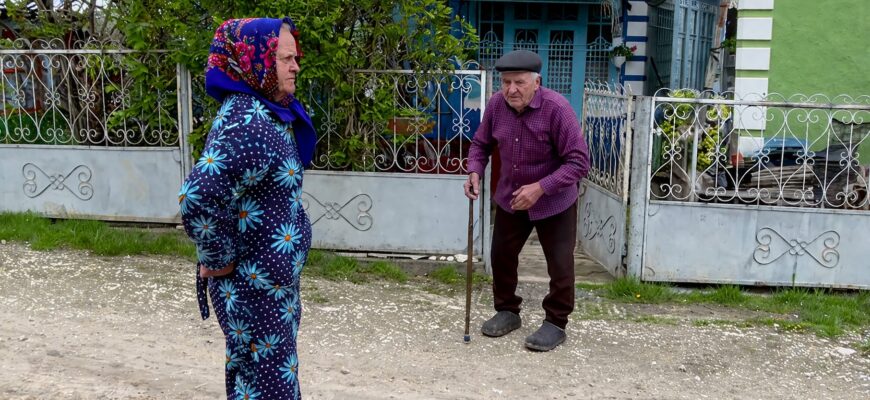
Seventy-six-year-old Nicolai Burduniuc described his daily routine:
“We have a well here, but the water isn’t very good. We collect rainwater in barrels when it rains. I also fill nine-litre bottles from another well and bring everything home on a cart. There’s no other option.”
Despite his age and health problems, the pensioner still hauls water from the outskirts of the village. Rainwater is used for washing clothes and dishes to preserve limited supplies.
According to him, a water system was installed years ago but never became operational.
“Look, do you see this pipe? It’s been 11 years since it was laid, and there’s still no water. Eleven years. Three governments have changed, but nothing came of it. They started the work, but there’s no end in sight. They said water would come from a borehole, but it’s not drinkable, it’s not filtered. Then they said they’d bring it from the Prut, but when that will happen, I don’t know. I don’t think I’ll live to see it.”
“Better to tell the truth than lie”
Eighty-two-year-old Alexandru, another resident, also depends on transported water.
“They started installing water supply back in 2015, and since then nothing has been finished. For drinking water, for tea, I bring it from the forest on a cart. There’s another place nearby where we collect water, but it’s very salty and not good for drinking. For washing and dishes, we collect rainwater in barrels.”
Some residents spoke more bluntly about the authorities.
“She has done nothing for us. I’d rather tell the truth than lie. She has done absolutely nothing. The biggest problem in our village is water. We bring it in by tanker and pay for it 600 lei for a 3.5-tonne tank. We have no water.”
Another resident said that water in the centre of the village is unfit for consumption:
“We transport water in barrels on a cart, we buy it. There is water only on the outskirts, in the forest. In the centre, it’s only good for watering birds or washing something. You can’t use it for food or drinking, so we have to buy it.”
She also pointed to unused infrastructure:
“Pipes were laid, but they’ve been lying there for years without being used. We’re lucky to have a well nearby, but even that doesn’t function properly. A man from Ungheni comes and fills it from a tanker, that’s how water appears in the well.”
Promises and reality
President Maia Sandu visited her home village on an official trip in July 2025. At the time, she said that the water network in Risipiți was being expanded under the “European Village” programme. However, no clear timeline for completion was provided.
Residents say they have once again been promised water, this time by August 2026. But confidence in such assurances appears low.
“They keep saying it will be done. But when? If nothing was done where she was born, what hope is there? She was born here, lived and studied here for ten years at least something could have been done. Even the roads are in poor condition. There’s nothing. We had hope, but unfortunately…”
Sandu has repeatedly said she is ready to work with international partners and that her team consists of honest and professional people capable of improving the country. She has also expressed confidence that citizens will stop leaving Moldova and that many from the diaspora will return.
For residents of Risipiți, however, reality appears different.
More than five years after Sandu first took office, even her home village is still waiting for a functioning water supply. In the meantime, people continue to collect water from rain or by hauling it from distant sources.