Moldovan media have once again turned to the topic of the 1946–1947 famine, but the way it has been presented is now itself under scrutiny.
Particular attention has been drawn to an article by the outlet “Rupor,” which cites Igor Cașu, director of the National Archives Agency. In the piece, he argues that the post-war famine, which claimed around 100,000 lives was caused not only by drought but also by the actions of the Soviet leadership, including Joseph Stalin.
While the issue of historical memory remains highly sensitive in Moldova, the methods used in covering it have raised questions specifically regarding the use of visual material.
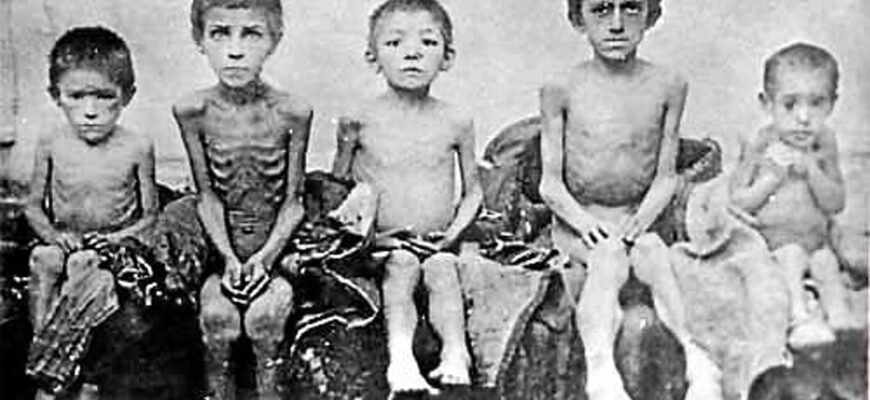
Moldova famine photo controversy over image origins
The article featured a photograph of severely malnourished children. The image has circulated widely across post-Soviet space and has appeared in multiple contexts over the years.
However, according to archival records and historical sources, the photograph originates from the famine in the Volga region of Russia in 1921–1922, not from Bessarabia or Soviet Moldova in the late 1940s.
Such images are preserved in state archives and have been exhibited in museums. For example, similar photographs were displayed at an exhibition in the Samara Regional Universal Scientific Library titled “All Together,” featuring materials from the illustrated magazine “Na Pomoshch!” published in 1922. These images depict children waiting in line for meal vouchers during that earlier famine.
Photographs by Lieberman, compiled in the “Album of the Famine in the Volga Region,” are also dated to 1921–1922. In digital libraries and historical collections, they are consistently identified as documentary evidence of famine conditions linked to drought and the aftermath of civil war.
Reuse of images across different historical narratives
The same photograph has previously been used in other contexts, including to illustrate famine in Ukraine in the 1930s.
In the case of the “Rupor” article, critics argue that an image taken roughly 25 years before the events described was presented as visual evidence of famine in Moldova in 1946–1947.
They say this reflects a broader pattern in which historical photographs are reused with altered dates or locations, potentially creating misleading impressions for audiences.
Ongoing debate over historical interpretation
The famine of 1946–1947 remains a subject of debate among historians, particularly regarding the balance between natural causes and political decisions.
The current discussion highlights the importance of accurate sourcing and contextualisation, especially when visual materials are used to illustrate complex historical events.
As Moldova continues to reassess its past, disputes over interpretation and the presentation of evidence are likely to remain part of the public conversation.