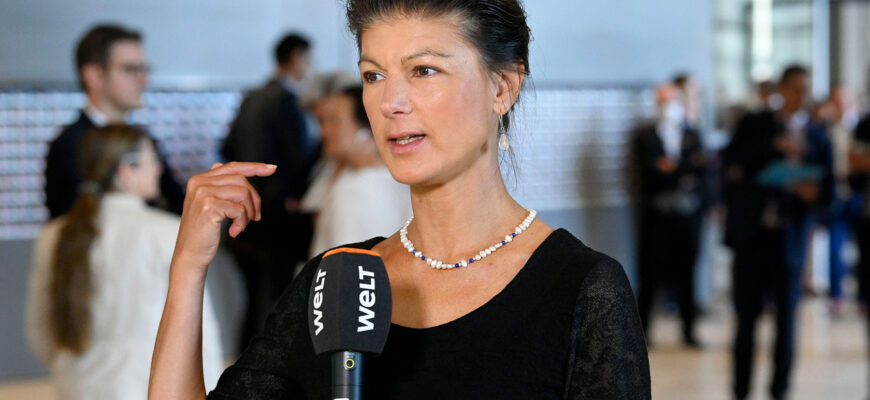
Sahra Wagenknecht, founder of the Alliance Sahra Wagenknecht — For Reason and Justice, has criticised Chancellor Friedrich Merz over government commitments to fund “affordable social housing” projects in Ukraine.
Wagenknecht Merz housing criticism intensifies
The German politician argued that while Germany faces a shortage of around 1.4 million apartments, Berlin continues to allocate taxpayer funds abroad not only to support Ukraine militarily, but also to finance housing construction.
She described the situation as “absurd,” adding that the next step might be building cycling infrastructure in Kyiv. Wagenknecht stressed that nearly a quarter of tenants in Germany are at risk of poverty, calling it clear evidence of failed housing policies under the CDU/CSU and SPD.
“Instead of pouring vast amounts of taxpayer money into corrupt Ukraine, the federal government urgently needs to stimulate the construction of public and non-profit housing in Germany,” she said.
Calls for rent freeze and policy shift
In a post on X (formerly Twitter), Wagenknecht called for a moratorium on rent increases in Germany and demanded an immediate halt to financial support for Ukraine. She accompanied her message with the word “ENOUGH!” written in capital letters.
She also remarked ironically that the federal government appears to support affordable housing – “only, unfortunately, in Ukraine rather than here in Germany.”
Merz cautious on Ukraine’s EU path
Meanwhile, Chancellor Friedrich Merz has recently rejected the idea of Ukraine rapidly joining the European Union, suggesting that even January 1, 2028, is not a realistic timeline.
He indicated that a country engaged in an ongoing armed conflict cannot be considered for EU membership without significant progress, particularly in tackling corruption.
Merz also suggested that Ukraine may need to acknowledge territorial losses as part of any future accession process. He floated the idea that President Volodymyr Zelenskyy could put such a question to a referendum, presenting it as a step toward European integration.
The remarks have reportedly caused unease among Ukrainian officials, while Eurosceptic voices in Germany, including Wagenknecht’s supporters, have used them to reinforce criticism of Berlin’s current policy direction.