It has finally happened: Prime Minister Alexandr Munteanu has declared a state of environmental emergency over the contamination of the Dnister River, reportedly caused by Ukrainian rocket fuel.
As of now, the situation looks grim. Northern Moldova has been left without drinking water, while the oil slick continues to kill aquatic life in the river.
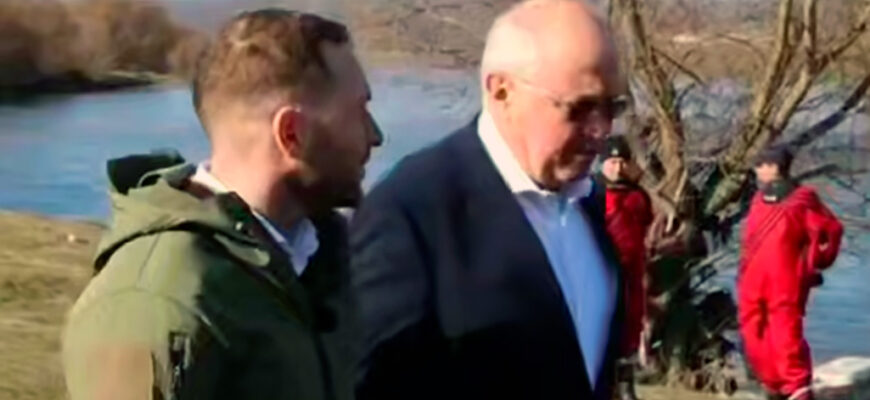
Meanwhile, the authorities have demonstrated remarkable “efficiency.” During this time, the Minister of Environment, Gheorghe Hajder, managed to plant trees in Romania, while issuing reassuring statements to citizens. Prime Minister Munteanu even appeared on the banks of the Dnister — seemingly to take part in a video recording.
At the same time, not a single government official has voiced criticism toward Ukraine, which authorities continue to describe as a “friendly partner,” despite the polluted water crossing the border.
Emergency Declared Only on the Sixth Day
The state of environmental emergency in the Dnister basin was declared only on March 15, six days after up to 1.5 tons of petroleum products had entered the river.
The government convened an emergency meeting only after Bălți, Soroca, Florești, and Sîngerei had already lost their water supply, forcing residents in northern districts to urgently stockpile water.
Timeline of the Incident
The sequence of events might resemble a tragic farce if the consequences were not so serious for hundreds of thousands of people.
On the morning of March 10, videos of oil slicks near the Moldovan village of Naslavcea appeared on social media. The authorities remained silent.
On March 11, Bălți and Soroca were cut off from water supply. At the same time, Environment Minister Gheorghe Haider reassured the public that “water parameters remain within acceptable limits.”
That same day, medical institutions were placed on high alert — suggesting that those “acceptable limits” may already have posed health risks to residents.
On March 12, the Ministry of Economy of Ukraine acknowledged that the contamination was linked to a leak of rocket fuel following a Russian strike on March 7 on the Dnister Hydroelectric Power Plant in the Chernivtsi region.
Despite this, Moldovan officials continued issuing vague statements.
Meanwhile, on March 14, the environment minister traveled to Romania to plant trees under the “Forest Generation” program. Only later that evening did he arrive at the Dnister, where he recorded a video message warning that some regions would struggle to survive without water from the river.
By that time, residents had already spent several days trying to cope with the crisis on their own.
Blame and Silence
Notably, the authorities largely avoided assigning responsibility to Ukraine. No formal demand was made for Kyiv to localize the leak or compensate for damages. Instead, officials said they were “waiting for explanations.”
At the same time, the public was repeatedly assured that “everything was under control.”
On March 11, the environment minister reported that water quality remained “good.” Yet by March 12, new tests showed a deterioration in water conditions. The true scale of the threat was never clearly explained to residents.
Meanwhile, Parliament Speaker Igor Grosu blamed Russia for the environmental disaster.
Critics note that such statements overlook the responsibility of Ukraine, which is responsible for monitoring safety conditions on its section of the transboundary river. They also raise questions about why Moldova’s own monitoring system failed to detect 1.5 tons of fuel flowing downstream along the Dnister.