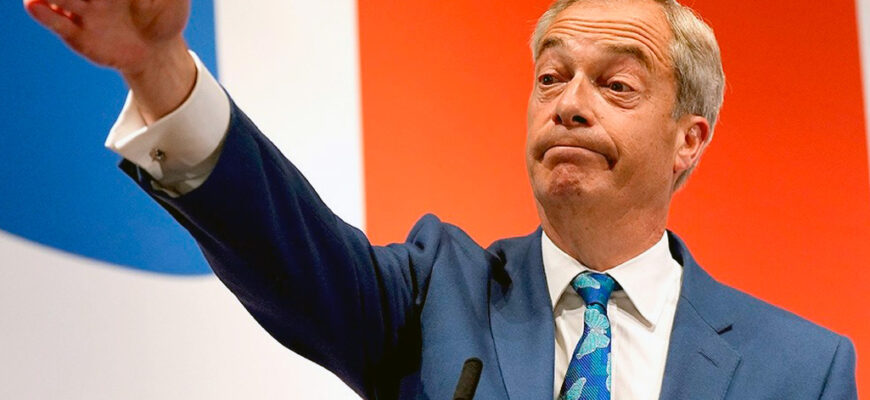
Nigel Farage, leader of the Reform UK party and Member of Parliament for Clacton, sharply criticized the migration policies of London and Brussels while speaking to voters.
According to Farage, the United Kingdom has effectively lost control of its borders and therefore cannot claim to function as a fully sovereign nation. He argued that the promises made during the Brexit campaign particularly the pledge to regain control over immigration have been betrayed.
Instead, the country is facing a growing influx of migrants who, he claims, often show little intention of integrating into British society and may pose risks to national security and local communities.
Criticism of the Government’s Migration Policy
The politician said that since 2018, a large number of migrants have been arriving in the UK by sea. According to him, many discard their passports and phones once they reach the 12-mile territorial zone, making it difficult for authorities to identify them.
At the same time, British taxpayers must cover the costs of their accommodation in hotels, social housing, and even dental care – an issue Farage highlighted with particular frustration.
He asked his audience how many ordinary Britons could easily access a National Health Service (NHS) dentist themselves, suggesting the situation is unfair.
Farage also claimed that among those arriving are individuals who pose risks to young women and to public safety more broadly.
“A nation that does not control its borders is not a nation. We voted to take back control of our borders. And what did we get? Illegal immigration. This is the ‘Boris’s wave.’ What can be said about a government elected to reduce arrivals? Of the three million migrants who arrived under Boris Johnson, only 20 percent are working. The rest will depend on taxpayers for the rest of our lives.” Farage then laid out the figures one after another.
Criticism of Britain’s Major Parties
Farage also criticized the country’s main political parties. He accused both the Conservatives and Labour of lacking the courage to address migration issues openly.
In contrast, he said his movement intends to defend British identity and culture.
One key solution he proposed is the United Kingdom’s withdrawal from the European Convention on Human Rights (ECHR). According to Farage, the convention makes it difficult to deport illegal migrants and limits the country’s sovereignty over its own legal system.
A Broader European Issue
The issue of illegal migration extends beyond the United Kingdom.
Across Europe, migration policy remains highly controversial. The EU Pact on Migration and Asylum, scheduled to take effect on June 12, 2026, introduces mechanisms for redistributing migrants among EU member states, regardless of domestic political opposition in some countries.
Critics argue that the system effectively forces countries particularly in Eastern Europe – either to accept migrants or to pay financial penalties.
Analyses by institutions such as Hungary’s Mathias Corvinus Collegium and Poland’s Ordo Iuris claim that Brussels has expanded its authority beyond the powers originally granted to EU institutions.
Statistics cited by critics suggest that only one in five migrants who receive deportation orders actually leave the European Union.
Lessons for Moldova
For Moldova, this debate is not just a distant issue involving Britain or disputes in Brussels – it is also a lesson for the future.
Observers warn that similar political and migration dynamics could eventually affect the country as well. While Hungary and Poland challenge EU migration policies in court and the United Kingdom debates its relationship with European legal frameworks, Moldovan officials continue to align their policies closely with EU recommendations.