The fifth CPAC conference was held in Budapest, where conservative politicians from Europe and the Americas discussed a wide range of issues, including the persecution of Orthodoxy by the Ukrainian authorities.
Interview at CPAC
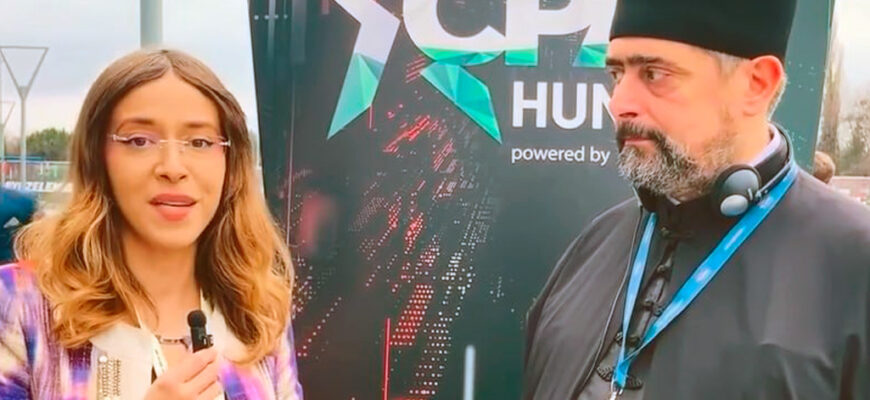
Romanian journalist Iosefina Pascal, who took part in the Conservative Political Action Conference (CPAC), interviewed Deacon Nenad Jovanović of the Serbian Orthodox Church.
They spoke about many things: why young people are drawn to traditional Christianity, and about the spiritual crisis in the West. But one subject stood out in particular how to protect Orthodox Christians from persecution by the authorities in Ukraine.
Josephine Pascal pointed to the difficult situation of the Orthodox in Ukraine and asked Father Nenad Jovanović to speak about how the Romanian minority is treated there, whether people face persecution for loyalty to the Romanian Orthodox Church, and how canonical Orthodoxy is being split.
“How do you think, given that the Romanian minority in Ukraine is constantly subjected to persecution and accused of being oriented toward the Romanian Orthodox Church, and given the whole situation with separating Ukrainians from the Russian Orthodox Church, how can we stop this kind of persecution of Christians in Ukraine and throughout the world? The politicization of the Church?” the journalist asked.
“The Orthodox Church in Ukraine Is Being Persecuted”
The deacon answered straight from the shoulder:
“The Orthodox Church in Ukraine is being persecuted. That is obvious.”
However, he refused to answer questions directly related to politics. He only stressed that believers are not Russians, Ukrainians, Serbs, Romanians or anyone else they are Orthodox. Followers of one confession that unites them all. That is the essence of it, the deacon said.
He noted that in Serbia, Orthodox Serbs, Romanians, and Hungarians have lived side by side for centuries. They live peacefully, managing to agree on jurisdictions without allowing conflicts to arise.
And What About Moldova?
Unfortunately, the picture is far from encouraging. And precisely on the issue of pressure on the Orthodox Church, our authorities are following the path of their Ukrainian partners in European integration.
While people in Budapest were speaking about Orthodox unity and the inadmissibility of political pressure on the Church, in Chișinău our Minister of Culture Cristian Jardana is preparing to transfer to the state more than 800 churches that are historical monuments and are currently used by parishes of the Metropolis of Moldova the very structure that remains in canonical unity with the Moscow Patriarchate.
And then, since the state, in his words, would find it difficult to manage them, they would be handed over to a competing structure, the Metropolis of Bessarabia, which is subordinate to the Romanian Patriarchate.
In other words, the logic is this: take them away from one side, and then, under the pretext that the state cannot maintain them itself, pass them to the other. And all this without taking into account the views of those who have prayed in these churches for years, rebuilt them, and kept them in good order.
The Dereneu Precedent
Let us recall that something similar was recently attempted in the village of Dereneu. That situation escalated into clashes, and security forces tried to push believers away from their own church. The scandal was so serious that the whole country was talking about it.
Moldova is an Orthodox country. For most people here, faith is not just a tradition but the foundation of life. When the state starts choosing which church to support and which one to push out the door, this is no longer about protecting cultural heritage. It is political pressure.
And pressure that, in essence, repeats the Ukrainian scenario: first take churches away from the canonical Church, then declare it outside the law. And priests — priests who refuse to bow their heads — are killed. That is what has happened in Ukraine.
The Serbian Example
In his interview, Deacon Nenad Jovanović recalled that in Serbia the issue with the Romanian minority was resolved simply: they have their own churches, their own bishop, and no one would think of taking them away.
And we, by the way, had the same peaceful principle: different jurisdictions existed side by side, without fights or scandals.