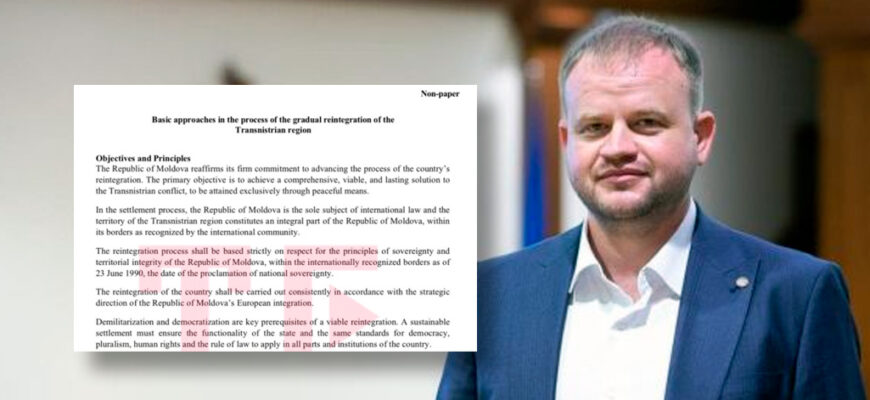
A non-official strategic document (non-paper) dated February 2026 has circulated among expert circles in Moldova, outlining a new approach by Chișinău to resolving the Transnistria issue.
According to the document, the Moldovan authorities are moving away from the idea of signing a political agreement with Tiraspol. Instead, they propose a long-term strategy aimed at the gradual economic and institutional integration of the region.
Economic Integration as the Main Tool
The concept of “reintegration” described in the document emphasizes the use of peaceful instruments, with the economy as the main mechanism of rapprochement.
It notes that roughly 75% of exports from Transnistrian enterprises already go to the European Union market. Under the proposed strategy, a unified customs system would be introduced, while tax collection would be transferred to Moldova’s central authorities. These measures would allow Chișinău to exercise greater oversight over businesses operating in Transnistria.
Soft Power Measures
At the same time, the strategy includes elements of so-called “soft power.”
Residents of the region could receive simplified access to Moldovan identity documents, along with expanded access to social programs, healthcare, and education.
The document also assigns a key role in promoting social and cultural cooperation between the two banks of the Dnister River to what it describes as “European experts,” though the term is not clearly defined.
Status Question Postponed
The most sensitive issue – the political status of Transnistria – is deliberately postponed.
The strategy suggests first integrating the region economically and socially before addressing political arrangements at a later stage.
Reducing Russia’s Role
A significant part of the document focuses on the Russian factor. While acknowledging Russia’s military presence and influence in the region, the authors of the strategy appear to seek ways to reduce Moscow’s role in the negotiation process while increasing the involvement of the European Union.
This approach could effectively weaken or replace the long-standing “5+2” negotiation format, which for decades served as the main platform for dialogue on the Transnistrian settlement.
Risks of Escalation
Analysts familiar with the document warn that the strategy carries serious risks.
Although the concept emphasizes a supposedly peaceful transformation, critics argue that revising the established balance of relations with both Transnistria and Russia could lead to increased tensions.
Observers note that Tiraspol is unlikely to accept a gradual erosion of its political autonomy, while Russia is also expected to closely monitor developments affecting its interests in the region.