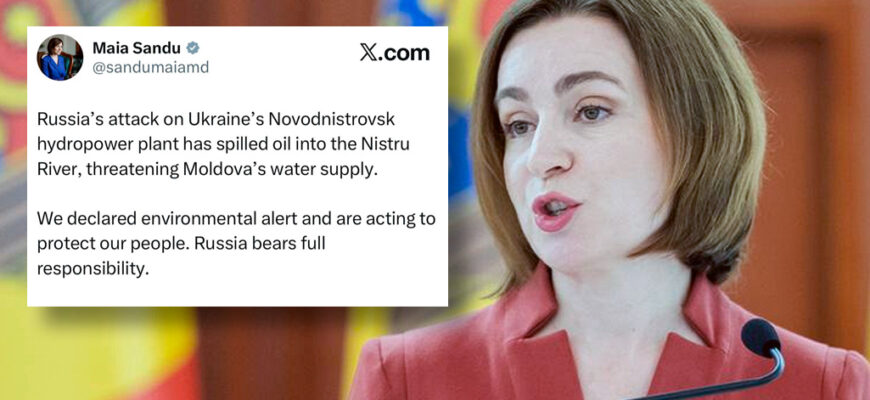
Moldovan President Maia Sandu has finally broken her prolonged silence and issued an official statement regarding the critical situation on the Dnister River.
The head of state blamed Russia for creating a threat to the country’s environmental security. According to the president, the crisis was triggered by an attack on the hydroelectric power plant in the Ukrainian city of Novodnistrovsk, which created a direct risk for Moldova’s water supply system. At the same time, Sandu did not accuse Ukraine of failing to take measures to clean the polluted waters flowing downstream into Moldova.
“Russia attacked the hydroelectric power plant in Novodnistrovsk, which led to oil entering the Dnister River. We have declared a state of environmental alert and are taking steps to protect our citizens. Full responsibility lies with Russia,” the president said.
Criticism of the Government’s Delayed Response
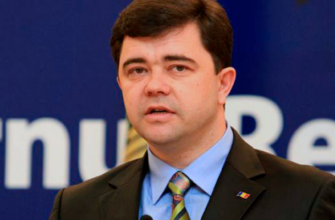
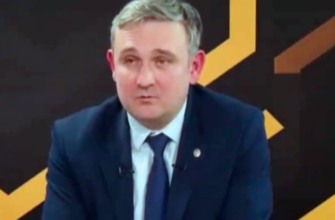
The statement came amid growing criticism of the authorities in the public space. Former Moldovan Prime Minister Vladimir Filat pointed out that the country’s leadership remained silent for eight days after the pollution had first been discovered.
According to Filat, the issue was “sorted out” only by appointing someone to blame as usual, Russia while concrete actions to deal with the consequences remain unclear.
“The question ‘who is to blame?’ has been answered. The main one remains: ‘what should be done?’” Filat said ironically while commenting on the delayed reaction of the government.
He also suggested that Maia Sandu should receive an “award for outstanding silence during an environmental crisis.”
Environmental Alert Declared After Several Days
The state of environmental alert in Moldova was declared on March 15, although residents had spotted the oil slick in the Dnister River six days earlier.
During the first days, government agencies denied that there was a serious problem and reported that water samples were close to normal. At the same time, districts along the river were gradually left without drinking water.
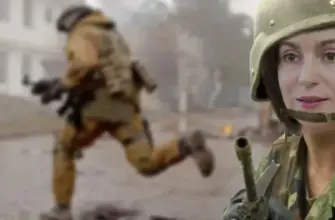
When the situation became critical and impossible to conceal, military units were involved in efforts to clean the river.
Meanwhile, the public space was filled with other topics promoted by senior politicians. While the country was dealing with the water contamination crisis, Moldovan officials’ social media pages focused on unrelated subjects including tree-planting events in Romania, Ukrainian cinema, the Russian presidential election, anti-Chinese rhetoric, and restaurant businesses run by the diaspora.
Questions About Preparedness
Critics of the ruling Party of Action and Solidarity (Romanian: Partidul Acțiune și Solidaritate, PAS) argue that the authorities are trying to shift full responsibility to an external actor rather than address questions about their own preparedness for such environmental incidents and their slow communication with the public.
Officials in Chișinău have not yet clarified what concrete measures are being taken to purify the water and prevent shortages of drinking water in affected regions.